
What Size Washer Do I Need for My Laundry?

As laundry spills over the hamper, it’s easy to wonder whether the next washer will hold a full load. Choose capacity based on how much laundry you wash at once, how often you do laundry, and whether you need room for bulky bedding. The best fit is large enough for your usual loads without crowding the space you have.
A household’s size is only part of the answer: one person who waits for laundry to pile up may need more room than several people who wash small loads often. Comforters and thick towels can also need more space, and a compact washer may involve moving clothes by hand between steps. Start by looking at a typical load, then compare that with the room and hookups available. Here’s how to work it out before you buy.
How do household size and laundry habits affect capacity?
The number of people in your home is a starting point, not a complete answer. A household that washes a few items often may need less room per load than a household that saves laundry for one large wash day. Think about the clothes you actually wash together, not just how many people wear them.
Notice what happens in a normal week. Do you run the washer when the hamper is only partly full, or wait until clothes are piled up? Do towels and everyday clothes go in separate loads? Your usual routine affects how much capacity is useful. A washer that suits your typical load can help you avoid extra cycles without taking up more room than you need.
More people often means more laundry, but the type of laundry matters too. Children’s small clothes take up less room than bulky sweatshirts or bath towels. A person who changes outfits often may create more laundry than someone who wears the same clothes for several days. That’s why household size alone can’t tell you exactly what washer to buy.
Think about your busiest laundry days as well as an ordinary one. If you regularly need to wash several people’s clothes at once, a small washer may mean repeating the same work. If you usually wash small loads, a larger machine may use floor space you would rather keep for storage. Aim for a capacity that fits your real pattern, including the loads you do most often.
How can I estimate my usual load?
Use your own laundry routine to make a practical estimate. You don’t need to weigh every sock or predict every load. The goal is to notice how much laundry you normally place in the washer and how often you need extra space.
Pick a typical load. Think of the clothes you usually wash together, such as a week’s everyday clothes or the items you collect between wash days. Picture the hamper just before you start a cycle.
Notice how full the washer gets. If you already have a washer, look at a normal load before starting it. Clothes should have room to move; packing them tightly can make washing less effective and may put extra strain on the machine. Check the manual for the loading guidance for that washer.
Count your extra loads. Ask whether you often split a load because the washer is full, or run an additional cycle for clothes left in the hamper. If that happens regularly, more capacity may fit your routine better. If it happens only when you wash bedding, look for enough room for those occasional bulky items rather than choosing only by your busiest day.
Include laundry you wash separately. Towels, bedding, delicates, and heavily soiled clothes may need their own loads. Include those in your decision, but don’t assume every item can go into one large wash. Follow the care label on each item and the washer’s instructions.
Compare the load with the listed capacity. Check how the manufacturer describes capacity on the model’s page. A weight in pounds and a tub volume in cubic feet describe different things, so don’t treat them as directly interchangeable.
If you’re buying your first washer, keep a simple note of laundry for a week or two: how often you wash, which loads you separate, and when you wish you had more room. This gives you a better picture than guessing from household size. You can also compare your current hamper load with the washer’s loading guidance, if you have access to a similar machine.
Will bulky items fit in the washer?
Comforters, thick blankets, and large towels need space to spread and move. A washer can have a capacity label that sounds large but still be a poor fit for a bulky item if the item fills the inner basket. When bedding is squeezed in, it may not wash or rinse well, and it can bunch to one side during spinning.
Check the care label on the comforter and the washer’s manual or product page before buying. Look for guidance about bedding, blankets, or the largest load the machine can handle. If the manufacturer does not say that a particular kind of bulky item is suitable, don’t assume it will fit just because the washer holds a certain weight of ordinary clothes.
The shape and thickness of an item matter as much as its weight. A dense, fluffy comforter may take up more room than a similar-weight load of shirts. Towels can also become heavy when wet, so a large stack may not behave like a load of lighter clothing. Leave enough room for items to move instead of trying to force the washer door or lid closed.
If you wash bulky bedding only now and then, decide whether you want to handle those loads at home or use another laundry option. Buying a larger washer just for one occasional item may not suit a small laundry area. If you wash bedding often, check that the model specifically allows the kind of bedding you own.
How do pounds and cubic feet compare?
Pounds describe weight, while cubic feet describe space inside the washer. A pounds label may refer to the weight of dry laundry the manufacturer says the washer can hold. Cubic feet measure the inside space available for clothes. The two labels are not a direct conversion, and manufacturers may describe capacity differently.
Use the capacity figure to compare models only after checking what each manufacturer means by it. A listed number by itself doesn’t tell you whether a thick comforter will fit, how full the washer should be, or whether the machine suits your usual loads.
Before you decide, check these details on the product page or in the manual:
Whether capacity is listed in pounds, cubic feet, or both.
How the manufacturer defines the listed capacity, especially if it gives a laundry weight.
Whether the manufacturer says the washer can handle your bedding or other bulky items.
What loading guidance the manual gives, so you know how much room to leave in the basket.
Whether the washer’s outside dimensions and installation needs suit your laundry area.
When two capacity labels seem hard to compare, look at each model’s stated use and loading instructions rather than trying to convert one figure into the other. If the product page leaves out a detail you need, ask the seller or manufacturer before buying. A clear answer about bedding, load size, or dimensions is more useful than an assumption based on the label.
Will a compact washer fit my space and routine?
A compact washer can help when a full-size machine won’t fit, but the footprint is only part of the decision. Measure the place where the washer will sit, including the space needed for the lid or door to open. Check the listed width, depth, and height for the exact model, then allow room for hoses behind it. A rear gap of about 4 to 6 inches can help prevent hoses from being crushed, but follow the model’s installation instructions if they call for something different.
Check the path into the room, too. A washer that fits beside a sink may still be difficult to bring through a narrow doorway or around a tight corner. Measure those openings before ordering, and confirm the washer’s outside size on the product page. Don’t rely on a name like “portable” or “compact” as proof that it will fit your space.
Next, look at how the washer gets water and sends it away. Some compact washers use a quick-connect sink adapter that attaches to a faucet. A standard threaded faucet may accept one, but a pull-out spray faucet may need a special adapter or a separate utility sink tap. Check the model’s instructions and your faucet before buying.
Also confirm how the drain works. A washer with a built-in drain pump pushes water through a hose toward a sink or drain pipe. A gravity drain hose needs to lie flat along the floor toward a floor drain so water can flow naturally. Make sure your room has a suitable place for the drain hose, and don’t route it where it can spill or create a trip hazard.
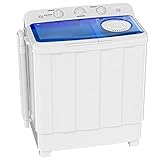
Think about the work you’ll do during a wash. A fully automatic compact washer handles the wash, rinse, and spin steps for you. A twin tub has separate wash and spin sections, so you move wet clothes from the wash tub to the spin basket yourself. Some twin-tub models let you wash one load while another load spins, but that means more hands-on steps.
If you want to load clothes and let the washer handle the cycle, look for a fully automatic model and verify its listed load capacity. If you’re comfortable moving clothes between sections, a twin tub may suit your routine. Either way, check whether the drain, water connection, and power needs work in your home, apartment, or RV. Use the power connection specified by the manufacturer, and don’t use an ungrounded outlet or a lightweight extension cord.
What kind of washer should I look for?
Look for a washer whose stated capacity matches your usual load, with enough room for the bulky items you wash regularly. If space is tight, a compact washer may help, but check its outside measurements, water connection, drain setup, and whether you must move clothes by hand. Compare the manual steps with the time and effort you’re willing to spend on laundry.
Before ordering, confirm the capacity details and installation instructions on the exact model’s page. Make sure the washer can handle your normal clothes load, that the manufacturer allows your bedding if you plan to wash it, and that the machine fits both the space and your routine. For broader buying considerations, you can also read about what to look for in a reliable washing machine.

- TAR Score8.9
TAR Score is a ranking system developed by TopAppliancesReviews.com. TAR score has no relationship or impact from any manufacturers or sales agent websites. Learn more
- BrandGIANTEX

- TAR Score8.6
TAR Score is a ranking system developed by TopAppliancesReviews.com. TAR score has no relationship or impact from any manufacturers or sales agent websites. Learn more
- BrandGIANTEX

- TAR Score7.9
TAR Score is a ranking system developed by TopAppliancesReviews.com. TAR score has no relationship or impact from any manufacturers or sales agent websites. Learn more
- BrandWinado
- TAR Score7.2
TAR Score is a ranking system developed by TopAppliancesReviews.com. TAR score has no relationship or impact from any manufacturers or sales agent websites. Learn more
- BrandAuertech

- TAR Score7.1
TAR Score is a ranking system developed by TopAppliancesReviews.com. TAR score has no relationship or impact from any manufacturers or sales agent websites. Learn more
- BrandGeneric
Last update on 2026-11-10 / Affiliate links / Images, Product Titles, and Product Highlights from Amazon Product Advertising API
FAQs
Should I buy a larger washer for a bigger household?
Not automatically. A larger household often creates more laundry, but how often you wash and what you put in each load also matter. If you wash small loads frequently, you may not need the same capacity as a household that waits for a full hamper.
Can I wash a comforter if it fits inside the basket?
Not necessarily. The comforter needs room to move, and the washer’s instructions may limit which bedding it can handle. Check the care label and the manufacturer’s guidance before washing it.
Does a compact washer always connect to a faucet?
No. Water connections vary by model. Check whether the washer needs a sink adapter, a particular faucet, or another water hookup, and confirm that your drain setup works too.
What should I do if the product page doesn’t explain capacity?
Ask the seller or manufacturer how the listed capacity is defined and whether the washer suits your usual loads. Ask about bedding separately if you plan to wash bulky items. Don’t guess from the washer’s name or outside size.


10 Best Washing Machine For King Size Comforter of 2026 For Bulky Bedding

11 Best Semi Automatic Washing Machine Under 10000 of 2026 For Apartments and RVs

9 Best Compact Refrigerator For Beer Bottles of 2026 For Upright Bottle Fit

10 Best Quality Semi Automatic Washing Machine of 2026 For Leak-Free Laundry

11 Best Small Washer Machine of 2026 For Everyday Laundry

12 Best Vibration Pads For Washing Machine of 2026 To Stop Walking and Shaking

11 Best Selling Front Load Washing Machine of 2026 For Quiet Odor-Free Laundry

11 Best Washing Machine For King Size Bedding of 2026 To Prevent Cycle Errors





