
What Is a Curved Knife Called?

Curved blades carry several distinct names. An inward claw shape is usually a hawkbill or karambit, while a tiny downward hook in the kitchen is called a bird's beak knife. Long blades that sweep upward toward the tip are typically butcher scimitars or boning knives. Each profile handles a completely different cut, from peeling fruit to slicing tough meat.
Identifying yours comes down to the direction of the bend, the room it belongs in, and the grip on the handle. A blade that hooks inward cuts on a pull stroke, whereas an upward belly (the rounded edge) slices forward along a cutting board. Knives with top handles or finger rings also separate specialized tools from everyday kitchen gear. The guide below breaks down each shape so you can name your blade and use it safely.
Curved knife names depend on blade direction and purpose
Curved knives look striking, but they often puzzle people who find one in a kitchen drawer or an old toolbox. A standard kitchen knife or pocket blade usually has a flat or gently sloping cutting edge. When a blade bends sharply, it does so for a specific mechanical reason.
The name of any curved knife comes down to which way the sharp edge faces and what job it was built to do. In the knife world, the curved cutting edge of a blade is called the belly. Some blades curve inward like a hawk talon, placing the sharp edge on the inside of the arc. Other blades sweep upward toward the sky, putting the cutting belly on the outside curve. A third group forms an overhead semicircle where the handle sits right on top of the steel.
If your knife hooks downward toward the ground, you are looking at a hawkbill, a linoleum knife, a karambit, or a kitchen bird's beak knife. If the blade sweeps upward toward a sharp tip, you are holding a curved boning knife, a skinning blade, or a butcher scimitar. If the edge forms a wide rocker crescent under a top-mounted handle, it is an ulu. Matching the curve direction to the work setting tells you the exact name immediately.
Inward claw shapes are hawkbills, karambits, and linoleum knives
Blades that hook inward toward the user are called concave blades. When you pull this kind of blade through an object, the curved edge draws the material directly into the cut. This mechanical bite stops the material from sliding off the tip, which makes inward hooks popular for heavy utility work and specialized defense.
The most common industrial version is the hawkbill knife. Hawkbills feature a blade that curves down like the beak of a bird of prey. Electricians, roofers, and gardeners use hawkbills because the hooked tip bites into tough surfaces with very little downward pressure. A landscaper pulling a hawkbill through tough root balls or thick shrub branches gets a clean cut without the blade slipping loose.
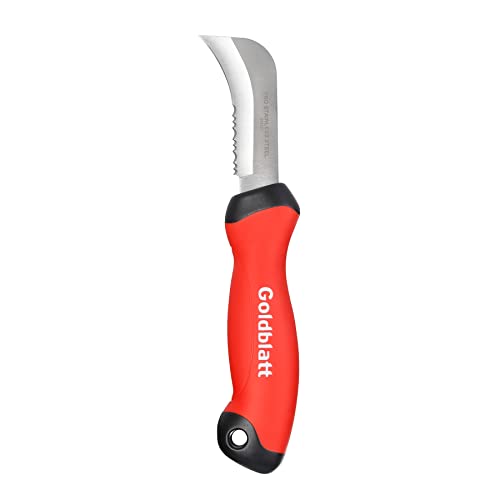
A closely related tool is the linoleum or flooring knife. This is a heavy, fixed utility knife with a wide hooked tip and a stiff handle. Flooring installers pull this blade across thick sheets of linoleum, carpet, and vinyl tile. The hooked tip lets the worker score the material cleanly without gouging the wood subfloor underneath. Many utility versions feature heavy-duty stainless steel (a rust-resistant, easy-to-clean metal) that withstands abrasive construction materials.
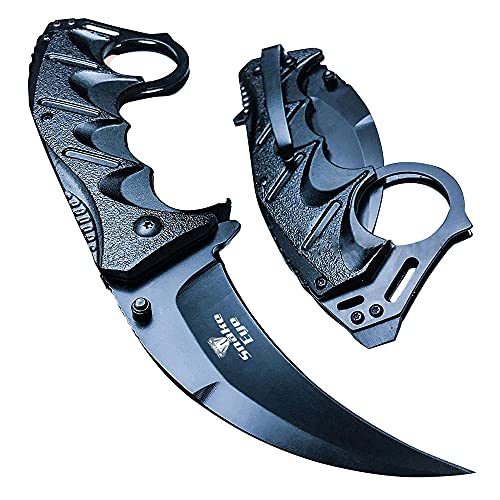
When an inward-curving blade includes a round ring at the base of the handle, it is called a karambit. Originating in Southeast Asia as an agricultural tool shaped like a tiger claw, modern karambits are popular as tactical and everyday carry pocket knife designs (often called EDC). The handle ring allows the user to lock their index finger or pinky into the grip, preventing anyone from knocking the knife out of their hand. Folding karambits often use a liner lock (the spring bar inside the handle that snaps behind the open blade to stop it from closing on your fingers) to keep the folding claw securely in place during hard pulling cuts.
Small downward curves in kitchens are bird's beak knives
If you discover a tiny downward-hooking blade inside a kitchen block, it is a bird's beak knife. In professional French kitchens, cooks call this a tourné knife (a small, downward-curving peeling knife). These knives are compact, usually carrying a blade between two and three inches long with a handle that fills the palm.
Bird's beak knives solve a specific problem that flat blades cannot handle. When you peel a round fruit or vegetable with a straight paring knife, only one tiny point of the flat blade touches the rounded skin at any second. The inward arc of a bird's beak knife mirrors the natural curve of an apple, orange, or potato. The curved belly hugs the produce, letting you strip away peel in one continuous ribbon without gouging into the tender flesh underneath.
Professional chefs also use bird's beak knives to make tourné cuts. This traditional culinary technique involves trimming root vegetables into uniform, football-shaped pieces with seven smooth sides. Outside of fancy culinary prep, home cooks rely on them to core whole tomatoes, remove strawberry stems, trim blemishes from apples, and loosen citrus segments. You will often see these specialty peelers included in German high-carbon steel knife block sets alongside standard utility knives.
Quality bird's beak knives often feature a full tang design (one solid piece of blade steel extending all the way through the handle). A full tang gives the cook better balance and tip control, which is essential when carving small, delicate garnishes in the palm of your hand.
Upward sweeping blades are boning knives and butcher scimitars
Not all curved knives hook downward. Many blades curve upward, placing the sharp edge along the outer belly while the tip rises above the handle line. These are convex blades, designed for slicing and trimming rather than hooking and pulling.
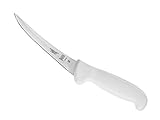
The most familiar upward-curved kitchen blade is the curved boning knife. These blades measure five to seven inches in length and have a narrow, slender profile. When you bone a pork loin, trim a beef brisket, or clean a leg of lamb, a straight blade forces your hand into an awkward downward angle. The upward sweep of a curved boning knife matches the natural swing of your wrist. It lets you slice right against bones, slip under connective tissue, and peel away silver skin without your knuckles scraping against the cutting board.
Butchers who break down large sides of meat use a much larger upward-curved blade called a scimitar (sometimes spelled cimeter). Named after the sweeping Middle Eastern sword, a scimitar blade stretches anywhere from ten to fourteen inches long. The broad, curved belly provides a long cutting edge. When slicing through large cuts of beef or pork, a butcher can make one long, continuous drawing stroke from heel to tip. This single sweeping motion produces smooth, uniform steaks without the ragged edges caused by sawing back and forth.
Hunters carry a field version of this upward curve called a skinning knife. A skinning knife features a deep, sweeping belly with a blunt or swept-back point. When separating an animal hide from the muscle, the wide belly glides smoothly beneath the skin. The swept-back tip stays angled away from the meat, preventing accidental punctures that could ruin the carcass. Many hunting and butcher knives are forged from high-carbon Japanese steel or tool steel, which stay sharp through hours of continuous slicing.
Crescent blades with top handles are called ulu knives
Some curved knives do not look like traditional knives at all. An ulu (an Alaskan curved rocker blade with a top handle) features a wide, crescent-shaped blade with the handle mounted directly on top of the spine. Instead of holding the handle behind the blade, your hand rests right over the cutting edge.
This overhead handle orientation changes the physics of cutting. With a regular knife, cutting pressure depends entirely on the strength of your wrist and forearm flexors. With an ulu, downward cutting force travels straight down through your arm and shoulder. You can slice through frozen fish, dense cabbage, or thick leather with minimal effort. This design makes the ulu exceptionally comfortable for cooks dealing with wrist fatigue, carpal tunnel, or arthritis.
Traditional Arctic cultures created the ulu thousands of years ago to skin game, fillet salmon, and chop vegetables. In modern home kitchens, the ulu serves as a fast rocking cutter. By rocking the rounded edge back and forth across a wooden board, you can mince fresh herbs, chop whole nuts, or dice mounds of garlic in seconds.
A similar Western tool built on the rocking crescent concept is the mezzaluna (Italian for "half-moon"). While an ulu uses a single central grip, a mezzaluna features a long curved blade with upright handles at both ends. Home cooks grip both handles with two hands, rocking the curved blade through herbs, leafy greens, or flatbread pizzas.
Sharpening and using curved blades requires round stones and care
Curved knives require different cutting habits and maintenance techniques than regular kitchen cutlery. Because the blade geometry bites or glides differently, using the wrong motion can damage your cutting surface or cause a dangerous slip.
Keep these practical habits in mind whenever you handle or maintain a curved knife:
- Cut away from your body on utility hooks: Hawkbills, linoleum knives, and karambits pull materials inward toward the handle. If you pull toward yourself and the blade cuts through the material unexpectedly, the hook will travel directly toward your chest or fingers. Always draw utility hook blades away from your body.
- Skip the flat whetstone for inward curves: You cannot sharpen a concave blade like a bird's beak or hawkbill on a standard flat bench stone. The inward dip will bridge over the flat surface, touching only at the heel and the tip while leaving the center dull.
- Use round ceramic rods or slipstones: To sharpen an inward curve, use a round sharpening rod, a tapered diamond hone, or a slipstone (a curved sharpening stone shaped like a cylinder or teardrop). The round stone fits perfectly inside the hollow belly of the blade.
- Watch for the burr: Match the factory angle (usually a steep 15-degree slicing edge per side for delicate paring knives, or a sturdy 20-degree utility edge for pocket and carpet blades). Stroke smoothly along the inside arc until you feel a burr (the microscopic wire edge or curved sliver of metal that forms on the opposite side during sharpening), then polish it off.
- Clean and dry by hand: Never toss curved knives into a sink full of soapy water. A hooked tip resting under suds creates a severe puncture hazard when you reach into the basin. Hand-wash the blade, wipe it dry immediately with a clean towel, and store it in a protective sheath or dedicated block slot.
Choose the right curved knife based on your cutting task
If you are looking to add a curved knife to your gear bag or kitchen counter, focus on the specific cutting problem you need to solve. No single curved knife handles every task, because an inward-hooking edge and an upward-sweeping belly do opposite jobs.
For fine kitchen peeling, coring, and carving, look for a bird's beak paring knife with a compact blade and an ergonomic handle. If you process whole cuts of meat, trim briskets, or work around bone joints, choose a curved boning knife with a slender profile and a slip-resistant grip. For serious meat slicing and large roasts, a long butcher scimitar provides the clean, single-pass cuts you need, making it a great companion to dedicated high-carbon Japanese chef knife sets.
If your work involves DIY flooring, heavy rope, pruning, or package opening, select a sturdy hawkbill or a dedicated linoleum knife. Before you buy, check the blade steel and handle construction. Stainless steel works best for kitchens and wet environments where rust resistance matters. High-carbon steels hold a razor edge longer for heavy-duty slicing but require immediate drying. Look for textured, contoured handles that prevent your fingers from sliding forward onto the curved cutting edge during hard use.

- TAR Score9.4
TAR Score is a ranking system developed by TopAppliancesReviews.com. TAR score has no relationship or impact from any manufacturers or sales agent websites. Learn more
- BrandGOOD WORKER

- TAR Score9.4
TAR Score is a ranking system developed by TopAppliancesReviews.com. TAR score has no relationship or impact from any manufacturers or sales agent websites. Learn more
- BrandOAKSWARE
- TAR Score9.4
TAR Score is a ranking system developed by TopAppliancesReviews.com. TAR score has no relationship or impact from any manufacturers or sales agent websites. Learn more
- BrandMercer Culinary

- TAR Score9.2
TAR Score is a ranking system developed by TopAppliancesReviews.com. TAR score has no relationship or impact from any manufacturers or sales agent websites. Learn more
- BrandHuusk

- TAR Score9.2
TAR Score is a ranking system developed by TopAppliancesReviews.com. TAR score has no relationship or impact from any manufacturers or sales agent websites. Learn more
- BrandIRWIN

- TAR Score9.2
TAR Score is a ranking system developed by TopAppliancesReviews.com. TAR score has no relationship or impact from any manufacturers or sales agent websites. Learn more
- BrandALBATROSS
- TAR Score9.2
TAR Score is a ranking system developed by TopAppliancesReviews.com. TAR score has no relationship or impact from any manufacturers or sales agent websites. Learn more
- BrandGoldblatt

- TAR Score9.0
TAR Score is a ranking system developed by TopAppliancesReviews.com. TAR score has no relationship or impact from any manufacturers or sales agent websites. Learn more
- BrandFUNBRO
- TAR Score8.8
TAR Score is a ranking system developed by TopAppliancesReviews.com. TAR score has no relationship or impact from any manufacturers or sales agent websites. Learn more
- BrandSnake Eye Tactical

- TAR Score8.8
TAR Score is a ranking system developed by TopAppliancesReviews.com. TAR score has no relationship or impact from any manufacturers or sales agent websites. Learn more
- BrandGrand Way
Last update on 2026-09-30 / Affiliate links / Images, Product Titles, and Product Highlights from Amazon Product Advertising API


Top Rated Best Quality Range Hoods: 2026 Expert Picks

The 12 Best Small Solar Generators 2026

10 Best Quality Semi Automatic Washing Machine of 2026 For Leak-Free Laundry

11 Best Small Washer Machine of 2026 For Everyday Laundry

12 Best Vibration Pads For Washing Machine of 2026 To Stop Walking and Shaking

11 Best Selling Front Load Washing Machine of 2026 For Quiet Odor-Free Laundry

11 Best Washing Machine For King Size Bedding of 2026 To Prevent Cycle Errors

10 Best Small Front Loader Washing Machine of 2026 For Tight Closets






