
Why Does Your Washing Machine Shake a Lot?

Heavy banging during a spin cycle sounds alarming, but it rarely means the appliance is broken. Most violent shaking happens when wet clothes clump onto one side of the drum or the bottom leveling legs do not rest flat against the floor. A brand-new machine can also rattle aggressively if delivery crews forgot to remove the shipping bolts, which are temporary metal rods that hold the drum still during transit.
What is happening behind the noise usually comes down to your flooring and what went into the wash. A single soaked blanket or thick bath mat can throw the spin cycle off balance in seconds. Flexible upper-floor boards also shudder much more than rigid concrete basements. A few quick checks will show you where the wobble starts so you can quiet the room without paying for a service call.
Hit Pause and Check for Bunched Clothes Right Away
When your washer starts thumping, shuddering, or sliding across the floor, push the pause button immediately. Letting a violent spin cycle finish on its own can dent your walls, crack the floor tiles, or tear the hot and cold water supply hoses loose from the wall. A sudden leak under pressure can flood your home in minutes. Shutting the machine off stops the strain before parts bend or snap.
Once the spin cycle (the high-speed spin at the end of the wash) halts and the automatic lid lock clicks open, take a close look at how the laundry sits inside the stainless steel clothes tub. In most homes, severe shaking is caused by simple physical weight imbalances rather than broken machinery.
- A heavy cluster on one side: Look for a thick bath sheet, heavy denim jacket, or bulky sweater rolled tightly into a ball on just one side of the tub.
- A sheet wrapped around the middle: See if a fitted bed sheet or blanket has twisted into a tight rope around the center agitator post or balled up over the wash plate, trapping smaller clothes inside a single heavy lump.
- Trapped standing water: Check whether several inches of dirty water remain pooled at the bottom of the clothes tub. If a drain line is clogged and water cannot pump out, that heavy standing water will slosh wildly during high-speed spinning.
- Waterlogged memory foam or rugs: Inspect bath mats with rubber backing. Rubber-backed mats hold trapped water instead of letting it spin out, creating dead weight that throws the whole machine off center.
Spreading Bulky Laundry Evenly Keeps the Tub Balanced
Washing machines depend on centered weight to run smoothly. During the final spin, the inner wash basket spins between 600 and 1,200 revolutions per minute, depending on your model. At that speed, even a single wet towel balled up on one side creates tens of pounds of uneven force. That force slams the wash tub against the outer metal cabinet, creating a loud banging noise and rattling your whole room.
How you load your laundry depends on the style of your machine. When weighing the difference between agitator and impeller washers, remember that both handle bulky loads differently. A washer with a center agitator post that twists clothes through the water requires you to drop clothes loosely around the central column in even piles. Never wind a sheet or towel around the post like a scarf. Washers with a flat bottom wash plate (impeller) that moves laundry using water currents need clothes placed in loose, balanced rings around the edge of the basket, leaving the center clear.
If you need to wash a single heavy item, such as a thick winter coat, a king-size towel, or a heavy cotton blanket, always add two or three smaller towels to the load. Washing one heavy item alone guarantees an unbalanced tub because that single item has nothing on the opposite side to balance its weight. Adding a couple of matching towels gives the tub counterweights so the weight spreads out evenly along the rim.
Most modern washers include an off-balance safety sensor that pauses spinning and beeps when bulky towels or blankets bunch up on one side. But older washers or basic cycle settings may keep trying to spin at top speed. If your washer pauses and sounds a balance alert, open the lid, pull the wet items apart by hand, drape them evenly around the basket, and restart the cycle.
Leveling the Bottom Feet Stops Rocking on Uneven Floors
A washer cannot spin quietly if all four of its corners do not press firmly against the floor. Even if your laundry load is balanced, a machine with one loose foot will wobble like an uneven dining table. Over time, that tiny wobble turns into a loud, rhythmic pounding that walks the machine away from the wall.
To check for loose feet, walk up to your washer while it is empty and turned off. Place your hands on opposite diagonal corners, such as the front-left and rear-right corners. Push down firmly and try to rock the machine back and forth. Then switch your hands to the front-right and rear-left corners and rock it again. If the machine tilts, clicks, or shifts even an eighth of an inch, the leveling legs need adjustment.
- Clean under the corners: Sweep away lint, detergent crust, and grit from around the machine base. Grit under the feet prevents them from gripping the floor surface securely.
- Check the cabinet with a bubble level: Place a standard carpenter level flat on top of the washer cabinet, first from side to side, and then from front to back. This shows which corner sits too low.
- Loosen the locknut: Look beneath each corner for the leveling legs (adjustable screw-in feet at the bottom corners). Each threaded metal post has a locknut (a small metal nut that holds the threaded foot tight against the cabinet). Use an adjustable wrench to turn this nut clockwise to loosen it from the frame.
- Adjust the foot height: Turn the rubber foot counter-clockwise to lower the foot so it extends further down toward the floor, or clockwise to raise it back up into the cabinet. Adjust the low corner until your bubble level shows the machine is straight.
- Lock the foot firmly in place: Once all four feet rest flat on the floor with zero rocking, spin the locknut counter-clockwise up the shaft until it presses tightly against the bottom of the washer cabinet. Tighten it firmly with your wrench. If you skip this step, normal wash vibrations will spin the loose foot out of adjustment within a few weeks.
Removing Rear Shipping Bolts Stops Violent New Machine Shaking
If your washing machine is brand new and shook violently across the floor on its very first spin cycle, someone almost certainly forgot to remove the factory shipping bolts. This happens constantly in newly renovated homes, rental units, and DIY installations. It is one of the most common causes of extreme, cabinet-shaking movement.
When deciding whether front-load or top-load washing machines fit your home, keep in mind that front-load washers always ship with heavy-duty shipping bolts (metal rods that secure the drum during delivery). Manufacturers bolt the internal stainless steel clothes tub directly to the heavy steel outer frame so the tub cannot swing and get damaged while bouncing inside a delivery truck on the highway.
During normal operation, your washer tub floats freely on heavy steel springs and shock absorbers. This floating suspension allows the inner tub to shake slightly while the outer cabinet stays completely still. But when shipping bolts remain screwed into the back, the tub cannot move on its springs. Every bit of vibration from the spinning drum transfers straight into the outer frame, making the entire cabinet jump, bang, and bounce across your laundry room floor.
Look at the rear panel of your washer. You will typically see three to five large steel bolt heads surrounded by heavy plastic or rubber spacers. Check your owner manual to confirm their locations. Use a socket wrench to unscrew each bolt completely, pull the metal rod and rubber spacer out of the machine, and press the manufacturer plastic plugs into the empty holes to keep dust and pests out. Store the bolts in a safe place, because you will need to screw them back in if you ever move to a new house.
Flexible Floors and Slick Tiles Cause Extra Machine Movement
The surface under your washing machine plays a massive role in how much noise and vibration you feel. A washer set up on a solid concrete basement slab rarely shakes, because concrete does not bend or bounce under heavy weight. But when you place that same washer on an upper-story wooden floor, the wooden subfloor acts like a drumhead that amplifies every tiny movement.
Wood joists flex under dynamic weight. When a heavy washer spins at top speed, the natural bounce of the subfloor can match the spin rhythm of the clothes basket. When these two rhythms line up, they create resonance, making the washer sway and shaking pictures on your living room walls downstairs. If your machine is level and balanced but still hums loudly on a second floor, the floor itself may simply need extra physical support or stiffening underneath.
Smooth flooring materials like polished ceramic tile, slick vinyl plank, and sealed concrete create a different problem: lack of grip. Even a well-balanced, leveled washer generates micro-vibrations during high-speed spinning. On slick surfaces, the hard plastic or worn rubber feet slowly glide across the damp floor, walking the entire machine several inches away from the wall cycle after cycle. Keeping the floor under the feet dry and free of slick detergent residue helps keep the feet planted where they belong.
Worn Suspension Springs and Dampers Demand a Hardware Fix
If your washer is several years old, sits completely level on a solid floor, and still bangs loudly with balanced laundry loads, internal hardware has likely worn out. Inside the cabinet, several mechanical parts work together to absorb movement and keep the wash tub centered.
Top-load washers hang their inner wash basket from four suspension rods (internal metal springs supporting the wash tub) attached to the top corners of the cabinet. Front-load washers use heavy coil springs at the top and hydraulic shock dampers at the bottom. Over years of regular family use, the springs stretch, damper seals dry out, and plastic mounting bushings crack. When these parts fail, the tub swings wildly like an uncontrolled pendulum.
- The empty tub bounce check: Open the washer door while the machine is empty. Push down hard on the bottom of the stainless steel clothes tub with both hands, then let go quickly. A healthy suspension will pop back up and settle in place immediately. If the tub bounces up and down several times like a worn car shock absorber, the suspension rods or dampers are worn out.
- A tilted inner basket: Look inside an empty top-load washer. The inner tub should sit directly in the center of the top opening. If the tub leans permanently toward one corner or rubs against the side of the cabinet, one of the suspension springs has snapped or lost its tension.
- Oil or grease under the unit: Look beneath the machine with a flashlight. Hydraulic shock dampers on front-load washers contain damping grease. If you see sticky fluid leaking down the plastic shock shafts, the internal seals have blown and can no longer absorb spin energy.
- Metal scraping or grinding sounds: If the shaking comes with a loud screeching or jet-engine roar, the main drum bearings behind the tub have failed. When bearings wear out, the drum wobbles loosely on its central shaft.
Replacing suspension rods or lower dampers requires unplugging the washer from the standard 120-volt 3-prong grounded wall outlet, turning off the hot and cold water shutoff valves, and opening the cabinet. If you are uncomfortable handling internal mechanical parts, shut the machine down and call a qualified appliance repair professional to inspect the suspension system.
Rubber Anti-Vibration Pads Absorb Shock and Stop Floor Walking
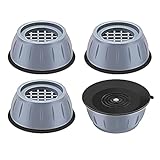
When your washer is level, the suspension is healthy, but normal spin vibrations still rattle your floorboards or cause the feet to slide on slick tile, adding external vibration pads is the simplest physical fix. These dense accessories sit directly between the machine feet and your floor, acting as shock absorbers that separate the vibrating washer frame from the structure of your house.
Before choosing a set of support pads, check the diameter of your machine feet and the space around your laundry hookups. Most heavy-duty pads use thick molded rubber or dense composite polymer that absorbs motor hum and stops the cabinet from creeping across slick tile. Look for pads with a deep recessed lip around the top rim. This lip traps the washer foot inside the pad so the leg cannot slip off the edge during a fast spin cycle.
Keep overall height in mind if your washer sits under a low shelf or fits into a tight laundry closet. Standard vibration pads add a fraction of an inch to the base, while raised stabilizer pads lift the unit nearly two inches off the ground. That extra height can make cleaning under the appliance easier and protect the bottom of the machine from floor moisture, but you must ensure your water supply hoses and drain lines still reach their wall connections without stretching or kinking.
- TAR Score9.3
TAR Score is a ranking system developed by TopAppliancesReviews.com. TAR score has no relationship or impact from any manufacturers or sales agent websites. Learn more
- Branddadop

- TAR Score7.1
TAR Score is a ranking system developed by TopAppliancesReviews.com. TAR score has no relationship or impact from any manufacturers or sales agent websites. Learn more
- BrandCUISIBOT
Last update on 2026-11-01 / Affiliate links / Images, Product Titles, and Product Highlights from Amazon Product Advertising API


10 Best Washing Machine For King Size Comforter of 2026 For Bulky Bedding

11 Best Semi Automatic Washing Machine Under 10000 of 2026 For Apartments and RVs

9 Best Compact Refrigerator For Beer Bottles of 2026 For Upright Bottle Fit

10 Best Quality Semi Automatic Washing Machine of 2026 For Leak-Free Laundry

11 Best Small Washer Machine of 2026 For Everyday Laundry

12 Best Vibration Pads For Washing Machine of 2026 To Stop Walking and Shaking

11 Best Selling Front Load Washing Machine of 2026 For Quiet Odor-Free Laundry

11 Best Washing Machine For King Size Bedding of 2026 To Prevent Cycle Errors





