
How to Use a Pull-Through Knife Sharpener Safely

Pull straight back using light, smooth strokes. Set the tool flat on a counter, brace the base with your free hand, and draw the blade toward yourself from the heel (the back corner near the handle) to the tip. Pull in one direction only, and never saw back and forth. Light contact is plenty. Pressing down hard will not speed things up, and it risks gouging metal or slipping off the counter.
Your routine depends on the knife and its edge. A truly blunt blade needs a few slow passes through coarse metal teeth to reshape the steel, while a mildly dull knife only needs the fine ceramic smoothing slot. Stick strictly to standard straight blades, as serrated bread knives will get damaged. Here is the safest way to set up your grip and run every pull cleanly.
Plant the Sharpener on a Flat Surface First
Setup mistakes cause slips, uneven bevels, and cut fingers. A pull-through sharpener needs complete stability before steel ever touches a slot. If the base shifts while you pull, the blade will tilt sideways and scrape metal unevenly along the angled cutting edge. That tilt creates flat spots and ruins your cutting performance.
Position the sharpener on a clear, dry section of your kitchen counter or sturdy work table. Never hold a pull-through sharpener in mid-air while pulling a blade through it. A sharpener held in loose hands wobbles with every movement, which guarantees an uneven edge and places your knuckles directly in the path of an exposed blade. Prepare your workstation with this quick checklist before you start:
- Clean and dry the counter: Wipe away grease, water, flour, and cutting dust. Even a small puddle of water underneath a rubber foot can cause the base to hydroplane across smooth granite or laminate.
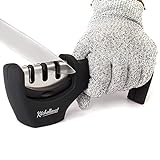
- Anchor your non-dominant hand: Grip the handle of the sharpener firmly with your non-dominant hand. Keep your fingers, knuckles, and thumb curled behind the built-in safety guard so they never cross into the path of the blade.
- Square your stance: Stand directly in front of the sharpener with your feet shoulder-width apart. Facing the tool straight on allows your arm to pull in a clean, straight line toward your chest without twisting.
- Wash and dry the blade: Food residue, cooking oils, and moisture will clog the sharpening stones and make the knife handle slippery. Wash the blade with warm soapy water and dry it completely with a clean towel.
Pull Smoothly From Heel to Tip Without Pushing
The core movement of sharpening requires one continuous backward draw. Never push a knife forward into a sharpening slot. Pushing forces the thin edge directly into the hard internal cutters, which gouges notches into the steel, chips the blade, or skips unpredictably across the surface.
Every stroke should move in one direction: starting at the heel (the back end of the blade near the handle) and finishing cleanly at the tip. You do not need to muscle the blade down into the unit. Heavy pressure peels off excessive steel and weakens the knife. Instead, use light, consistent downward pressure, about the weight of a standard apple, and let the sharpening elements do the cutting.
- Seat the blade heel: Lower the heel of the knife vertically into the center of the V-shaped slot. Ensure the blade stands straight up at a 90-degree angle to the countertop, without leaning toward either side.
- Match the slot angle: Rest the edge gently against the sharpening rods or carbide cutters. Keep your wrist locked straight so the knife does not tilt as you prepare to move.
- Draw backward steadily: Pull the knife straight back toward your body in one smooth, unbroken motion. Maintain a slow, controlled speed so that a standard eight-inch chef knife takes about two to three full seconds to pass through the slot.
- Follow the blade profile: As you reach the curved section of the blade (the belly), slowly lift your knife handle slightly upward. Raising the handle keeps the edge perpendicular to the sharpening slot all the way through to the tip.
- Clear the slot and reset: Pull the very tip of the blade completely free from the slot without letting it snap or drop against the counter. Lift the knife back to the starting position and repeat the stroke.
Start Coarse for Dull Steel and Finish Fine
Most pull-through sharpeners feature two or three separate slots labeled coarse, medium, or fine. Knowing which slot to start with depends on how blunt your knife has become. A dull blade needs careful metal removal, while a blade that simply feels sluggish only needs edge realignment.
The coarse slot contains carbide cutters (hard metal shaping teeth) or coarse diamond-coated rods. These teeth shave away dull metal to cut a fresh angled bevel into blunt steel. You only need this stage if your knife cannot slice through an onion skin or slips off the surface of a tomato. For routine care, running a knife through carbide teeth too often grinds away the blade unnecessarily and shortens the working life of your cutlery. Standard kitchen cutlery, such as blades found in German high-carbon steel knife sets, holds up well to occasional carbide reshaping, but regular maintenance should rely on finer stages.
The fine slot houses ceramic rods (fine smoothing stones). This stage does not remove heavy metal. Instead, it polishes the cutting bevel and buffs away the burr (the microscopic wire edge or curved sliver of metal that forms on the opposite side during sharpening). If your knife is in decent shape and just needs a quick touch-up before dinner prep, skip the coarse slot completely and use the fine ceramic slot.
Follow a simple pull count based on blade condition:
- Routine weekly touch-up: Make 3 to 5 light pulls through the fine ceramic slot only. Check the edge on a sheet of scrap paper. If it slices cleanly without tearing, the edge is ready.
- Moderately dull blade: Make 2 to 3 pulls through the medium diamond slot (if your unit has one), followed by 5 to 6 pulls through the fine ceramic slot to smooth the burr.
- Completely blunt blade: Make 3 to 5 controlled pulls through the coarse carbide slot to set the bevel. Then make 3 pulls through the medium slot, and finish with 6 to 8 light pulls through the fine ceramic slot to polish the steel.
Avoid Heavy Pressure and Back-and-Forth Sawing
Pull-through sharpeners have an unfair reputation for ruining kitchen knives, but user error causes almost all the damage. When people treat a manual sharpener like a hand saw or lean their body weight into the stroke, the tool shreds the steel. Correcting four common habits protects your knives from uneven wear and extends their lifespan.
- Pushing down with heavy force: Bear down on the blade, and the carbide teeth will take deep, jagged bites out of the steel. This creates a wavy, uneven edge along the cutting profile that prevents the blade from making flat contact with a cutting board. Use only light downward force; the weight of your hand is plenty.
- Sawing back and forth: Moving the knife forward and backward inside the slot chatters the blade against the sharpening elements. This hacks jagged micro-teeth into the edge, snaps delicate tips, and bends the microscopic burr back and forth until chunks of steel flake away. Always pull in one single direction from heel to tip.
- Flicking or dropping the tip: When pulling through quickly, people often yank the knife out of the slot with a sudden upward flick. This rounds off the sharp point of the knife over time and risks nicking your counter or the housing of the sharpener. Keep your speed steady all the way to the very end of the stroke.
- Tilting the blade off-center: If you cant the knife handle to the left or right, you sharpen one side of the bevel while grinding down the shoulder of the opposite side. Keep the spine of the knife straight up and down, perpendicular to the base, through every single pass.
Keep Thin Japanese and Serrated Blades Out of Slots
Not every knife in your kitchen drawer belongs in a standard pull-through sharpener. Most handheld units use fixed internal angles set to roughly 20 degrees per side. That sturdy 20-degree utility edge works well for thick Western chef knives, everyday carry pocket knives, and standard utility blades, but it will damage specialty cutlery.
Keep delicate high-carbon Japanese chef knife sets away from coarse pull-through sharpeners. Traditional Japanese blades are forged from hard, brittle steel sharpened to a steep 15-degree slicing edge per side. Dragging a hard, thin 15-degree Japanese edge through aggressive 20-degree carbide cutters will chip the brittle steel and grind away the precise factory geometry. These thin blades require water sharpeners, whetstones, or specialized fine-angle systems to maintain their thin cutting profile safely.
Standard serrated bread knives also require caution. Pulling a serrated blade through coarse carbide slots will flatten the pointed teeth and ruin the scalloped bevels. Only run a serrated knife through a pull-through unit if the manufacturer specifically includes a dedicated ceramic slot designed for serrations, and use only light passes through that fine ceramic stage to clean the scalloped grooves without altering the teeth.
Single-bevel knives, such as traditional sushi blades where only one side of the steel is ground flat, must never go into a V-shaped pull-through slot. The dual-sided cutters will grind an unwanted bevel into the flat back of the blade, permanently altering how the knife tracks through food.
Choose Multi-Stage Sharpeners With Stable Grip Bases
If you want fast, dependable edge maintenance without the learning curve of bench stones, selecting the right pull-through tool makes all the difference. Look for a model that provides distinct coarse and fine stages rather than a single abrasive slot. Having separate coarse carbide teeth for dull steel and fine ceramic rods for daily smoothing allows you to maintain edges without stripping unnecessary metal off your knives.
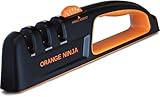
Stability and hand safety should guide your choice. Select a sharpener built with a broad, slip-resistant rubber base that grips wet kitchen counters securely. The handle should feel comfortable in your non-dominant hand and feature a tall protective barrier between your grip and the sharpening channel to protect your fingers from slipping blades.
Finally, verify the sharpening angle of the unit against the cutlery you own. Many modern sharpeners offer adjustable dials that let you switch between a 15-degree angle for Asian-style slicing knives and a 20-degree angle for Western knives and outdoor pocket blades. Choosing a unit that matches the bevel angles of your everyday knives ensures clean cuts, less metal waste, and blades that stay sharp through months of prep work.

- TAR Score9.6
TAR Score is a ranking system developed by TopAppliancesReviews.com. TAR score has no relationship or impact from any manufacturers or sales agent websites. Learn more
- BrandWORK SHARP

- TAR Score9.4
TAR Score is a ranking system developed by TopAppliancesReviews.com. TAR score has no relationship or impact from any manufacturers or sales agent websites. Learn more
- BrandACCUSHARP

- TAR Score9.2
TAR Score is a ranking system developed by TopAppliancesReviews.com. TAR score has no relationship or impact from any manufacturers or sales agent websites. Learn more
- BrandACCUSHARP
- TAR Score9.0
TAR Score is a ranking system developed by TopAppliancesReviews.com. TAR score has no relationship or impact from any manufacturers or sales agent websites. Learn more
- BrandKITCHELLENCE

- TAR Score9.0
TAR Score is a ranking system developed by TopAppliancesReviews.com. TAR score has no relationship or impact from any manufacturers or sales agent websites. Learn more
- BrandF.Dick

- TAR Score8.8
TAR Score is a ranking system developed by TopAppliancesReviews.com. TAR score has no relationship or impact from any manufacturers or sales agent websites. Learn more
- BrandCAROTE
- TAR Score8.8
TAR Score is a ranking system developed by TopAppliancesReviews.com. TAR score has no relationship or impact from any manufacturers or sales agent websites. Learn more
- BrandSharp Pebble

- TAR Score8.8
TAR Score is a ranking system developed by TopAppliancesReviews.com. TAR score has no relationship or impact from any manufacturers or sales agent websites. Learn more
- BrandRAZORSHARP
Last update on 2026-10-01 / Affiliate links / Images, Product Titles, and Product Highlights from Amazon Product Advertising API


Top Rated Best Quality Range Hoods: 2026 Expert Picks

The 12 Best Small Solar Generators 2026

10 Best Quality Semi Automatic Washing Machine of 2026 For Leak-Free Laundry

11 Best Small Washer Machine of 2026 For Everyday Laundry

12 Best Vibration Pads For Washing Machine of 2026 To Stop Walking and Shaking

11 Best Selling Front Load Washing Machine of 2026 For Quiet Odor-Free Laundry

11 Best Washing Machine For King Size Bedding of 2026 To Prevent Cycle Errors

10 Best Small Front Loader Washing Machine of 2026 For Tight Closets






