
How to Hold and Use an Ulu Knife Safely

An ulu knife can look intimidating without a traditional handle, but there is no reason to worry about losing control of the blade. The trick is to cup your palm over the center handle and rock the curved edge back and forth using gentle downward weight from your forearm. Because your hand sits directly above the steel, the blade will not twist or slip out of line.
How you move the knife changes slightly depending on your board and what you are preparing. Mincing fresh herbs works best when rocking inside a shallow wooden bowl that traps runaway scraps, while slicing pizza or dense meat calls for a direct downward press on a flat board. The edge style also plays a role, especially if the steel is sharpened on only one side. Getting comfortable takes only a few minutes once you master the safe grip.
How do you grip an ulu knife safely?
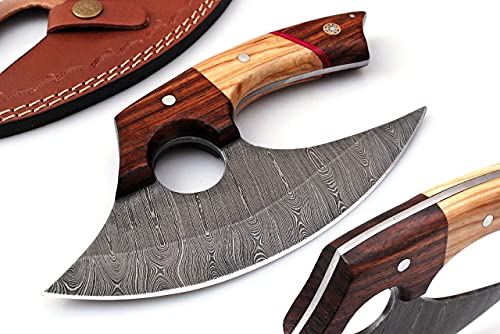
The crescent shape of an ulu knife (an Alaskan curved rocker blade with a top handle) positions your hand directly over the cutting edge. Unlike a standard kitchen knife with an extended handle and a finger guard, an ulu has its grip mounted across the top spine of the blade. This design often makes beginners nervous because fingers sit close to sharp steel. Gripping the handle properly keeps your fingers safe while giving you complete control over every cut.
Follow these steps to lock in a safe, balanced grip:
- Center your palm over the top grip: Place the center of your palm squarely over the middle of the handle. Your palm should rest flat along the top curve, absorbing the weight of your hand naturally.
- Wrap your four fingers snugly around the wood: Curl your fingers around the underside of the handle. Keep your fingertips pressed against the handle material. Never let your pinky drift down to curl around the exposed metal shoulders beneath the grip.
- Lock your thumb against your fingers: Wrap your thumb over your fingers to close your fist around the handle, similar to holding a hand planer. Avoid resting your thumb flat against the steel blade, where an unexpected slip during a heavy cut could slide your thumb down to the cutting edge.
- Keep your wrist straight and firm: Align your wrist directly with your forearm. Your arm and the knife should form one solid vertical line so downward arm pressure drives the cut rather than wrist strain.
- Tuck your guide hand into a claw: If you use your non-cutting hand to hold food, curl your fingertips inward like a bear claw. Keep your knuckles facing the blade and position your hand several inches away from the rocking path.
Keep your grip centered where blade clearance is greatest to prevent your knuckles from brushing against the metal during heavy chopping.
What cutting motions work best for different foods?
Standard kitchen knives rely on a forward-and-back slicing stroke where the blade slides across food. An ulu cuts through downward leverage and curving rolls. Trying to pull or saw an ulu across a board feels awkward and increases the risk of slipping.
The rocking cut (tilting the curved edge forward and back) handles most daily prep. Rest the front curve on your board in front of the food. Press down gently and roll the blade backward along its curve until the rear tip touches, then rock it forward again. Keep the steel in continuous contact with the wood. This smooth rolling motion glides through herbs, celery, green onions, and tender vegetables without bruising delicate leaves or scattering food across the counter.
For dense items like carrots, potatoes, cheese blocks, or pizza crusts, switch to a downward chop. Position the center of the curve directly over the food. Lean forward slightly and press straight down through the handle using your forearm and shoulder. The blade drives through tough textures cleanly without wrist twisting.
When mincing garlic cloves or ginger into fine pieces, use a pivot motion. Rest the front tip of the crescent blade firmly against the cutting board as an anchor. While keeping that tip pinned, swing the rear half down across the pile of food in short, rhythmic arcs. Scrape the pile together, rotate your angle, and repeat. You can also lower the blade angle to slice meat or skin fish, using light, continuous rolls rather than rapid sawing.
Do you need a curved bowl or a flat board?
Many ulu knives arrive with a hollowed bowl (a cutting board with a scooped center). While both flat cutting boards and curved bowls work well, each suits different kitchen tasks.
A hollowed wooden bowl makes chopping herbs, nuts, and loose vegetables effortless. The concave hollow matches the arc of the crescent blade. As you rock the knife back and forth, the sloped sides naturally guide ingredients back into the center so garlic and greens cannot scatter. The scooped shape also keeps the entire blade edge in contact with the wood throughout each roll, speeding up your prep work.
A flat cutting board works better for large items. You cannot portion a pizza, a wide flatbread, or a beef roast inside a scooped bowl. On a flat board, the crescent blade acts as a heavy-duty rocker cutter to slice crusts or dice squash into clean rounds. Small items will spread outward on a flat board, so you will need to scrape them back together periodically.
Stick to hardwoods like birch, maple, or walnut regardless of board shape. Avoid glass, granite, marble, or ceramic surfaces. Hard counters dull sharp steel quickly and can chip the cutting edge under downward pressure.
Why does an ulu knife ease wrist strain?
Standard chef knives can cause pain for cooks with arthritis, carpal tunnel syndrome, or general joint fatigue. A traditional handle sits behind the blade, forcing your wrist to act as a pivot that absorbs downward torque and twisting strain with every slice.
An ulu knife eliminates that lever effect by placing the handle directly over the blade arc. Downward force travels straight from your shoulder, down through your forearm bones, and directly into the cutting edge. Your wrist stays locked in a neutral, straight alignment instead of flexing under strain.
This alignment works like pressing down with your open palm rather than pushing through a stick. Direct downward force engages larger arm muscles, letting cooks with stiff joints cut dense produce using body weight rather than a tight hand grip.
The rolling design also prevents joint fatigue during repetitive prep. Because the curved blade rolls along the board, you do not need to lift the tool off the surface between cuts. Arm momentum powers the motion, protecting wrist tendons from repetitive shock.
How do you clean, oil, and store the blade?
The broad blade and wooden handle of an ulu degrade quickly in dishwashers or wet sinks. A basic cleaning and storage routine protects the edge and prevents accidental cuts.
Follow this quick checklist after every meal:
- Hand-wash right after use: Wash the blade with warm water, mild soap, and a soft sponge. Wipe from the handle toward the dull spine, keeping fingers behind the sharp edge. Never soak the knife in soapy water where a hidden blade can cut reaching hands.
- Dry completely with a clean towel: Moisture causes rust and swells wooden handles. Wipe the steel and handle dry with a cloth immediately after washing. Do not leave the knife to air-dry in a dish rack.
- Oil carbon steel blades lightly: If your blade uses high-carbon steel (harder metal that stays sharp longer but requires dry wiping and light oiling to prevent rust spots), rub a few drops of food-safe mineral oil across the clean metal before storing. Stainless steel (rust-resistant, easy-to-clean metal) needs less oil, but treating wood handles prevents cracking. Similar to maintaining German high-carbon steel knife sets, keeping moisture away from reactive blade steel prevents staining.
- Store in a sheath, stand, or block: Never leave an ulu loose in an open drawer where it can dull or cut reaching hands. Keep it in a fitted leather sheath or a wood stand. If you use magnetic knife block sets, verify that the magnetic surface holds the broad blade flat and steady without letting the edge slide.
What features should you check before buying an ulu?
Choosing the right ulu knife comes down to how it feels in your palm and what you chop most often. Build quality and handle geometry determine whether the tool feels stable or awkward during prep.
Check the handle attachment first. Look for an ulu with full tang construction (one solid piece of blade steel extending all the way through the handle) rather than a partial tang (where the blade metal narrows or stops inside the handle). A full tang secured by solid rivets prevents the handle from loosening when you press down on dense foods. Look for smooth, rounded wood or composite grips that fill your palm comfortably without sharp edges.
Next, check the blade grind. Traditional knives often feature a single bevel (a blade sharpened on only one side). Single-bevel edges slice cleanly and excel at skinning meat or fish, but they tend to pull slightly to one side during downward chops. Modern kitchen ulus usually feature a double bevel (an edge sharpened evenly on both sides). Double-bevel blades chop straight down without steering, making them easier for beginners.
Finally, check the included accessories. A matched hollowed bowl makes cutting herbs and vegetables much cleaner. If you plan to store the knife in a drawer or take it outdoors, choose a model with a fitted leather sheath or a sturdy wooden display stand to protect the edge.

- TAR Score10.0
TAR Score is a ranking system developed by TopAppliancesReviews.com. TAR score has no relationship or impact from any manufacturers or sales agent websites. Learn more
- BrandWAZIR CRAFTS HANDMADE

- TAR Score10.0
TAR Score is a ranking system developed by TopAppliancesReviews.com. TAR score has no relationship or impact from any manufacturers or sales agent websites. Learn more
- BrandWAZIR CRAFTS HANDMADE

- TAR Score10.0
TAR Score is a ranking system developed by TopAppliancesReviews.com. TAR score has no relationship or impact from any manufacturers or sales agent websites. Learn more
- BrandWAZIR CRAFTS HANDMADE

- TAR Score10.0
TAR Score is a ranking system developed by TopAppliancesReviews.com. TAR score has no relationship or impact from any manufacturers or sales agent websites. Learn more
- BrandGeneric

- TAR Score9.4
TAR Score is a ranking system developed by TopAppliancesReviews.com. TAR score has no relationship or impact from any manufacturers or sales agent websites. Learn more
- BrandBushcraft

- TAR Score9.4
TAR Score is a ranking system developed by TopAppliancesReviews.com. TAR score has no relationship or impact from any manufacturers or sales agent websites. Learn more
- BrandThe ULU Factory

- TAR Score9.2
TAR Score is a ranking system developed by TopAppliancesReviews.com. TAR score has no relationship or impact from any manufacturers or sales agent websites. Learn more
- BrandFAIQENTERPRICE
- TAR Score9.2
TAR Score is a ranking system developed by TopAppliancesReviews.com. TAR score has no relationship or impact from any manufacturers or sales agent websites. Learn more
- BrandBushcraft

- TAR Score8.8
TAR Score is a ranking system developed by TopAppliancesReviews.com. TAR score has no relationship or impact from any manufacturers or sales agent websites. Learn more
- BrandNULU
Last update on 2026-10-07 / Affiliate links / Images, Product Titles, and Product Highlights from Amazon Product Advertising API
FAQs
Can left-handed cooks use an ulu knife?
Yes, left-handed cooks can use an ulu knife easily, provided the edge grind matches their hand. Ulus with a double-bevel edge cut straight down and work equally well in either hand. If a knife has a single-bevel edge ground for right-handed users, left-handed cooks may notice the blade steering sideways during vertical chops.
How do you sharpen a curved ulu blade?
You can sharpen an ulu using a handheld ceramic rod or a small whetstone. Hold the stone at the factory bevel angle, usually around 20 degrees, and sweep it along the curved edge from tip to tip. Once you feel a burr (the microscopic wire edge or curved sliver of metal that forms on the opposite side during sharpening), make a light pass on the opposite side to smooth the edge.
Can an ulu knife cut through raw meat and bone?
An ulu cuts boneless raw meat, poultry, and fish easily, but you should never use it on thick bones. Pressing down on hard bones can chip, bend, or dull the sharpened edge. Use a heavy meat cleaver for splitting bone and keep your ulu for slicing, skinning, and trimming.
Why does food stick to the wide curved blade?
Moist vegetables like potatoes and zucchini stick because the broad, flat blade creates light suction against wet surfaces. Rocking the knife inside a hollowed bowl pushes chopped pieces aside naturally. Wiping the blade with a drop of cooking oil before cutting also reduces suction and lets food drop away cleanly.


Top Rated Best Quality Range Hoods: 2026 Expert Picks

The 12 Best Small Solar Generators 2026

10 Best Quality Semi Automatic Washing Machine of 2026 For Leak-Free Laundry

11 Best Small Washer Machine of 2026 For Everyday Laundry

12 Best Vibration Pads For Washing Machine of 2026 To Stop Walking and Shaking

11 Best Selling Front Load Washing Machine of 2026 For Quiet Odor-Free Laundry

11 Best Washing Machine For King Size Bedding of 2026 To Prevent Cycle Errors

10 Best Small Front Loader Washing Machine of 2026 For Tight Closets






