How to Use a Knockdown Knife to Flatten Drywall Texture

Glide the flexible blade across tacky mud. Once wet drywall mud loses its shine and turns slightly sticky, skim the tool along the surface at a shallow angle with feather-light pressure. That gentle sweep flattens the raised bumps into smooth plateaus without scraping the wall clean.
Room temperature and humidity change your timing, since dry air hardens the mud faster and shortens your window to wipe. Blade angle matters just as much, because tilting the edge too steep will gouge the finish instead of skimming it. Working across a ceiling also takes an extension pole and a softer touch than doing a wall by hand. Here is how to master the timing, angle, and touch for a clean finish.
Timing the Wipe: Visual Cues That Mud Is Ready
Knocking down drywall mud (joint compound) depends on timing. Wiping immediately after spraying turns the droplets into a smeared mess. Waiting too long lets the compound cure into hard peaks that tear out of the wall board. The goal is catching the spatter (sprayed mud droplets) during a narrow window, typically 10 to 15 minutes after spraying.
Drying rates change with room temperature, airflow, and humidity. Unprimed drywall also absorbs moisture much faster than painted walls. Instead of relying on a clock, look for these physical signals:
- Loss of wet gloss: Fresh spatter shines under room light. As moisture evaporates, that wet glare dulls into a flat matte finish. Once the shine disappears from the droplet tips, your wiping window is open.
- The tacky touch check: Lightly press a clean fingertip against a droplet edge. The mud should feel tacky (slightly sticky) without transferring wet paste to your skin. If paste sticks to your finger, wait two minutes. If it feels hard, wipe right away.
- Firm droplet edges: The thin perimeter where the mud meets the wall dries first. When that rim looks chalky while the raised center remains slightly pliable, the texture is ready to flatten.
- Uneven room zones: Areas near heating vents, drafty windows, and high doorways dry faster than quiet corners. Inspect the wall from an angle to identify which sections lost their gloss first.
In humid or chilly rooms, mud may need 20 minutes to set. In dry, heated rooms, it can set in under eight minutes. Follow the gloss rather than the clock.
Step-by-Step Knockdown Knife Technique
A knockdown knife (a wide flexible plastic blade) does not cut. It glides across raised mud droplets, squashing the peaks while leaving low areas untouched. Follow these steps to flatten your texture evenly:
- Start where you sprayed first. That section has been drying the longest and will harden before the rest of the room.
- Hold the blade at a shallow 15 to 30 degree angle. A flat blade angle lets the plastic float across the peaks. Tilting the knife too steep scrapes the mud off the wall.
- Apply feather-light pressure with both hands. You only need enough force to keep the plastic touching the wall. Heavy pressure gouges the drywall and smears the pattern.
- Pull the knife in straight, overlapping passes. Draw the blade downward or sideways in continuous three-foot strokes. Stopping mid-stroke leaves a heavy ridge of mud that shows after painting.
- Wipe the blade clean after every single pass. Mud collects on the plastic edge with each stroke. If left uncleaned, that mud creates a burr (a raised ridge from a blade edge) that scratches your work.
- Overlap each pass by one to two inches with zero extra force. Floating the blade edge lightly over the previous row prevents visible seam lines between your passes.
Keep your wrists firm and pull from your elbows and shoulders. Bending your wrists alters the blade angle mid-pull, making the texture uneven from top to bottom.
Knocking Down Ceiling Texture with an Extension Pole
Working on ceilings brings quick shoulder fatigue. Moving a stepladder every few feet also breaks your rhythm, making smooth, continuous strokes difficult across wide spans.
Attaching your knockdown knife to a threaded extension pole solves this issue. Knives with threaded sockets screw directly onto standard painter poles. Working from the floor keeps you comfortable and lets you see the whole ceiling, making it easy to track when the mud turns matte.
Unlike food preparation tools such as high-carbon Japanese chef knife sets that rely on razor edges to cut fibers, a knockdown knife has no cutting edge at all. It is simply a wide flexible plastic blade designed to glide flat across wet drywall mud. When mounted on an extension pole, the blade flexes under its own weight. That built-in bend maintains the proper 15 to 30 degree angle without you pushing upward.
Position yourself beneath your starting point. Rest the blade flat against the texture four feet ahead of you, and walk backward smoothly while drawing the pole toward your chest. Keep your grip relaxed; pressing upward digs the corners into the drywall.
Work across the shortest width of the room first. Shorter runs are easier to control and help you finish each row before the mud dries out.
Fixing Streaks, Tears, and Smeared Spots
Even careful work can produce texture flaws. Fast-drying mud or compound buildup on the blade can cause uneven patches. Here is how to fix common issues:
- Smeared mud patches: Wiping while the mud is still wet and glossy flattens the texture into a solid smear. Let the spot dry completely, sand it smooth with 120-grit sandpaper, prime the area, and spray a small patch of texture before wiping again.
- Torn peaks and gouges: Waiting too long allows a hard crust to form. The blade then rips peaks off the wall instead of flattening them. If you see tearing, stop wiping. Lightly mist the dry mud with clean water from a spray bottle, wait two minutes for it to soften, and resume wiping gently.
- Chatter lines: If the blade stutters across the wall like a washboard, your angle is too steep. Drop the handle closer to the wall to flatten the blade. A shallower angle glides over bumps without skipping.
- Tramlines and burrs: A burr (a raised ridge from a blade edge) forms when mud collects on the knife corners, leaving parallel lines in the finish. Wipe the blade edge with a wet rag after every stroke. If a burr dries on the wall, shave it off flush with a wide putty knife before painting.
If an entire wall dries before you can wipe it, let it cure overnight. Sand the sharp peaks down lightly using a pole sander, then spray a fresh coat of spatter over the surface.
What to Look for in a Knockdown Knife
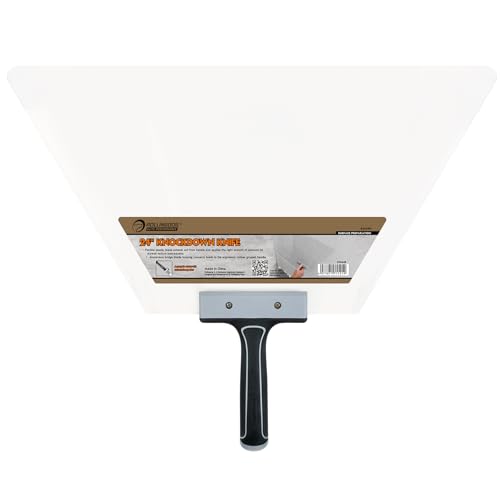
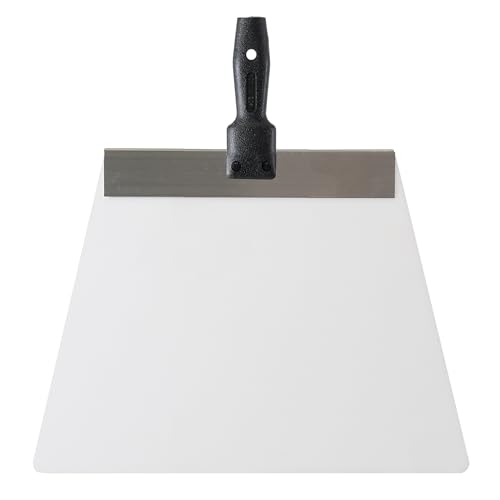
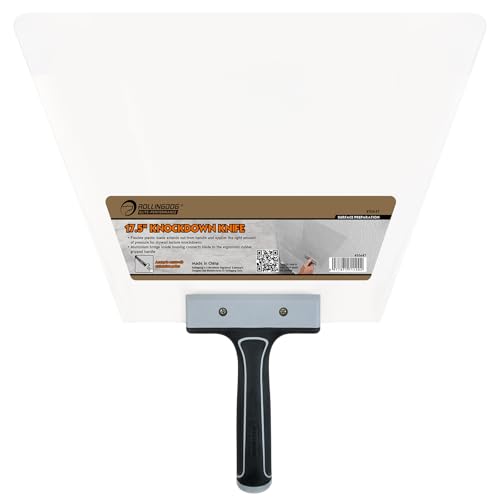
Choosing the right tool ensures smooth results. Look for a blade made from clear acrylic or polycarbonate plastic. These materials provide balanced flex, bending easily under light pressure to glide over bumps without scoring drywall paper. Clear plastic also lets you watch the texture pattern flatten as you pull.
Blade width determines your coverage speed and the number of seams you must blend. A 12-inch blade offers great agility in small bathrooms, hallways, and around door frames. An 18-inch or 24-inch blade covers large rooms and ceilings in fewer passes, leaving fewer overlapping lines.
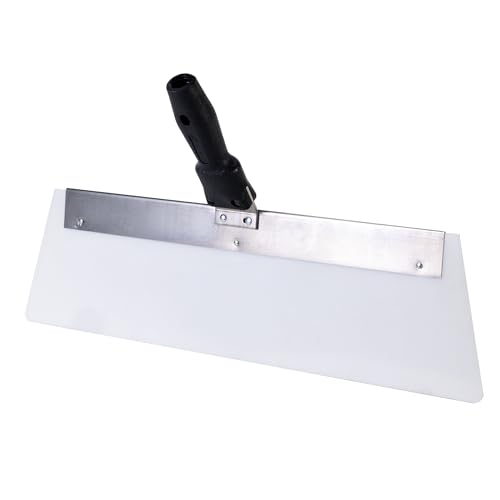
Check the handle features before buying. A soft rubber grip reduces hand fatigue during long wall sessions, and a threaded socket is necessary for attaching extension poles for ceiling work. Finally, choose a knife with a rigid metal bridge across the top spine. That bridge keeps the blade straight while allowing the bottom edge to flex freely against the wall.
- TAR Score10.0
TAR Score is a ranking system developed by TopAppliancesReviews.com. TAR score has no relationship or impact from any manufacturers or sales agent websites. Learn more
- BrandAdvance Equipment MFG CO
- TAR Score10.0
TAR Score is a ranking system developed by TopAppliancesReviews.com. TAR score has no relationship or impact from any manufacturers or sales agent websites. Learn more
- BrandROLLINGDOG

- TAR Score9.4
TAR Score is a ranking system developed by TopAppliancesReviews.com. TAR score has no relationship or impact from any manufacturers or sales agent websites. Learn more
- BrandAdvance Equipment MFG CO

- TAR Score9.4
TAR Score is a ranking system developed by TopAppliancesReviews.com. TAR score has no relationship or impact from any manufacturers or sales agent websites. Learn more
- BrandHyde
- TAR Score9.4
TAR Score is a ranking system developed by TopAppliancesReviews.com. TAR score has no relationship or impact from any manufacturers or sales agent websites. Learn more
- BrandAdvance Equipment MFG CO

- TAR Score8.8
TAR Score is a ranking system developed by TopAppliancesReviews.com. TAR score has no relationship or impact from any manufacturers or sales agent websites. Learn more
- BrandROLLINGDOG
- TAR Score8.6
TAR Score is a ranking system developed by TopAppliancesReviews.com. TAR score has no relationship or impact from any manufacturers or sales agent websites. Learn more
- BrandROLLINGDOG
- TAR Score8.4
TAR Score is a ranking system developed by TopAppliancesReviews.com. TAR score has no relationship or impact from any manufacturers or sales agent websites. Learn more
- BrandStorey Publishing
Last update on 2026-10-17 / Affiliate links / Images, Product Titles, and Product Highlights from Amazon Product Advertising API
FAQs
What drywall mud consistency works best for knockdown texture?
Mix standard joint compound with clean water until it reaches the consistency of thick pancake batter. It should pour smoothly without lumps. Mud that is too thick creates large, heavy globs that dry unevenly, while runny mud will sag and drip down the wall before it can set.
Can you use a metal drywall taping knife instead of a knockdown knife?
Metal taping knives work for tiny patch repairs, but they are not suitable for full rooms. Steel blades are stiff and heavy, making it easy to dig sharp corners into soft drywall. Knockdown knives use flexible plastic blades with rounded edges that bend under light pressure, preventing gouges and lines.
How do you clean and care for an acrylic knockdown blade?
Wash the blade immediately after use with warm water and a soft sponge. Avoid abrasive pads or metal scrapers, as scratches on the plastic edge will leave streak lines across future texture jobs. Store the tool hanging up or lying flat so the blade does not warp or bend permanently.
What should you do if the texture dries completely before wiping?
If the mud cures completely, do not force the blade across it. You can either leave the surface as an unflattened spatter texture, or wait until it dries overnight and sand down the sharp peaks using a pole sander with 120-grit paper. Wipe away the dust thoroughly before applying primer and paint.


Top Rated Best Quality Range Hoods: 2026 Expert Picks
The 12 Best Small Solar Generators 2026

10 Best Quality Semi Automatic Washing Machine of 2026 For Leak-Free Laundry

11 Best Small Washer Machine of 2026 For Everyday Laundry

12 Best Vibration Pads For Washing Machine of 2026 To Stop Walking and Shaking

11 Best Selling Front Load Washing Machine of 2026 For Quiet Odor-Free Laundry

11 Best Washing Machine For King Size Bedding of 2026 To Prevent Cycle Errors

10 Best Small Front Loader Washing Machine of 2026 For Tight Closets