
How to Use a Kitchen Knife Sharpener Without Damaging the Blade

Sharpening a dull kitchen knife is entirely straightforward and nothing to stress over. Set the tool flat on the counter, rest the heel (the back corner of the blade near the handle) in the slot, and pull the knife straight back toward you with light, steady pressure. Repeating this smooth motion three to five times restores a clean edge in seconds without chewing up the steel.
The exact routine changes slightly based on your blade and its current shape. Blades that struggle to cut through an onion skin need a pass through the coarse grinding slot first, while knives that just feel a bit sluggish only need the fine ceramic stage. Standard kitchen knives fit standard V-shaped slots, but serrated bread knives require specialized grooves to avoid snapping their teeth. Here is how to lock down your sharpener, work through the slots in order, and protect your edges.
Lock down your work surface and secure your grip before touching the blade
A knife sharpener cannot do its job if it slides across the counter while you work. Before you pick up your knife, take thirty seconds to prepare your workspace so the sharpener stays completely motionless. Any sudden shift during a stroke can scratch the side of the blade, ruin the cutting edge, or cause the knife to jump off the counter.
Set up your station using this safety checklist:
- Wipe the counter dry: Clear away all water droplets, stray vegetable peelings, and cooking oil. Even a few drops of water beneath a rubber foot can cause a sharpener to hydroplane when you pull a blade through.
- Set the sharpener at waist height: Work on a flat, solid surface like a clean countertop or a sturdy kitchen table. Avoid low coffee tables or cramped chopping boards where your arm movement feels restricted.
- Anchor the non-slip base: Place the sharpener down and give it a firm push with your bare hand. If your sharpener has a clamp or a lever-action suction base, press it down firmly on a smooth surface and engage the latch until it locks tight.
- Position your guide hand behind the safety barrier: Grip the sharpener handle firmly with your non-dominant hand. Keep your fingers, thumb, and knuckles tucked securely behind the protective guard so they never cross into the path of the blade.
- Clear your pulling path: Make sure there are no spice jars, drinking glasses, or dish racks directly behind the sharpener. Your knife hand needs several inches of open counter space to complete a smooth pull without hitting an obstacle.
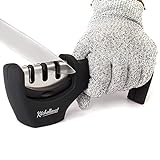
If you feel nervous holding the unit, put on a cut-resistant kitchen glove on your non-knife hand. Stand square to the counter with your feet shoulder-width apart. Standing firmly balanced keeps your upper body steady, which makes it much easier to pull the knife straight back without wobbling.
Pull the knife smoothly from heel to tip in one single motion
Sharpening a knife with a manual pull-through tool is all about consistent rhythm. You want the abrasive surfaces inside the slot to shave away dull metal evenly along the entire length of the blade. Rushing the stroke or hesitating in the middle creates dips and uneven flat spots along the cutting edge.
- Seat the heel deep in the slot: The heel is the back corner of the blade near the handle. Lower the blade heel straight down into the center of the sharpening slot until the cutting edge touches the abrasive rollers or blades. Keep the knife handle level with the countertop.
- Keep the blade perfectly vertical: Align the knife so the spine points straight up at the ceiling at a ninety-degree angle to the counter. If you tilt the knife to the left or right, you will grind away one side of the edge while dulling the other side.
- Draw the blade backward with gentle pressure: Pull the knife straight back toward your chest in a steady, deliberate motion. Apply only light downward pressure, about the same weight you would use to slice a soft peach. Let the abrasive material inside the slot do the cutting rather than forcing the steel down into the unit.
- Raise your elbow slightly as you reach the curve: Most chef knives curve upward near the tip. As that curved belly enters the slot, lift your knife hand and elbow slightly upward so the edge maintains continuous, flat contact with the sharpeners. Do not let the tip slam downward into the bottom of the slot.
- Exit smoothly at the tip: Pull the very point of the knife cleanly out of the slot without snapping or twisting your wrist. Once the tip clears the abrasive, lift the knife up and return to the heel to start your next pass.
Each full pull should take about two to three seconds for an eight-inch chef knife. Keep your pulling speed smooth and steady from the heel all the way to the tip. If the blade chatters or stutters inside the slot, you are either pulling too fast or pressing down too hard.
Work through the slots from coarse grinding to fine polishing
Most pull-through kitchen sharpeners feature two, three, or four distinct slots. These slots are numbered or labeled by stage, and following the correct order is the difference between a razor-sharp edge and a scratched-up blade. Sharpening works by taking away dull steel to form a clean point, then polishing that point so it glides through food.
The coarse stage uses rough grinding materials like tungsten carbide or rough diamond bars. This slot acts like heavy-grit sandpaper. It aggressively strips away damaged steel, reshapes rounded bevels (the angled cutting edge on either side of the blade), and removes small nicks. You only need the coarse slot when your knife is genuinely dull, meaning it slides across onion skins without biting or squashes a ripe tomato instead of slicing it.
The medium stage, if your unit has one, uses finer diamond abrasives or hard ceramic to smooth out the deep scratch marks left by the coarse slot. It tightens the cutting point and begins aligning the fresh steel.
The fine stage uses smooth ceramic polishing rods. As you pull the blade through the coarse slots, the grinding process pushes a burr (the microscopic wire edge or curved sliver of metal that forms on the opposite side during sharpening) across the blade. The ceramic slot gently strips off that rough wire edge and polishes the metal to a clean, slick finish.
Here is the routine to follow based on how dull your knife feels:
- For very blunt or damaged knives: Pull the blade through the coarse grinding slot three to five times. Wipe the blade with a towel, then make three to five passes through the fine ceramic polishing slot to remove the burr.
- For routine weekly touch-ups: Skip the coarse slot entirely. Making three light passes through the fine ceramic slot once a week realigns the edge without grinding away valuable blade steel.
Steel hardness also influences how your knife responds to these slots. Tough German knives made from rust-resistant, easy-to-clean stainless steel, such as those found in sturdy German knife sets, respond very well to standard manual sharpeners because their metal is slightly softer and forgiving. In contrast, high-carbon metal found in delicate Japanese chef knives is much harder and often sharpened to a steep 15-degree slicing edge per side. Running hard Japanese steel through an aggressive carbide slot can chip the edge, so check your sharpener manual to ensure the preset angle matches your knife style before you begin.
Stop sawing back and forth to keep from chewing up your edge
The most common mistake home cooks make with a pull-through sharpener is treating it like a handsaw. Moving the knife back and forth inside the slot destroys the blade geometry. Sharpening slots contain angled carbide blades or ceramic rods designed to cut in one direction only. When you push the knife forward against those edges, the blade catches, gouges deep notches into the metal, and can bend the delicate tip.
Another frequent mistake is applying heavy downward force. You might think pressing hard sharpens the knife faster, but the opposite is true. Heavy pressure forces the blade too deep into the V-shaped notch, stripping away large curls of metal and leaving deep ripples along the bevel. Heavy pressure also increases the risk that the knife slips out of the groove and shoots across your countertop. Use light, even pressure and let the abrasive stones do the work.
Be careful about what kinds of blades you insert into standard slots. Standard sharpening slots are shaped strictly for straight-edged kitchen knives like chef knives, santokus, and paring knives. Never run a serrated bread knife through a coarse carbide slot. The rigid carbide teeth will grind off the scalloped points of the bread knife, turning your expensive bread slicer into a ruined, wavy piece of scrap metal. Kitchen shears and scissors also have single-beveled blades that require specialized sharpening slots; forcing them through a standard double-sided knife slot will instantly dull them.
Finally, always pull the knife straight back. Do not twist the handle or lean the blade to the side as you pull. Leaning the knife rounds off the sharp corner you are trying to create, leaving you with a blunt edge that feels worse than when you started.
Check your edge on scrap paper instead of using your thumb
Never run your thumb or finger along the cutting edge to see if a knife is sharp. Even a partially sharpened blade can easily slice into your skin, and testing with your finger does not tell you if the edge will cleanly cut food. Use simple, safe kitchen tests to confirm the sharpness of your blade.
Use these reliable methods to check your cutting edge:
- The printer paper test: Hold a loose sheet of scrap printer paper vertically in one hand. Place the heel of the knife against the top edge of the paper and slice gently downward and outward. A sharp knife will slice through the paper with a quiet whisper, creating a clean cut without catching or tearing. If the knife rips the paper near the heel or catches in the middle, run the blade through the ceramic fine slot two more times to clear away leftover burrs.
- The ripe tomato test: Set a ripe tomato or grape on your cutting board. Rest the blade on top of the skin without pressing down with your hand. Draw the knife backward across the skin using only the physical weight of the knife. A properly sharpened blade will bite through the slick skin immediately without crushing the fruit or spraying juice across the board.
- The overhead light test: Hold the knife directly under a bright kitchen light with the sharp edge pointing straight up at the ceiling and the spine pointing at the floor. Look down along the edge. A dull knife has a rounded edge that reflects bright pinpricks or ribbons of white light back into your eyes. A truly sharp edge is microscopic and flat, so it reflects zero light and looks like an invisible dark line.
Once your knife passes the paper or tomato test, wash the blade thoroughly with warm water and mild dish soap. Sharpening leaves microscopic metal dust along the steel that you do not want ending up in your dinner. Dry the knife immediately with a clean kitchen towel before putting it away.
Choose a stable manual sharpener with preset angles for quick kitchen maintenance
If you want fast slicing power without mastering traditional water stones, a manual pull-through sharpener is the most practical tool for everyday kitchen prep. These sharpeners take the guesswork out of kitchen maintenance by locking the sharpening abrasives into fixed angles. That means you do not have to guess how many degrees you are holding the knife off the table; the internal guides keep the angle steady for you on every stroke.
When picking out a manual sharpener for your kitchen, check the construction of the base first. Look for a unit that features wide, textured rubber pads along the entire bottom or a heavy-duty suction mechanism that locks tight to smooth laminate or stone counters. A sharpener that wobbles or skitters across the counter is frustrating to use and creates an unnecessary safety hazard.
Make sure the unit provides at least two distinct sharpening stages: a coarse slot (usually carbide or coarse diamond) to repair dull knives, and a fine ceramic slot to polish the metal. Sharpeners with comfortable, roomy handles allow your guide hand to grip the unit firmly while keeping your fingers safely behind a tall protective barrier. Once you restore your knives to working sharpness, storing them securely on a magnetic knife block prevents the edges from knocking against other tools inside crowded kitchen drawers, keeping them sharp much longer between touch-ups.

- TAR Score9.4
TAR Score is a ranking system developed by TopAppliancesReviews.com. TAR score has no relationship or impact from any manufacturers or sales agent websites. Learn more
- BrandACCUSHARP
- TAR Score9.0
TAR Score is a ranking system developed by TopAppliancesReviews.com. TAR score has no relationship or impact from any manufacturers or sales agent websites. Learn more
- BrandKITCHELLENCE

- TAR Score8.8
TAR Score is a ranking system developed by TopAppliancesReviews.com. TAR score has no relationship or impact from any manufacturers or sales agent websites. Learn more
- BrandFANERFUN

- TAR Score8.8
TAR Score is a ranking system developed by TopAppliancesReviews.com. TAR score has no relationship or impact from any manufacturers or sales agent websites. Learn more
- BrandSharp Pebble
- TAR Score8.8
TAR Score is a ranking system developed by TopAppliancesReviews.com. TAR score has no relationship or impact from any manufacturers or sales agent websites. Learn more
- BrandSharp Pebble

- TAR Score8.8
TAR Score is a ranking system developed by TopAppliancesReviews.com. TAR score has no relationship or impact from any manufacturers or sales agent websites. Learn more
- BrandNarcissus

- TAR Score8.6
TAR Score is a ranking system developed by TopAppliancesReviews.com. TAR score has no relationship or impact from any manufacturers or sales agent websites. Learn more
- Brandlongzon

- TAR Score8.6
TAR Score is a ranking system developed by TopAppliancesReviews.com. TAR score has no relationship or impact from any manufacturers or sales agent websites. Learn more
- BrandSHARPAL

- TAR Score8.6
TAR Score is a ranking system developed by TopAppliancesReviews.com. TAR score has no relationship or impact from any manufacturers or sales agent websites. Learn more
- Brandlongzon

- TAR Score8.2
TAR Score is a ranking system developed by TopAppliancesReviews.com. TAR score has no relationship or impact from any manufacturers or sales agent websites. Learn more
- BrandTechnoLegend
Last update on 2026-10-25 / Affiliate links / Images, Product Titles, and Product Highlights from Amazon Product Advertising API
FAQs
Do I pull the knife toward me or push it back and forth?
Always pull the knife toward you in one smooth, continuous motion from the heel to the tip. Never push the blade forward or saw back and forth inside the slot. Pushing forward catches the steel against the abrasives, which nicks the edge, ruins the preset angle, and can cause the blade to jump out of the slot.
Which slot should I put my knife into first?
Start in the coarse slot only if your knife is completely dull, chipped, or struggling to cut soft vegetables. The coarse slot cuts away metal quickly to shape a fresh edge. If your knife is already in decent shape and just needs a quick touch-up, skip the coarse slot entirely and start in the fine ceramic slot to polish the steel without grinding away extra metal.
How hard should I press down while pulling the blade?
Use very light downward pressure, letting the weight of the knife do most of the work. You only need enough contact to keep the cutting edge touching the abrasive rollers inside the slot. Pressing down hard strips away too much metal, creates deep scratches along the blade bevel, and can warp the thin edge of your knife.
Can I sharpen a serrated bread knife in a standard pull-through sharpener?
No, you should never run a serrated bread knife through standard V-shaped sharpening slots. The rigid carbide blades inside standard slots will grind down the raised teeth of the serrations and ruin the knife permanently. Serrated knives require specialized ceramic slots or a dedicated handheld sharpening rod designed to fit between the individual scalloped teeth.


Top Best Quiet Portable Generator Electric Start 2026 - (2026 Updated)

The 10 Best Portable Power Station For Tailgating 2026

10 Best Washing Machine For King Size Comforter of 2026 For Bulky Bedding

11 Best Semi Automatic Washing Machine Under 10000 of 2026 For Apartments and RVs

The Best Concrete Floor Buffer 2026 - Top Choices

Best Cooling Fan with HEPA Filter: Our 2026 Top Picks for Cleaner Air

Best poulan chainsaw 2026 - Reviews & Buying Guides

Value Picks: 10 Vitamix 5300 Best Price of 2026




