
How to Use a Butterfly Knife Without Cutting Your Hands

Most people assume that flipping a butterfly knife requires lightning-fast reflexes and inevitably leads to cut fingers. That is simply not true. Safe flipping relies on one fundamental rule: always grip the dull-side handle and guide the knife with steady wrist momentum. Because the dull spine faces your fingers while the sharpened edge swings freely away from your hand, you can open and close the knife smoothly without a single nick.
How quickly this becomes second nature depends on three clear factors. Practicing with a dull trainer knife or taping a sharp edge eliminates the fear of cuts while hands build muscle memory. Handle motion also depends on the hinge screws, since overtightened pivots stick while loose screws wobble out of line. Spotting the safe handle before touching the knife makes learning smooth, predictable, and completely safe.
The Short Version
- Find the safe handle first: Always hold the dull-side handle so only the unsharpened blade spine can touch your knuckles during a swing.
- Rely on wrist momentum: Move the handles using light, flexible wrist flicks rather than stiff arm motions.
- Protect your skin during practice: Cover a live cutting edge with two layers of painter tape, or practice with a blunt trainer knife.
- Flip over soft ground: Stand over a bed, couch, or carpeted rug so falling knives do not bend hinge screws, mar floors, or injure your feet.
Butterfly Knife Anatomy and Finding the Safe Handle
To use a butterfly knife without cutting your fingers, you must understand how its parts interact. A butterfly knife, traditionally called a balisong, uses two handles that rotate around two separate hinge screws (pivot screws). When the knife is closed, the handles enclose the blade. When opened, the handles swing around on their hinge screws and meet to form a solid grip.
Safe handling depends on knowing which handle you are holding. One handle protects your fingers, while the other handle can cut your skin.
The safe handle (the dull-side handle) connects to the same side as the dull, flat spine of the blade. The spine has no sharp edge. When you hold the safe handle and flip the knife open or shut, any contact between the swinging blade and your hand involves only this smooth spine. The flat steel can bump your knuckles without cutting your skin.
The bite handle (the sharp-side handle) connects to the sharpened cutting edge. If you hold the bite handle and attempt an opening flick, the sharp edge rotates directly into your knuckles. Grabbing the bite handle by mistake is the primary cause of cuts among beginners.
Between the handles and the blade tang, small stop pins (tang pins) prevent the handles from slamming against the blade steel. At the bottom of one handle, a handle clasp (a latch) locks the knife shut.
Never rely solely on the clasp to identify the safe handle, because some designs place the clasp on the safe handle. Always inspect the blade grind first. Find the sharp edge, trace it back to its hinge screw, and hold the opposite, dull-side handle.
The Standard One-Handed Open Flick Step by Step
The basic forward flick is the foundational move for butterfly knife handling. It is simple, reliable, and teaches your hand how to use handle momentum without brute force. Practice this sequence slowly before building speed.
- Set your grip on the safe handle: Hold the closed knife vertically by the dull-side handle. Pinch the upper third of the handle between your thumb and index finger, keeping your palm open. Release the handle clasp so the bite handle hangs freely.
- Flick the knife forward: Snap your wrist forward in a gentle throwing motion while keeping your elbow steady. The bite handle and blade will swing outward and upward until the dull spine bumps against the back of your knuckles. Because you hold the safe handle, this impact cannot cut you.
- Rotate the handle: As soon as the spine taps your knuckles, roll the safe handle a half turn (180 degrees) between your thumb and index finger. This rotation moves your fingers clear of the gap between the two handles.
- Snap the handles shut: Flick your wrist backward toward your body. This reverse momentum swings the bite handle around the hinge screw, bringing both handles together against your palm. Close your fingers around both handles against the stop pins. The blade is now locked open.
If the knife stalls mid-swing, you are likely gripping the safe handle too tightly. A rigid grip stops the handles from rotating smoothly. Hold the handle firmly enough to maintain control while letting wrist momentum complete the arc.
Safe Closing Technique Using Handle Momentum
Closing a butterfly knife uses the reverse motion of the opening flick. The main challenge is avoiding a handle pinch, which happens when skin is trapped between the closing handles and the stop pins.
- Confirm your starting grip: Ensure your fingers hold only the safe handle. Release the bite handle entirely. If you hold the bite handle while closing the knife, the sharp edge will swing directly into your palm.
- Flick the blade upward and back: Snap your wrist upward. This pops the bite handle and blade up and backward over your hand until the dull spine contacts the back of your knuckles. Let momentum carry the handle over without forcing it down.
- Twist your hand outward: Give your wrist a gentle quarter turn outward. This moves your palm and fingers away from the open channel where the blade is about to rest.
- Snap your wrist forward to close: Flick your wrist forward and downward. The bite handle will swing over the hinge screw and meet the safe handle, enclosing the sharp blade inside. Squeeze the handles together and fasten the handle clasp.
Watch your thumb position during the final snap. Beginners often leave their thumb extended across the handle frame, causing a painful pinch when the handles meet. Keep your thumb pressed flat along the outer side of the safe handle throughout the move.
Safe Practice Habits: Blade Taping, Drop Zones, and Hardware Care
Developing clean habits early prevents accidental cuts and keeps your knife in proper working order. Adopt these practical steps during practice:
- Tape the live edge: Wrap two strips of painter tape or electrical tape over the cutting edge of a sharp blade, covering the tip. This creates an immediate protective barrier while keeping the dull spine visible so you can track handle orientation.
- Set up a soft drop zone: Never practice over concrete, tile, or hardwood floors. Hard impacts chip blade tips and bend stop pins. Practice over a bed, sofa, or thick carpet, and keep your feet pulled back out of the drop path.
- Adjust hinge screw tension: The hinge screws (pivot screws) determine how freely handles swing. If screws are too loose, handles wobble and strike the blade. If too tight, handles bind mid-swing. Snug the hinge screws so the handles swing smoothly under their own weight with minimal side-to-side play.
- Keep pivots clean and lightly oiled: Pocket lint and dust accumulate around pivot washers. Wipe the pivot area clean regularly. If your blade uses high-carbon or tool steel (such as D2), which is harder metal that stays sharp longer but requires dry wiping and light oiling to prevent rust spots, keep the metal dry and lubricated. While kitchen cutlery rests safely on knife block and knife set combos between meal preps, a balisong is handled constantly and requires regular pivot oiling to maintain smooth rotation.
Carry Limits and Checking Local Knife Laws
Before taking a butterfly knife outside your home, research your state and municipal knife laws. Butterfly knives face stricter legal restrictions across the United States than typical utility knives.
Many jurisdictions classify butterfly knives under the same statutes as gravity knives or automatic switchblades. A gravity knife is defined under many penal codes as any folding blade that opens via centrifugal force or gravity through a flick of the wrist. Because a butterfly knife opens using that exact wrist momentum, it often falls under these statutory bans.
Unlike a standard EDC (an everyday carry pocket knife) featuring a thumb stud and a liner lock (the spring bar inside the handle that snaps behind the open blade to stop it from closing on your fingers), a butterfly knife draws immediate scrutiny from law enforcement. In several states, owning and flipping a butterfly knife inside your private residence is legal, but carrying it concealed in public is treated as a weapons violation.
Other areas enforce strict blade length limits, restricting public carry of folding blades longer than 3 inches or 3.5 inches. Check your state penal code, county ordinances, and municipal laws before carrying a live butterfly knife in public. When in doubt, keep live butterfly knives at home for practice and carry a standard utility folder for daily tasks.
What to Look for in a Practice Butterfly Trainer
The safest way to master flipping mechanics without cuts is to start with a dedicated trainer. A trainer is an unsharpened practice tool that features a blunted metal blade in place of a live cutting edge. Because the trainer cannot cut skin, you can build muscle memory and finger timing without fear of injury.
When choosing a trainer, prioritize stainless steel (rust-resistant, easy-to-clean metal) construction. Flimsy plastic or hollow aluminum models lack the weight needed to maintain momentum, making flips feel jerky and unnatural. A trainer that closely matches the weight and balance of an authentic folding knife ensures that your flipping habits transfer accurately to a real blade later.
Check the hardware before buying. Reliable trainers feature reinforced hinge screws, solid stop pins, and smooth copper or bronze washers at the pivots to provide a fluid swing. Look for models equipped with a spring latch. A spring clasp stays pushed out of the way during movement, preventing it from rattling against the handles or catching on your fingers during a flick.

- TAR Score10.0
TAR Score is a ranking system developed by TopAppliancesReviews.com. TAR score has no relationship or impact from any manufacturers or sales agent websites. Learn more
- BrandMajosta
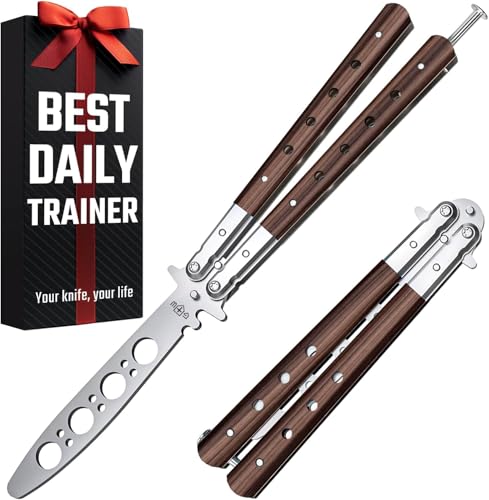
- TAR Score9.2
TAR Score is a ranking system developed by TopAppliancesReviews.com. TAR score has no relationship or impact from any manufacturers or sales agent websites. Learn more
- BrandGOOD WORKER

- TAR Score9.0
TAR Score is a ranking system developed by TopAppliancesReviews.com. TAR score has no relationship or impact from any manufacturers or sales agent websites. Learn more
- BrandVORNNEX

- TAR Score8.8
TAR Score is a ranking system developed by TopAppliancesReviews.com. TAR score has no relationship or impact from any manufacturers or sales agent websites. Learn more
- BrandGrand Way

- TAR Score8.6
TAR Score is a ranking system developed by TopAppliancesReviews.com. TAR score has no relationship or impact from any manufacturers or sales agent websites. Learn more
- BrandZaccheus Entertainment

- TAR Score8.6
TAR Score is a ranking system developed by TopAppliancesReviews.com. TAR score has no relationship or impact from any manufacturers or sales agent websites. Learn more
- BrandDIMROM

- TAR Score8.4
TAR Score is a ranking system developed by TopAppliancesReviews.com. TAR score has no relationship or impact from any manufacturers or sales agent websites. Learn more
- BrandN/A

- TAR Score8.0
TAR Score is a ranking system developed by TopAppliancesReviews.com. TAR score has no relationship or impact from any manufacturers or sales agent websites. Learn more
- BrandLittle World

- TAR Score8.0
TAR Score is a ranking system developed by TopAppliancesReviews.com. TAR score has no relationship or impact from any manufacturers or sales agent websites. Learn more
- BrandAIFUSI

- TAR Score7.8
TAR Score is a ranking system developed by TopAppliancesReviews.com. TAR score has no relationship or impact from any manufacturers or sales agent websites. Learn more
- BrandBILYSKEP

- TAR Score5.8
TAR Score is a ranking system developed by TopAppliancesReviews.com. TAR score has no relationship or impact from any manufacturers or sales agent websites. Learn more
- BrandMajosta
Last update on 2026-10-17 / Affiliate links / Images, Product Titles, and Product Highlights from Amazon Product Advertising API
FAQs
How do I tell which handle is safe if my knife does not have a latch?
Look closely at the blade to locate the sharp cutting edge. Follow the dull spine on the opposite side down to the hinge screw. The handle attached to that dull spine is your safe handle. You can wrap a small piece of colored tape or slip a tiny rubber band near the base of the safe handle so you can recognize it instantly without checking the blade edge every time.
Why do my knife handles feel stiff and refuse to swing freely?
Handles usually bind because the hinge screws are over-tightened or because dirt has accumulated around the pivot washers. Use the proper driver to loosen each hinge screw by a tiny fraction of a turn until each handle swings under its own weight. Apply a single drop of light knife oil to the pivot washers, work the handles back and forth, and wipe away any excess oil with a clean paper towel.
Can I practice safely if my knife is already sharpened?
Yes, you can make a sharpened blade safe for practice by wrapping two layers of thick blue painter tape or electrical tape over the sharp cutting edge. Press the tape firmly over the apex of the blade from the base to the tip. This blunts the edge completely during accidental drops or finger bumps while allowing the knife to swing with its true weight and balance.
How is a butterfly knife different from an everyday carry pocket knife?
An EDC (an everyday carry pocket knife) typically has a single handle, opens with a thumb stud or flipper tab, and locks in place with a mechanism such as a liner lock (the spring bar inside the handle that snaps behind the open blade to stop it from closing on your fingers). A butterfly knife features two split handles that rotate around two separate hinge screws, enclosing the blade when shut and meeting to form the grip when open. This two-handle design relies on wrist momentum rather than mechanical locks.


Top Rated Best Quality Range Hoods: 2026 Expert Picks

The 12 Best Small Solar Generators 2026

10 Best Quality Semi Automatic Washing Machine of 2026 For Leak-Free Laundry

11 Best Small Washer Machine of 2026 For Everyday Laundry

12 Best Vibration Pads For Washing Machine of 2026 To Stop Walking and Shaking

11 Best Selling Front Load Washing Machine of 2026 For Quiet Odor-Free Laundry

11 Best Washing Machine For King Size Bedding of 2026 To Prevent Cycle Errors

10 Best Small Front Loader Washing Machine of 2026 For Tight Closets






