
How to Sharpen a Folding Knife with a Stone?

Sharpening a folding blade on a bench stone requires holding the cutting edge at roughly a twenty-degree angle and pushing it forward from base to tip using light, smooth strokes. How long that work takes changes entirely with how dull or chipped the steel has become. Once a tiny rough ridge of rolled metal forms along the opposite side, flip the knife over to balance both sides evenly.
The exact routine also depends on the stone material on your workbench, since natural stones often need water or honing oil while diamond plates work dry. Blade shape plays a big role as well, because sharpening a curved pocket knife tip requires tilting the handle up slightly to keep the angled edge flat against the surface. A few simple habits will keep the blade secure in your hand and restore a clean, working edge without scratching the finish.
Lock the Blade Open and Steady Your Stone Base
Pocket knives fold for convenience, but that folding joint introduces real hazards during manual sharpening. If you push the blade at an awkward angle, the hinge can pivot closed directly onto your fingers. Before touching steel to stone, verify that your folding knife is locked open firmly. Check the liner lock (the spring bar inside the handle that snaps behind the open blade to stop it from closing on your fingers) or lockback mechanism. Wiggle the blade gently with your fingers clear of the cutting path to confirm there is zero play. If the lock slips or feels loose, tighten the pivot screw before you start.
Next, secure your sharpening surface. A stone that slides across a table ruins your bevel angle and can send an edge slipping toward your hands. Place the stone on a level counter or workbench using a rubber stone holder, silicone mat, or damp washcloth folded flat beneath the block. The stone should not budge under moderate hand pressure. Many kitchen knife setups rely on stable bases for secure grip, and your pocket sharpening workstation requires that same solid footing.
Prepare your stone lubricant according to its surface material. Water whetstones must soak in clean water for ten to fifteen minutes until bubbles stop rising, while splash-and-go stones only need a surface mist. Traditional oil stones need a few drops of light mineral honing oil spread across the grit to float away tiny metal shavings called swarf. Diamond plates are the easiest to manage, as you can run them completely dry or with a splash of water.
Use this pre-sharpening checklist before making your first stroke:
- Lock engagement: confirm the lock bar sits squarely behind the blade tang with no wobble.
- Clean blade: wipe off pocket lint, dirt, and tape residue using warm soapy water, then dry thoroughly.
- Base grip: set your stone on a non-slip rubber base or damp cloth so it cannot slide.
- Lubricant ready: soak water stones, add mineral oil to oil stones, or mist your diamond plate.
- Clear space: keep your elbows free so your arms move in smooth, steady lines.
Match the Factory Edge Using Everyday Household Items
Every knife blade narrows down to a bevel (the angled cutting edge). Most everyday carry pocket knives leave the factory with an angle of roughly twenty degrees per side. That twenty-degree angle creates a sturdy utility edge that can carve wood, open boxes, and cut rope without chipping. In comparison, delicate kitchen blades often feature a steep 15-degree slicing edge per side, similar to what you find on German high-carbon steel premium knife block sets. Tilting your folding knife too high creates a blunt wedge, while tilting too low scratches the blade flats without sharpening the apex.
Finding twenty degrees by eye feels tricky at first, but everyday objects make it simple. Place the blade flat on the stone, then lift the spine and slide two standard coins beneath the back of the blade. The height of two stacked pennies sets the blade at roughly twenty degrees for an average pocket knife. A folded cardboard matchbook tucked under the spine gives you that exact same clearance. Once you feel that height in your fingers, slide the coins away and lock your wrist.
You can confirm your angle using the black marker trick. Color the entire bevel along both sides of the blade with a permanent marker. Set the knife on the stone at your chosen tilt and push it forward across the grit once with light pressure. Inspect the ink under a bright light:
- Ink removed only from the top shoulder: your angle is too low, meaning you are grinding the blade body.
- Ink removed only from the extreme cutting tip: your angle is too steep, meaning you are blunting the edge.
- Ink removed evenly across the entire bevel: your angle matches the factory edge.
Pay close attention to the curved belly of your folding knife. Pocket knives usually have a straight section near the heel that curves upward into a sweeping point. To maintain that exact twenty-degree contact along the curved tip, gently raise your wrist and the knife handle upward by a fraction of an inch as you reach the curve. Raising the handle keeps the curved edge flat against the stone so the point stays sharp and does not round off.
Push the Blade Forward from Heel to Tip Smoothly
When sharpening a folding knife on a stone, push the cutting edge forward across the grit as if slicing a thin layer off the stone. This movement is called an edge-leading stroke. Pushing the edge forward keeps the steel firmly supported and prevents giant wire edges from forming. Dragging the blade backward can gouge soft water stones and leaves behind a ragged edge that folds over quickly during normal use.
Follow these sequential steps to execute a clean forward stroke:
- Set the blade at your verified twenty-degree angle across the coarse stone, starting with the heel (the back of the blade near the handle) resting near the close edge of the stone.
- Place the fingertips of your non-dominant hand lightly on the side of the blade near the cutting edge to steady it, keeping fingers clear of the stone surface.
- Push the blade forward and across the stone in one smooth diagonal sweep, moving from the heel out to the tip.
- Raise the knife handle slightly as the curved belly glides across the abrasive surface, ensuring the stone touches every millimeter of steel out to the point.
- Finish the stroke right as the tip reaches the far end of the stone, lifting the blade cleanly away rather than letting it roll off the edge.
- Repeat this forward motion for ten to fifteen strokes on this first side, keeping your wrist locked at that exact angle with light pressure.
Excessive downward pressure is a frequent mistake. Pressing hard does not sharpen the knife faster. Heavy force flexes the blade, damages the stone, and can cause your hand to slip off the compact handle. Let the abrasive particles do the cutting work. The stroke should sound like a crisp, steady hiss across the stone.
Feel for the Rolled Steel Ridge Across the Edge
You cannot guess when a side is done by counting strokes alone. You must confirm the formation of a burr (the tiny rough ridge of rolled steel that forms on the opposite side of the blade during sharpening). As the abrasive stone removes worn metal and creates a new flat bevel, the microscopic apex of the steel becomes so thin that it folds over away from the stone. Feeling this burr proves that you have ground completely through the old, dull edge.
To verify the burr, stop after ten to fifteen passes. Turn the knife so the side facing away from the stone is facing upward. Place the pad of your thumb on the flat face of the blade and slide your thumb gently outward past the cutting edge. Never run your finger along the length of the edge, as that can slice your skin. Always move your thumb perpendicularly from the spine outward past the edge. If the burr has formed, you will feel a distinct, scratchy catch or small wire lip along the steel.
Inspect the entire length of the blade from the heel to the tip:
- If you feel the rough wire ridge along the entire opposite side, you have finished that side.
- If you feel the ridge near the heel but the tip feels smooth, make three or four extra sweeping strokes focusing on raising your handle through the curve.
- If you feel no catch at all, return the knife to the stone and make another five to ten passes at your verified angle until the wire ridge appears.
Once you confirm a complete burr along the entire blade, flip the folding knife over. Sharpen the second side using the exact same angle, light pressure, and stroke count. You are now grinding the other side of the bevel until that thin wire ridge folds back over in the opposite direction. Once you feel the burr catch on your initial side, both faces of your knife bevel meet at a true, crisp point.
Polish the Edge and Check Sharpness on Paper
Now that you have formed a sharp apex, you must remove the weak wire burr and refine the steel. If you leave that rolled wire ridge on the blade, it will fold over the first time you slice cardboard, leaving the knife feeling dull right away. Refining the edge means switching to a finer grit (stone roughness level) to buff away the rough micro-teeth left by the coarse surface.
Follow these steps to finish your edge and confirm its cutting quality:
- Move to your fine stone surface, typically around 600 to 1000 grit, or rinse your water stone clean of coarse slurry.
- Make five alternating single strokes per side, pushing edge-leading from heel to tip with very light hand pressure. Alternating sides weakens the wire burr until it snaps cleanly off the apex.
- Lighten your touch further for the last two strokes per side, letting barely more than the weight of the folding knife touch the stone.
- Strop the blade on a strip of leather, a piece of thick denim, or clean cardboard pulled flat on your table. Drag the blade backward (edge-trailing) at your twenty-degree angle for ten passes per side to polish the bevel.
- Wipe the blade clean with a soft dry cloth, paying close attention to the folding joint to ensure grit particles do not remain inside the handle pivot.
Confirm the sharpness of your folding knife using a standard sheet of copy paper. Hold the paper loosely by one corner between your thumb and index finger. Rest the heel of your folding knife on the top edge of the paper at a slight angle and push gently downward and forward without sawing. A properly sharpened blade will bite into the paper instantly and glide through the sheet from heel to tip without snagging, ripping, or hanging up.
If the blade tears the paper near the tip or catches halfway through, examine that section of the blade under a direct light. Look straight down at the cutting edge. A dull spot or leftover burr will reflect light as a shiny silver dot or glint. A sharp apex does not reflect any light because it comes to a microscopic point. If you spot a bright reflection, make three more light passes on your fine stone or strop along that exact section and verify the cut again.
Choose Dual Grit Stones with Stable Non-Slip Bases
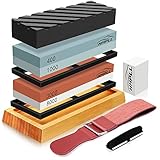
Restoring a pocket knife requires the right combination of coarse shaping and fine polishing abrasives. Single-grit stones force you into an annoying compromise: coarse stones reshape nicked edges quickly but leave a jagged finish, while fine stones take far too long to grind out damage. A dual-grit stone solves this by giving you a coarse surface (around 300 to 400 grit) on one side to establish your bevel, and a fine surface (around 600 to 1000 grit) on the reverse side to refine and hone the cutting edge.
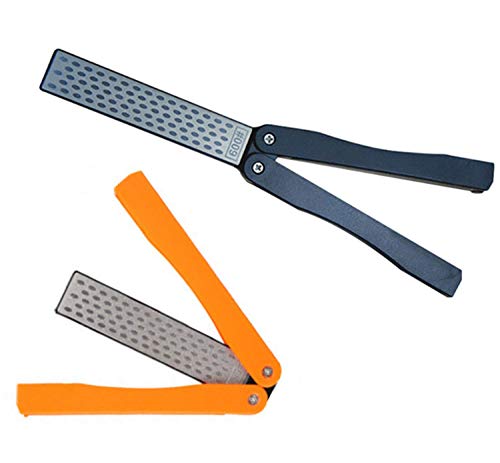
When selecting a stone for folding knives, look for a model that includes a dedicated rubber or silicone base. Pocket knives have short handles, meaning your hands work in close quarters. A base that grips the tabletop prevents unwanted shifts that ruin your bevel or cause slips. Bench stones that measure five to eight inches long provide plenty of room for smooth heel-to-tip strokes, while small folding diamond sharpeners fit easily into a glove box, pocket, or camping pack for field repairs.
Consider the type of steel used in your folding knife before choosing your sharpening stone material. Standard stainless steel blades (such as rust-resistant, easy-to-clean metal like 420 or 8Cr13MoV) sharpen readily on traditional aluminum oxide water stones or oil stones. In contrast, harder modern pocket steels like high-carbon or tool steel (such as D2, a harder metal that stays sharp longer but requires dry wiping and light oiling to prevent rust spots) respond much faster to diamond abrasive plates. Diamond stones stay flat over years of use and cut through wear-resistant tool steels without dishing or wearing hollow in the center.

- TAR Score9.2
TAR Score is a ranking system developed by TopAppliancesReviews.com. TAR score has no relationship or impact from any manufacturers or sales agent websites. Learn more
- BrandDMT (Diamond Machining Technology)

- TAR Score9.2
TAR Score is a ranking system developed by TopAppliancesReviews.com. TAR score has no relationship or impact from any manufacturers or sales agent websites. Learn more
- BrandPatelai

- TAR Score9.2
TAR Score is a ranking system developed by TopAppliancesReviews.com. TAR score has no relationship or impact from any manufacturers or sales agent websites. Learn more
- BrandIntelitopia
- TAR Score9.0
TAR Score is a ranking system developed by TopAppliancesReviews.com. TAR score has no relationship or impact from any manufacturers or sales agent websites. Learn more
- BrandHMPLL

- TAR Score9.0
TAR Score is a ranking system developed by TopAppliancesReviews.com. TAR score has no relationship or impact from any manufacturers or sales agent websites. Learn more
- BrandSmith's
- TAR Score8.8
TAR Score is a ranking system developed by TopAppliancesReviews.com. TAR score has no relationship or impact from any manufacturers or sales agent websites. Learn more
- BrandXILEWHZF

- TAR Score8.8
TAR Score is a ranking system developed by TopAppliancesReviews.com. TAR score has no relationship or impact from any manufacturers or sales agent websites. Learn more
- BrandDMT (Diamond Machining Technology)

- TAR Score8.6
TAR Score is a ranking system developed by TopAppliancesReviews.com. TAR score has no relationship or impact from any manufacturers or sales agent websites. Learn more
- BrandHonoson

- TAR Score8.6
TAR Score is a ranking system developed by TopAppliancesReviews.com. TAR score has no relationship or impact from any manufacturers or sales agent websites. Learn more
- BrandDMT (Diamond Machining Technology)
Last update on 2026-10-01 / Affiliate links / Images, Product Titles, and Product Highlights from Amazon Product Advertising API


Top Rated Best Quality Range Hoods: 2026 Expert Picks

The 12 Best Small Solar Generators 2026

10 Best Quality Semi Automatic Washing Machine of 2026 For Leak-Free Laundry

11 Best Small Washer Machine of 2026 For Everyday Laundry

12 Best Vibration Pads For Washing Machine of 2026 To Stop Walking and Shaking

11 Best Selling Front Load Washing Machine of 2026 For Quiet Odor-Free Laundry

11 Best Washing Machine For King Size Bedding of 2026 To Prevent Cycle Errors

10 Best Small Front Loader Washing Machine of 2026 For Tight Closets






