
How to Sharpen a Victorinox Knife to a Factory Edge

Sharpening a dull pocket or kitchen blade means sliding the steel at a 15 to 20 degree angle across a fine stone with light, smooth passes. That grinding step only matters if the cutting edge is genuinely blunt, because a folded rim just needs honing to straighten the metal without shaving steel away. Keeping that gentle tilt protects the polished sides from scratches while bringing back a clean, crisp cut.
The exact method also depends on what kind of knife sits on your counter. Small folding pocket tools have narrow edges that require steady fingers on a small handheld stone, whereas longer chef knives need wide, even strokes across a flat bench block. A wavy bread knife brings its own rule, since scalloped teeth must be refreshed one notch at a time. Here is how to match the right angle to your blade and bring back a keen factory edge safely.
The Short Version
- Hone before you grind: If your blade slides on slick food like tomato skin but has no chips, the edge is likely bent rather than blunt. Straighten it with a honing rod (a metal rod that realigns bent steel) before grinding away good metal.
- Match the factory angle: Tilt the blade between 15 and 20 degrees against your sharpening surface. This matches the factory bevel (the angled cutting edge) ground into Swiss steel at the factory.
- Use light, steady pressure: Sweep the blade smoothly from heel to tip across a fine sharpening stone or handheld ceramic slot. Heavy downward pressure scratches the polished sides and rounds over the apex.
- Treat serrated blades individually: Sharpen wavy bread knives or serrated paring knives by polishing the individual hollow grooves with a narrow round ceramic rod, rather than rubbing the blade flat on a bench stone.
Honing Versus Sharpening: Is Your Blade Bent or Dull?
When a Victorinox knife stops slicing cleanly, most people assume the blade is dull. In many cases, the metal is simply bent out of line. Understanding the difference saves your knife from unnecessary wear and keeps it performing like new for decades.
Victorinox crafts cutlery from high-grade stainless steel (a rust-resistant, easy-to-clean metal). This alloy provides great toughness and resists chipping when chopping against cutting boards. Because the metal is slightly softer than brittle specialty steels, the microscopic cutting apex flexes to the left or right during routine use. This condition is called a rolled edge.
Honing means straightening the edge without shaving metal off. A honing rod pushes that microscopic curl back into the center. It restores a crisp bite in less than thirty seconds without removing any blade steel. If you run your knife across a coarse stone every time it slows down, you shave away good metal and shorten the lifespan of your knife.
Sharpening means grinding away dull metal to expose a fresh, brand new cutting apex. You only need actual sharpening when regular honing no longer restores clean cutting, or when the blade develops visible flat spots, small nicks, or rounded shoulders from months of heavy prep work.
To check what your knife needs, hold the blade directly under an overhead lamp with the sharp edge pointing up toward your eyes. Tilt the knife slowly from side to side. If you see bright glints of light reflecting off the top ridge, the edge has flattened out and needs sharpening. If the apex looks like a thin, dark line that reflects no light at all, a quick session on a honing rod will bring back its bite.
Setting the Right Angle: Matching the Swiss Factory Edge
Victorinox kitchen cutlery and pocket knives leave the workshop ground to an angle of 15 to 20 degrees per side. That slender profile gives Swiss blades their effortless slicing power through dense root vegetables and tender meats. Maintaining that exact angle is the secret to keeping factory performance.
Many home cooks worry about ruining their knives because they lack angle guides. You do not need expensive measuring tools to find 15 to 20 degrees. You can set the angle using a simple visual reference:
Picture a square corner, like a book resting upright on a table. If you hold your knife straight up and down against a flat sharpening stone, that is 90 degrees. Tilt the knife halfway toward the stone surface, and you are at 45 degrees. Cut that remaining distance in half again, and you are resting at roughly 22 degrees. Lower the blade just a tiny fraction more, and you are right at the 15 to 20 degree target.
You can also use everyday objects to check your height. On a standard eight-inch chef knife, resting the blade on a stone and tilting the spine until you can slip two stacked quarters beneath the thick back edge puts you right at 15 degrees. For a smaller Victorinox Swiss Army pocket knife, the space under the spine should match the thickness of a standard wooden matchstick.
The most important rule is consistency. Keep your wrist locked throughout the entire stroke. If your hand wobbles up and down while pushing the knife, you will create a convex, rounded edge that pushes food apart like an axe rather than slicing smoothly through it.
Step-by-Step Sharpening for Straight Blades
Straight blades include chef knives, santokus, boning knives, utility knives, and the main drop-point blade on an everyday carry pocket knife. You can sharpen these blades using a traditional bench whetstone (a flat sharpening stone used with water or oil) or a guided manual pull-through tool.
If you are using a bench whetstone, follow these steps:
- Prepare your stone and work area. If you use a water stone, submerge it in water for ten minutes until air bubbles stop rising. If using an oil stone, spread a few drops of mineral oil across the surface. Place the stone on a damp cloth or non-slip silicone base on your counter so it cannot slide during use.
- Position the heel of the blade. Place the heel of the knife (the section of the cutting edge closest to the handle) across the coarse or medium grit side of the stone. Grit refers to the roughness level of a sharpening surface. Tilt the knife to your 15 to 20 degree angle, facing the sharp edge away from your body.
- Glide the blade across the stone. Using gentle downward pressure, push the blade forward across the stone while smoothly drawing it sideways toward you. Think of this motion as trying to slice a paper-thin layer off the surface of the stone. Follow the curve of the belly so that the tip of the knife reaches the end of the stone just as your stroke finishes.
- Check for a burr. A burr is a thin ridge of bent metal that curls over to the opposite side of the blade when you remove enough steel. Gently slide your thumb pad across the unsharpened side of the blade from the spine down toward the edge. If you feel a rough, wire-like catch along the whole length, you have ground enough. Never slide your finger parallel along the cutting edge.
- Sharpen the opposite side. Turn the knife over, set your 15 to 20 degree angle, and repeat the exact same number of sweeping strokes on the second side. Continue until the burr flips over to the first side.
- Hone and polish the edge. Flip your stone over to the fine grit side, or switch to a ceramic finishing surface. Make light, alternating single strokes on each side, heel to tip, using barely any downward pressure. This removes the thin wire burr and polishes the cutting apex into a razor-sharp finish.
If you prefer a handheld pull-through sharpener with preset ceramic wheels, place the unit on a flat, stable surface. Insert the knife heel into the sharpening slot, holding the blade straight up and down. Pull the knife smoothly toward you without pushing down hard. Three to five light, steady pulls will reshape the bevel without scratching the side of the blade.
How to Sharpen Wavy and Serrated Victorinox Knives
Victorinox bread knives, tomato knives, and wavy paring knives feature scalloped edges that cut through crusts and soft skins. A flat bench stone will ruin these knives because it grinds off the high teeth and flattens out the wavy dips.
Victorinox serrated blades have a chisel-style grind. The front side features ground concave scallops, while the back side is ground completely flat. You only sharpen inside the individual grooves on the front side.
Here is how to sharpen a serrated edge safely:
- Select a narrow ceramic or diamond rod. Pick a cylindrical sharpening rod that fits comfortably inside the individual curved scallops of your blade. A tapered rod works well because it accommodates both small paring scallops and wide bread knife curves.
- Align the rod with the factory bevel. Place the rod directly into the first curved groove near the handle on the scalloped side of the knife. Tilt the rod until it rests flat against the angled bevel inside that specific groove, matching the factory angle.
- Stroke outward through each scallop. Push the rod through the groove, sweeping away from the sharp edge toward the open air. Use light, controlled strokes. Give each individual groove four to five gentle passes. Work your way methodically down the entire length of the blade, tooth by tooth.
- Clean the flat back side. Sharpening the hollow grooves pushes a thin ridge of metal onto the flat back side of the blade. Turn the knife over and lay the ungrooved back side completely flat against a fine sharpening stone or ceramic rod. Make one or two light, flat sweeps across the surface. Do not tilt the blade. This knocks away the tiny metal burrs without rounding off the flat profile.
Checking the Edge: The Paper Slice Test and Safe Inspections
Never test the sharpness of a knife by running your bare thumb or finger along the cutting edge. A properly sharpened Victorinox edge will bite deep into your skin before you feel any pressure. Use safe, reliable verification methods instead:
- The paper slice check: Hold a standard sheet of copy paper upright by one corner. Place the heel of your knife against the top edge of the sheet and push forward and down with gentle pressure. A truly sharp knife will glide through the paper from heel to tip with a quiet hiss. If the blade catches, snags, or tears the sheet, that specific spot on your blade still has a bent burr or a dull patch that needs another light pass.
- The bright light inspection: Look straight down at the sharpened apex under a bright work light. Tilt the knife slightly left and right. Any dull sections or unaligned metal will shine like small silver flecks. A fully sharp, aligned edge appears completely dark because the cutting apex is too thin to catch light.
- The tomato skin grip: Place a ripe tomato or grape on a cutting board. Rest the blade on the smooth skin without applying downward force. Draw the blade backward across the fruit. A sharp Swiss blade will slice immediately through the glossy skin under its own weight without squishing the soft fruit underneath.
Choosing the Right Sharpening Tools for Victorinox Blades
Victorinox cutlery uses a dependable stainless steel formula that is easy to sharpen compared to harder tool steels. You do not need industrial grinders or complex machinery to keep these knives in prime cutting condition.
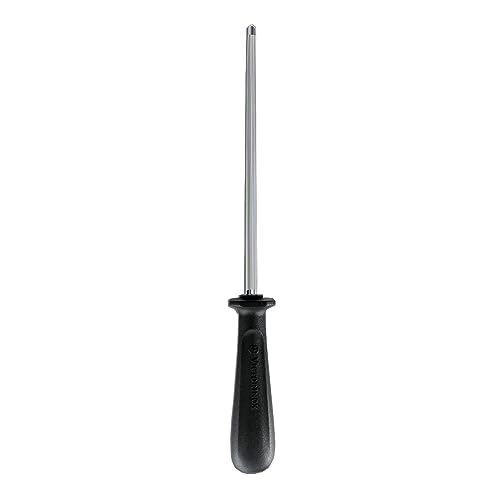
Your primary everyday tool should be a dedicated honing steel. Look for a rod made of chrome-plated steel or smooth ceramic with an ergonomic handle and a protective guard to shield your hands. The rod should be at least as long as your longest kitchen knife so you can complete full, continuous strokes from heel to tip. A medium-fine cut surface realigns the steel gently without stripping away excess metal.
For periodic sharpening, choose tools that match your comfort level. A dual-sided water stone gives you complete control over your cutting bevels. A medium grit around 1,000 quickly restores a dull profile, while a fine grit between 3,000 and 6,000 polishes the edge. If you prefer convenience, a handheld sharpener with fixed ceramic wheels lets you restore straight edges safely without guessing the angle.
Always avoid high-speed electric belt grinders. The friction created by electric wheels heats thin steel rapidly, which can ruin the heat treatment of your knife and leave the metal permanently soft. Keep your blades protected between uses as well; placing your kitchen knives in magnetic knife block combos keeps edges safe from rubbing against other utensils. While Victorinox stainless steel requires less oiling than the metal found in German high-carbon steel premium knife block sets, storing them properly preserves your freshly sharpened edge for months of clean cutting.
- TAR Score9.6
TAR Score is a ranking system developed by TopAppliancesReviews.com. TAR score has no relationship or impact from any manufacturers or sales agent websites. Learn more
- BrandVictorinox

- TAR Score9.4
TAR Score is a ranking system developed by TopAppliancesReviews.com. TAR score has no relationship or impact from any manufacturers or sales agent websites. Learn more
- BrandVictorinox

- TAR Score9.4
TAR Score is a ranking system developed by TopAppliancesReviews.com. TAR score has no relationship or impact from any manufacturers or sales agent websites. Learn more
- BrandVictorinox

- TAR Score9.4
TAR Score is a ranking system developed by TopAppliancesReviews.com. TAR score has no relationship or impact from any manufacturers or sales agent websites. Learn more
- BrandACCUSHARP

- TAR Score9.2
TAR Score is a ranking system developed by TopAppliancesReviews.com. TAR score has no relationship or impact from any manufacturers or sales agent websites. Learn more
- BrandVictorinox

- TAR Score9.2
TAR Score is a ranking system developed by TopAppliancesReviews.com. TAR score has no relationship or impact from any manufacturers or sales agent websites. Learn more
- BrandVictorinox

- TAR Score9.0
TAR Score is a ranking system developed by TopAppliancesReviews.com. TAR score has no relationship or impact from any manufacturers or sales agent websites. Learn more
- BrandIndependently Published

- TAR Score8.8
TAR Score is a ranking system developed by TopAppliancesReviews.com. TAR score has no relationship or impact from any manufacturers or sales agent websites. Learn more
- Brandlongzon

- TAR Score8.8
TAR Score is a ranking system developed by TopAppliancesReviews.com. TAR score has no relationship or impact from any manufacturers or sales agent websites. Learn more
- BrandBltyzio

- TAR Score8.6
TAR Score is a ranking system developed by TopAppliancesReviews.com. TAR score has no relationship or impact from any manufacturers or sales agent websites. Learn more
- BrandLUFFEXX

- TAR Score8.4
TAR Score is a ranking system developed by TopAppliancesReviews.com. TAR score has no relationship or impact from any manufacturers or sales agent websites. Learn more
- BrandVictorinox
Last update on 2026-10-01 / Affiliate links / Images, Product Titles, and Product Highlights from Amazon Product Advertising API
FAQs
Can I use an electric pull-through sharpener on a Victorinox knife?
It is best to avoid fast motorized sharpeners on Victorinox knives. The high-speed grinding wheels produce rapid friction heat that can damage the factory heat treatment, leaving the thin stainless steel soft or brittle. Handheld manual sharpeners, ceramic rods, or whetstones remove metal much more gently and protect the blade.
How often should I hone my knife versus sharpening it?
You can hone your Victorinox knife on a steel rod every few uses, or even before every major kitchen prep session. Honing simply pushes bent metal back into alignment without grinding away steel. Actual sharpening on a stone or ceramic sharpener is only needed every few months when regular honing stops restoring clean cuts.
Why does my knife tear paper near the tip after sharpening?
Paper tearing usually happens when the sharpening angle flattens out along the curved belly of the knife. As you move toward the tip on a flat stone, you must lift your wrist slightly to maintain the 15 to 20 degree angle along the upward curve. If you keep your wrist completely flat, the stone misses the curved apex entirely.
Can I sharpen a Victorinox Swiss Army pocket knife with kitchen tools?
Yes, you can sharpen pocket knives using the same fine bench stones or ceramic rods you use for kitchen blades. Pocket knives generally perform best with a slightly sturdier 20-degree bevel to withstand outdoor cutting tasks. Avoid wide kitchen pull-through slots, as they rarely support short, narrow pocket blades securely.


Top Rated Best Quality Range Hoods: 2026 Expert Picks

The 12 Best Small Solar Generators 2026

10 Best Quality Semi Automatic Washing Machine of 2026 For Leak-Free Laundry

11 Best Small Washer Machine of 2026 For Everyday Laundry

12 Best Vibration Pads For Washing Machine of 2026 To Stop Walking and Shaking

11 Best Selling Front Load Washing Machine of 2026 For Quiet Odor-Free Laundry

11 Best Washing Machine For King Size Bedding of 2026 To Prevent Cycle Errors

10 Best Small Front Loader Washing Machine of 2026 For Tight Closets






