
How to Sharpen a Kitchen Knife With a Rod Safely

Anchor the rod tip-down on a board. Gently glide the blade downward from the heel (the wide base near the handle) to the tip, using four to six light strokes on each side to realign the edge. Skip the flashy midair waving seen on television. Planting the tip against a damp cutting board prevents painful slips and gives you steady control.
Your exact steps change slightly based on your gear and blade condition. Steel rods simply straighten a bent edge, while diamond or ceramic rods shave away steel to form a fresh bevel (the angled cutting surface). Traditional Western knives favor a 20-degree tilt, but thinner Japanese blades need a narrower 15-degree slant. If your knife still struggles through a tomato after several passes, the edge is rounded and calls for a whetstone. Here is how to lock in the correct motion and sharpen safely.
Realignment vs Sharpening: What Your Rod Actually Does to the Edge
Most rods that sit inside a wooden kitchen block do not actually sharpen your knife in the traditional sense. True sharpening means grinding away metal to form a brand-new cutting edge. A traditional steel rod performs honing, which means straightening a bent cutting edge that has folded over during daily food prep.
When you look closely at a sharp chef knife, the cutting edge is incredibly thin, like a row of microscopic teeth. As you chop against a wooden or plastic board, those tiny teeth take heavy impact. They do not instantly snap off or wear away, but they do bend slightly to the left or right. When those teeth curl sideways, the knife cannot slice into food cleanly. It slides off a tomato skin or tears an onion instead of parting it.
A steel rod gently nudges those curled metal teeth back into a straight line. Sliding your blade along the smooth or lightly grooved steel pushes the edge back to center. Because no steel gets shaved away, honing does not wear out your knife. You can hone your blade every time you cook to keep it performing at its best.
Some modern rods use diamond dust or ceramic materials instead of smooth steel. These abrasive rods do remove tiny amounts of metal, functioning as true sharpeners. But for regular kitchen care, a standard high-carbon steel rod keeps your knife slicing cleanly without chewing up the blade.
Safe Setup: Preparing Your Counter and Securing the Rod
The safest way to use a rod is by anchoring it directly to your kitchen counter. You might have seen television chefs wave a steel rod around in midair while slashing a knife toward their chests. That style looks flashy, but it invites accidental slips and emergency room visits. Anchoring the tip against a stable surface gives you complete physical control.
Setting up your workspace takes less than twenty seconds and keeps your fingers safe:
- Lay down a damp cloth: Fold a clean kitchen towel or paper towel and lay it flat on a dry counter. This damp base stops hard materials from sliding around under downward pressure.
- Position the rod tip down: Place the rubber or steel tip of your rod directly onto the damp towel so the steel shaft points straight up toward the ceiling.
- Anchor your non-dominant hand: Grip the handle of the rod firmly with the hand you do not use for cutting. Keep your thumb and all four fingers wrapped securely behind the protective guard built into the handle.
- Keep the rod vertical: Hold the rod steady at a clean 90-degree angle to the counter. When the rod stays completely still, your cutting hand only has to worry about guiding the blade.
The Basic Stroke: How to Hone Your Blade Step by Step
Once your rod is firmly anchored, you can move your knife along the steel with steady, controlled motions. Take your time on the first few strokes to get a feel for the contact between the metals.
-
Anchor the rod tip-down firmly onto the towel.
Reason: A stationary base prevents the metal rod from sliding across the counter and keeps the moving edge completely under your control. -
Set your blade angle against the upper section of the steel.
Start by holding the flat side of the knife perpendicular to the rod at 90 degrees. Cut that angle in half by tilting the knife out to 45 degrees, and then cut that space in half once more to reach roughly 20 degrees. If you use sturdy blades from german high-carbon steel premium knife block sets, stick to this 20-degree angle. If you cut with thinner blades from high-carbon japanese chef knife sets, lean the knife slightly closer to the rod at roughly 15 degrees. Matching this bevel (the angled cutting slope of the blade) ensures you straighten the true edge instead of scraping the knife flat.
Reason: Matching the factory bevel keeps you from blunting the fine edge or scratching the broad face of the blade. -
Place the heel of the blade against the top of the rod.
Place the heel (the wide end of the blade near the handle) right against the steel shaft, just below the rod handle guard. The sharp edge should face down toward the counter.
Reason: Starting at the heel ensures you treat the entire length of the cutting edge in a single, balanced stroke. -
Pull the knife downward and back toward your body using light pressure.
Glide the blade down the length of the rod while gently pulling the knife back toward you. Apply very light force, roughly the weight of an apple resting in your palm. Think of slicing thin shavings off the side of the steel rather than chopping into it.
Reason: Gentle pressure realigns the curled metal teeth without gouging notches into the blade or bending the steel further. -
Sweep smoothly so the tip finishes near the bottom of the rod.
As you reach the bottom of your downward stroke, the very tip of the knife should still be in light contact with the steel just above the counter towel. Do not let the tip flick off the steel abruptly, and do not drive the point into the cutting board.
Reason: Finishing smoothly at the tip maintains an even profile across the whole blade so you do not create flat, dull spots near the point. -
Switch to the other side of the rod and repeat the motion.
Lift the knife and place the heel on the opposite side of the steel rod. Match the exact same angle and glide down and back toward your body. Complete four to six gentle strokes on each side, alternating sides with every pass.
Reason: Alternating strokes centers the microscopic teeth along the blade rather than rolling a burr (the microscopic wire edge or curved sliver of metal) to one side. -
Wipe the blade clean with a dry cloth.
Even basic steel rods can dislodge tiny metal particles or grease during the stroke. Wipe the knife spine to edge using a soft kitchen towel before cutting any food.
Reason: Cleaning the blade prevents stray metal dust from transferring onto your ingredients.
Habits to Avoid: How Knives Get Dulled and Hands Get Cut
Honing is a gentle maintenance task, yet many people pick up bad habits from movies or busy restaurant kitchens. Avoiding these common mistakes will protect your fingers and keep your knives sharp for years.
- Swinging the knife in midair: Freehand honing without a stable base leads to wobbling. Every time your hand shakes, the blade hits the steel at an uncontrolled angle, which rounds off the edge instead of straightening it. More importantly, midair strokes bring a sharp blade moving quickly toward your supporting hand.
- Pressing down with heavy force: Honing is not an arm workout. Pushing the blade hard against the rod can crush the delicate cutting edge, grind flat spots into the steel, or cause the knife to jump off the rod. Light, smooth contact is all that carbon steel needs to straighten out.
- Slapping the blade rapidly: Speed does not make your knife sharper. Moving too quickly causes you to bounce the knife along the rod, leaving microscopic nicks and dents along the edge. Slow, steady strokes give far better results.
- Using inconsistent angles: Tilting your wrist back and forth during the stroke turns a crisp cutting bevel into a dull, rounded curve. Lock your wrist straight and move your entire arm from the shoulder and elbow to keep the angle identical from heel to tip.
When the Rod Is Not Enough: Recognizing When You Need a Whetstone
A honing rod is an everyday tool, but it cannot fix every dull blade. Because a steel rod only straightens metal that is already there, it cannot rebuild an edge that has worn flat or chipped away over months of heavy use.
You can check the condition of your knife using a simple sheet of paper. Hold a standard piece of printer paper vertically by one corner. Place the heel of your knife on the top edge of the paper and gently pull downward without sawing. A knife with a properly aligned edge will slice smoothly through the sheet from heel to tip with zero tearing. If the blade catches, snags, or tears the paper even after several passes on your rod, the microscopic teeth are no longer just bent. They have worn away completely.
When an edge wears flat, it requires true sharpening on a water stone or sharpening system. Sharpening uses abrasive grits to grind away old metal and form a brand-new cutting apex with a fresh burr. Once a stone resets that crisp edge, your honing rod can take over again to maintain that sharpness for months at a time.
What to Look for in a Reliable Sharpening Rod
If your knife block came with an old, worn rod, or if you need a dedicated tool for your prep station, a few basic features make a major difference in daily use. A good rod should give you complete control and match the knives you use most.
First, check the length of the steel shaft. A standard chef knife has an eight-inch blade, which means you need a rod that measures at least ten to twelve inches long. A longer rod gives the knife plenty of runway to travel smoothly from heel to tip without running out of steel before the stroke finishes.
Second, inspect the handle shape and hand guard. Look for an ergonomic grip made from non-slip polypropylene or textured wood that sits securely in your palm even if your hands are damp. A wide, sturdy guard between the handle and the metal rod is essential. That guard acts as a physical wall that stops the knife from slipping into your fingers if your stroke goes wide.
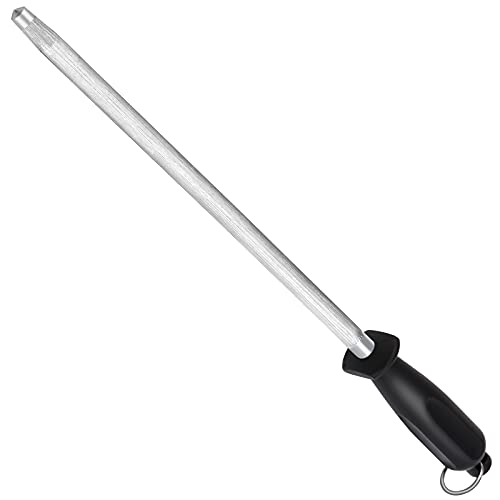
Finally, consider the rod material. High-carbon steel with a hard chrome plating provides classic realignment for everyday stainless steel and carbon blades. Magnetized steel is another helpful feature because it pulls tiny metal filings onto the rod rather than letting them drop onto your cutting board. If you want a rod that removes a tiny amount of steel to touch up moderately dull edges, an oval diamond-electroplated rod or fine ceramic stick offers that extra cutting power.

- TAR Score9.4
TAR Score is a ranking system developed by TopAppliancesReviews.com. TAR score has no relationship or impact from any manufacturers or sales agent websites. Learn more
- Brandwgsajlo

- TAR Score9.4
TAR Score is a ranking system developed by TopAppliancesReviews.com. TAR score has no relationship or impact from any manufacturers or sales agent websites. Learn more
- BrandKimura

- TAR Score9.2
TAR Score is a ranking system developed by TopAppliancesReviews.com. TAR score has no relationship or impact from any manufacturers or sales agent websites. Learn more
- BrandUtopia Kitchen
- TAR Score9.0
TAR Score is a ranking system developed by TopAppliancesReviews.com. TAR score has no relationship or impact from any manufacturers or sales agent websites. Learn more
- BrandAcoWELL

- TAR Score8.8
TAR Score is a ranking system developed by TopAppliancesReviews.com. TAR score has no relationship or impact from any manufacturers or sales agent websites. Learn more
- BrandWarthog Sharpeners

- TAR Score8.8
TAR Score is a ranking system developed by TopAppliancesReviews.com. TAR score has no relationship or impact from any manufacturers or sales agent websites. Learn more
- BrandFANERFUN
- TAR Score8.8
TAR Score is a ranking system developed by TopAppliancesReviews.com. TAR score has no relationship or impact from any manufacturers or sales agent websites. Learn more
- BrandKota Japan

- TAR Score8.6
TAR Score is a ranking system developed by TopAppliancesReviews.com. TAR score has no relationship or impact from any manufacturers or sales agent websites. Learn more
- BrandMaclia
Last update on 2026-10-02 / Affiliate links / Images, Product Titles, and Product Highlights from Amazon Product Advertising API
FAQs
How often should you use a sharpening rod on kitchen knives?
You can safely use a honing rod every time you pull your chef knife out of the block, or after every couple of heavy meal prep sessions. Because a standard steel rod realigns bent metal rather than grinding steel away, frequent use does not wear down the blade. Regular light honing keeps the edge straight so you rarely have to grind the knife on a stone.
Can a honing rod scratch or damage a knife blade?
A rod can scratch the side of your blade if you use an angle that is far too shallow, letting the broad face of the knife scrape against the steel. It can also blunt the edge if you press too hard or hold the knife at too steep an angle. Moving slowly with light pressure and a steady 15 to 20 degree angle prevents surface scratches and protects the cutting bevel.
Does a honing rod work on serrated bread knives?
A standard round steel rod cannot properly sharpen the gullets of a serrated knife. Running a serrated blade down a rod will only contact the high points of the teeth while skipping the curved valleys where most of the cutting happens. Serrated knives require a specialized, slender conical sharpening stick sized to fit inside each individual tooth indentation.
How can you tell if the blade edge is properly aligned?
The easiest check is slicing into a ripe tomato without pressing down. A properly aligned edge will bite into the slick tomato skin under the knife's own weight the moment you draw the blade backward. If the blade slides over the smooth skin without cutting, the edge is either still folded over or dull enough to need a sharpening stone.


Top Rated Best Quality Range Hoods: 2026 Expert Picks

The 12 Best Small Solar Generators 2026

10 Best Quality Semi Automatic Washing Machine of 2026 For Leak-Free Laundry

11 Best Small Washer Machine of 2026 For Everyday Laundry

12 Best Vibration Pads For Washing Machine of 2026 To Stop Walking and Shaking

11 Best Selling Front Load Washing Machine of 2026 For Quiet Odor-Free Laundry

11 Best Washing Machine For King Size Bedding of 2026 To Prevent Cycle Errors

10 Best Small Front Loader Washing Machine of 2026 For Tight Closets






