
How to Open a Mango Without a Knife

Being caught without a blade is nothing to worry about. A fresh mango is easy to open cleanly by pressing it against the rim of a drinking glass or peeling the skin like a banana. A simple metal spoon can also wedge between the rind and the sweet meat, giving you ready-to-eat pieces without making a sticky mess.
Which technique works best depends mainly on the softness of the fruit. Soft, ripe mangos with tender skins pull apart easily with bare hands, while slightly firmer varieties need the firm push of a cup edge or a spoon bowl. A rock-hard fruit will resist every trick, so ripeness makes all the difference. Here are the easiest ways to enjoy your snack right now using everyday items around you.
How do you peel a mango with a drinking glass?
Using a drinking glass is the quickest way to separate the skin from a mango cheek (the fleshy side piece) without leaving half the pulp on the rind. The rim of the cup acts as a blunt scraper. It slips between the leathery skin and the tender pulp, forcing the fruit into the glass while the peel stays in your hand.
Glass selection matters for safety. Use a thick pint glass, a heavy kitchen tumbler, or a sturdy stainless steel cup. Never use delicate wine glasses, champagne flutes, or thin crystal. Leaning down on thin glassware can shatter the rim, causing severe hand injuries. A rigid plastic tumbler from an office breakroom or picnic set is also a dependable choice.
To prepare the fruit without a knife, you must first separate a cheek from the seed. Look at the stem end (the top dimple of the fruit). Dig your thumbnail into the dimple to tear a small flap of peel. Pull that strip down to expose the pulp. Slide your thumbs along the flat side of the pit (the flat hard seed in the center) and pull the cheek away from the seed in one solid piece.
Follow these steps to scoop the fruit:
- Set your glass on a level table with a paper towel underneath to catch juice.
- Hold the mango cheek with the skin facing your palm and the yellow pulp facing the cup interior.
- Place the bottom edge of the cheek against the glass rim, wedging the rim right where the skin meets the pulp.
- Push downward with steady pressure. Keep the skin outside the glass while the cup edge slides upward through the fruit.
- Let the pulp drop into the cup. Repeat with the second cheek, then eat the fruit straight from the glass.
Can you peel a soft mango with your bare hands?
You can peel a mango like a banana if the fruit is soft and ripe. This hands-only method is ideal for lunch breaks, dorm rooms, or picnics where you lack utensils. It works best on yellow Ataulfo mangos (often called honey or champagne mangos), but it also works on round Kent or Tommy Atkins mangos that give under gentle thumb pressure.
The trick is starting at the right spot. Digging into the side of a mango bruises the pulp and squirts sticky juice across your hands. The peel is anchored most loosely around the top, which makes the stem dimple the ideal place to begin.
Follow these steps to peel by hand:
- Locate the stem end (the top dimple of the fruit) where the fruit was attached to the tree branch.
- Pinch the skin around the dimple with your thumb and forefinger to tear a small opening.
- Grip the torn peel flap and pull it straight down toward the base of the fruit in a clean ribbon.
- Work your way around the fruit, stripping three or four peel ribbons down to the halfway mark.
- Leave the bottom skin intact to act as a built-in wrapper so the slippery fruit does not slip from your hand.
- Eat the exposed pulp down to the pit (the flat hard seed in the center), then peel the bottom strips away to finish the rest.
Does a standard metal spoon work as a fruit peeler?
A standard metal spoon is an excellent substitute for a knife. The curved bowl of a soup spoon or tablespoon matches the natural curve of a mango cheek (the fleshy side piece). Because the spoon edge is dull, it glides along the tough inner skin without slicing through the peel or risking a cut on your fingers.
Metal spoons work far better than disposable plastic spoons. Flimsy plastic cutlery bends or snaps under the resistance of mango fibers, leaving broken plastic in your snack. A sturdy stainless steel spoon gives you the leverage needed to pry the pulp away cleanly.
Follow these steps to scoop out mango cheeks with a spoon:
- Pry open a small tear in the skin near the top dimple using the spoon tip or your thumbnail.
- Insert the bowl of the spoon between the rind and pulp, keeping the curved back of the spoon resting against the peel.
- Slide the spoon forward along the curve of the fruit, separating the flesh from the rind with short scooping motions.
- Work around the perimeter of the cheek until the spoon frees the pulp on all sides.
- Lever the spoon upward to lift the entire fruit dome out in one piece, or slice it into cubes inside the peel cup before scooping.
How do you get the meat off the flat pit?
Harvesting fruit from around the pit (the flat hard seed in the center) is the messiest part of opening a mango without cutlery. The seed is broad, flat, and covered in fibrous strands that hold tightly to the surrounding flesh. Without a knife to trim flush against the seed wall, you need a different technique to claim the remaining pulp.
Grip is your main issue. Ripe mango pulp is very slick, and squeezing a bare seed usually shoots it right out of your fingers. Wrap a paper towel or a clean napkin around the base of the seed to give your hand a reliable, non-slip handle while you work.
Once you have a secure grip, use the edge of your metal spoon to harvest the fruit. Place the spoon right against the hard seed casing and scrape downward along the natural direction of the fibers, moving from the top dimple toward the base. Scraping with the grain peels off sweet curls of fruit without shredding the woody seed coat underneath. Work across both broad sides before clearing the narrow edges.
If you have no spoon, eat the remaining meat directly from the core like corn on the cob over a sink or bowl. Scrape the pulp with your front teeth, but avoid biting deeply into the tough fibers attached to the seed. Finally, squeeze the stripped core over your cup to press out several tablespoons of rich juice before discarding the seed.
Is your mango soft enough to open without tools?
Knife-free methods work only when a mango is fully ripe. Ripe pulp yields easily and separates from both the skin and the pit. If you try these tricks on a firm, underripe fruit, you will crush the flesh, bend your spoon, or break your drinking glass. Check your fruit for these four physical signs before starting:
- Check the firmness: Cup the fruit in your palm and squeeze gently with the pads of your fingers. A ready mango yields softly to light pressure, feeling like a ripe peach or avocado. If it feels solid like an apple, wait a few days.
- Sniff the stem dimple: Hold the stem end (the top dimple of the fruit) to your nose. A ripe mango produces a sweet, floral, tropical aroma. An underripe fruit smells like grass or has no scent at all.
- Look for surface wrinkles: Many mango varieties stay green even when fully ripe, so color is not a reliable test. Instead, look for slight wrinkling around the stem shoulders, which shows that natural water loss has softened the pulp inside.
- Inspect the stem area: Look at the indentation where the fruit hung from the branch. Ripe mangos usually have a plump, raised ring around the stem, often with a tiny bead of dried sugary sap near the center.
If your fruit feels firm, leave it in a brown paper bag at room temperature. Adding an apple or ripe banana traps natural ethylene gas, which softens the mango within two or three days. Never refrigerate an underripe mango, because chilly air stops the ripening process permanently.
What kitchen gadgets replace knives for prepping mangos safely?
Opening fruit with cups and spoons works well on the go, but slicing slippery mangos at home can still lead to kitchen accidents. Mangos have an awkward oval shape that wobbles on cutting boards, and sticky juice makes them hard to grip. While home cooks often rely on precision blades from German high-carbon steel premium knife block sets for clean culinary cuts, specialized splitters provide a blade-free, guided downward press that keeps fingers completely away from slippery edges.
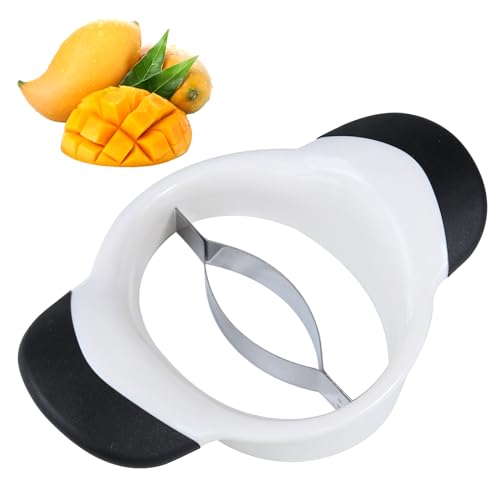
If your kitchen counter already features stable storage like magnetic knife block and knife set combos, you have plenty of cutting options at home. But a dedicated mango splitter (also called a mango corer or pitter) offers a much safer alternative for family snacks. A splitter features two sturdy side handles and an oval center blade. You place the fruit upright on a board, line up the oval blade with the seed, and press down with both hands. In one motion, the tool separates both cheeks and removes the pit cleanly.
When choosing a mango splitter for home use, verify these key features:
- Non-slip rubber grips: Look for wide handles with soft rubber or silicone padding. Mango juice makes smooth plastic slick, so textured handles keep your hands from slipping during the downward push.
- Micro-serrated stainless steel blades: Choose stainless steel cutting rings with micro-serrated edges. Serrations pierce tough, waxy mango skin immediately without sliding across the surface.
- Wide frame clearance: Ensure the center opening is broad enough to fit larger mango varieties without getting stuck on thick seeds.
- Durable ABS housing: Pick tools made with sturdy ABS plastic or cast metal that will not flex under pressure, and confirm they are dishwasher-safe for easy cleanup.

- TAR Score9.6
TAR Score is a ranking system developed by TopAppliancesReviews.com. TAR score has no relationship or impact from any manufacturers or sales agent websites. Learn more
- BrandDraduo

- TAR Score9.0
TAR Score is a ranking system developed by TopAppliancesReviews.com. TAR score has no relationship or impact from any manufacturers or sales agent websites. Learn more
- BrandZyliss

- TAR Score8.8
TAR Score is a ranking system developed by TopAppliancesReviews.com. TAR score has no relationship or impact from any manufacturers or sales agent websites. Learn more
- BrandChef'n

- TAR Score8.4
TAR Score is a ranking system developed by TopAppliancesReviews.com. TAR score has no relationship or impact from any manufacturers or sales agent websites. Learn more
- BrandJAKENHAM
- TAR Score8.2
TAR Score is a ranking system developed by TopAppliancesReviews.com. TAR score has no relationship or impact from any manufacturers or sales agent websites. Learn more
- BrandCheeren

3-in-1 Mango Slicer/Peeler/Cutter/Splitter/Pitter with Stainless Steel Blade Pit Remover Tool
View on Amazon- TAR Score8.0
TAR Score is a ranking system developed by TopAppliancesReviews.com. TAR score has no relationship or impact from any manufacturers or sales agent websites. Learn more
- BrandLOUIS FELT

- TAR Score7.8
TAR Score is a ranking system developed by TopAppliancesReviews.com. TAR score has no relationship or impact from any manufacturers or sales agent websites. Learn more
- BrandPCTC

- TAR Score7.4
TAR Score is a ranking system developed by TopAppliancesReviews.com. TAR score has no relationship or impact from any manufacturers or sales agent websites. Learn more
- BrandQUJIFETU

- TAR Score7.2
TAR Score is a ranking system developed by TopAppliancesReviews.com. TAR score has no relationship or impact from any manufacturers or sales agent websites. Learn more
- BrandDraduo

- TAR Score7.2
TAR Score is a ranking system developed by TopAppliancesReviews.com. TAR score has no relationship or impact from any manufacturers or sales agent websites. Learn more
- BrandPCTC
Last update on 2026-10-03 / Affiliate links / Images, Product Titles, and Product Highlights from Amazon Product Advertising API
FAQs
Can you eat mango skin if you cannot peel it?
Eating mango skin is not recommended. The rind contains urushiol, an oily compound that triggers allergic reactions, lip swelling, and digestive upset in sensitive individuals. The peel also has a bitter, resinous taste and a leathery texture that is unpleasant to chew.
Why does handling raw mango skin make some people itch?
Mangos belong to the same botanical family as poison ivy and poison oak. The skin and stem sap contain small amounts of urushiol, which causes contact dermatitis, itching, and redness. If your hands itch after peeling a mango, wash them immediately with warm water and degreasing dish soap.
What should you do if the mango is rock hard?
Never try to open a rock-hard mango with a cup, spoon, or your fingers. The tough connective fibers cling tightly to the seed, resulting in crushed pulp and bent utensils. Leave the mango on your kitchen counter at room temperature for three to five days to soften naturally.
How do you stop mango juice from ruining your clothes?
Mango juice contains sugars and tannins that leave faint brown rings on cotton fabrics once dry. Always open a knife-free mango directly over a bowl, rimmed tray, or sink to catch the sticky runoff. If juice splatters on clothing, rinse the spot with cold water immediately and pretreat it with laundry detergent.


Top Rated Best Quality Range Hoods: 2026 Expert Picks

The 12 Best Small Solar Generators 2026

10 Best Quality Semi Automatic Washing Machine of 2026 For Leak-Free Laundry

11 Best Small Washer Machine of 2026 For Everyday Laundry

12 Best Vibration Pads For Washing Machine of 2026 To Stop Walking and Shaking

11 Best Selling Front Load Washing Machine of 2026 For Quiet Odor-Free Laundry

11 Best Washing Machine For King Size Bedding of 2026 To Prevent Cycle Errors

10 Best Small Front Loader Washing Machine of 2026 For Tight Closets






