How to Safely Open a Wine Bottle with a Knife

A sturdy knife eases the cork out. Press the tip deep into the center of the plug, then slowly twist and pull to walk the stopper upward. The trick is letting friction do the heavy lifting so the blade never slips. If the cork refuses to budge or starts crumbling, you can safely push it straight down into the wine instead.
The right move depends on your blade and the stopper itself. Pocket knives with a locking blade or stiff steak knives work best, while thin, flexible kitchen knives risk snapping under pressure. Synthetic plastic stoppers also grip the glass much tighter than real wood, and old, dry corks tend to crumble into pieces. Taking a few seconds to inspect your setup keeps your hands safe and your drink clean.
Pick a rigid blade and remove all neck foil
Opening a wine bottle with an everyday blade requires the right tool and proper preparation. Never grab the first sharp object you see in your kitchen drawer. A blade that bends or folds under pressure can slip across the glass, ruining your evening with a severe hand cut.
Look for a short, stiff knife with a blade under four inches long. A standard steak knife with small, shallow serrations works exceptionally well because the tiny teeth bite into cork fibers without tearing them apart. A compact pocket knife is another practical option, provided the blade locks solidly into place. If you use a folding knife, confirm it features a liner lock (the spring bar inside the handle that snaps behind the open blade to stop it from closing on your fingers) or a sturdy lockback mechanism. Never attempt this with a non-locking slipjoint knife, because downward pressure will cause the blade to snap shut onto your knuckles.
Blade construction also matters for kitchen knives. Choose a knife with full tang construction (one solid piece of blade steel extending all the way through the handle) rather than partial tang construction (the blade metal narrows or stops inside the handle). Full tang knives handle downward pushing force without snapping at the bolster. Avoid flexible paring knives, utility blades with thin profiles, or long slicing knives. Slicing tools found in German high-carbon steel premium knife block sets are designed for balanced kitchen slicing, not vertical prying against heavy friction.
Before touching the cork, completely remove the neck foil (the protective metal or plastic wrap covering the rim). Traditional corkscrews allow you to cut just the top ring of foil, but an emergency knife extraction requires a completely bare bottle neck. Any leftover metal wrapping clamps against the glass lip, creating extra friction that prevents the cork from sliding upward.
- Slice below the lower glass ring: Position your blade just beneath the bottom glass ridge on the bottle neck. Cut horizontally around the glass, then peel away the entire foil sleeve down to the glass shoulder.
- Wipe the bottle top clean: Bottling facilities often leave dust or residual sugars under the foil wrap. Use a clean kitchen cloth to wipe the exposed glass lip and top of the cork.
- Identify your cork type: Check whether you are dealing with traditional bark cork or a plastic stopper (a dense, synthetic cork). Natural cork provides better traction for knife teeth but can crumble if dry. Plastic stoppers are tough and will not crumble, but they grip the inner glass neck much tighter, requiring significantly more twisting force.
- Secure your work area: Place the bottle on a flat, sturdy counter at waist height. Lay down a damp dishcloth or a silicone baking mat beneath the base to keep the bottle from spinning out of control.
Twist the bottle while lifting the blade slowly
The secret to removing a cork with a knife is rotating the glass bottle rather than cranking the blade. Prying or twisting the knife handle directly tends to carve a hollow hole through the center of the cork, leaving the outer ring stuck against the glass. Turning the bottle distributes the friction evenly around the neck, easing the cork out millimeter by millimeter.
- Center the blade tip: Place the tip of your knife squarely in the center of the cork. Avoid setting the tip near the outer edge where the blade could slip and strike the glass rim. Keep the knife straight up and down, matching the vertical line of the bottle neck.
- Sink the blade into the cork: Press down firmly on the knife handle using smooth, steady downward pressure. Do not pound the handle with your palm or hammer it with another object, as sudden impacts can shatter the bottle neck. Push the blade into the cork until it sinks roughly one-half to three-quarters of an inch deep. You want enough depth to anchor the blade firmly, but you must not pierce all the way through into the wine.
- Set your grip: Grasp the knife handle firmly with your dominant hand. Keep all five fingers wrapped securely around the handle, well back from the blade heel. With your non-dominant hand, grasp the body of the wine bottle firmly near the shoulder.
- Rotate the bottle, not the blade: Hold the knife handle steady at a slight upward angle, keeping constant upward tension on the cork. With your other hand, turn the bottle smoothly in one direction. As the bottle rotates against the anchored blade, the cork will break its adhesive seal against the glass wall and begin climbing up the neck.
- Ease the cork upward: Continue turning the bottle while applying gentle upward lift with your knife hand. Watch the gap between the bottom of the cork and the glass rim. You will feel the resistance drop as the cork rises past the halfway mark.
- Finish the removal by hand: As soon as roughly one inch of cork clears the top of the bottle, stop using the knife. Set the knife down on the counter away from your hands. Grip the exposed cork with your bare fingers or wrap a clean kitchen towel around it, then wiggle and twist it the rest of the way out. Pulling the cork entirely out with a knife often leads to a sudden slip when the tension releases.
Push stubborn or crumbly corks straight into the bottle
Sometimes a cork refuses to lift. Dry natural corks in aged wine can disintegrate into small flakes under the knife edge, while tight plastic stoppers can bind so hard against dry glass that lifting becomes impossible. If your blade begins to bore a core out of the center without raising the cork, stop pulling immediately. Pushing the cork downward into the bottle is far safer and cleaner than shredding it into cork dust.
Before you push a cork down, you must address internal air pressure. A wine bottle contains a small pocket of air between the liquid and the bottom of the cork. When you push the cork into the bottle, you compress that air pocket. Without a vent, the compressed air will eventually force a sudden geyser of red wine straight up past the cork, splashing your face, clothes, and walls.
- Relieve internal pressure: Take your narrow, pointed blade and press it down between the edge of the cork and the inside glass neck. Wiggle the blade gently until you hear a faint hiss of air escaping. This tiny channel prevents pressure buildup inside the bottle when the cork moves down.
- Switch to a blunt tool: Once vented, remove the sharp knife completely. Pushing hard against a sharp blade tip is an easy way to slip and cut your hand. Instead, find a blunt, sturdy cylinder that fits comfortably inside the bottle neck. The rounded handle of a wooden kitchen spoon, a thick permanent marker, or a clean wooden dowel works best.
- Wrap the neck in a towel: Fold a clean kitchen towel in half and wrap it securely around the neck of the bottle, holding it loosely over the opening. The cloth catches any stray droplets that might escape as the cork slides past the liquid level.
- Apply steady downward force: Place the bottle flat on the floor or a low, stable counter so you can press straight down from above. Place your blunt tool on top of the cork and lean down with controlled body weight. Push smoothly until the cork clears the narrow neck and drops into the wide body of the bottle.
- Pour and strain the wine: The cork will float harmlessly inside the wine without altering the flavor during your meal. When pouring your first glass, pour slowly so the floating cork does not rush forward and block the neck opening. If small pieces of cork broke off during your initial attempt, pour the wine through a fine mesh kitchen strainer or a unbleached paper coffee filter into a clean glass pitcher.
Avoid side prying and keep fingers away from blades
Using a knife as an emergency wine tool carries real risks that you must manage carefully. Knives are built for linear cutting and slicing, not for high-torque prying. Understanding where the physical forces go will protect you from deep lacerations and ruined bottles.
The most common mistake is resting the side of the blade against the glass rim to use the bottle neck as a lever. Glass bottle rims are brittle under point loads. When you pry sideways, the steel blade exerts intense lateral pressure against a tiny contact point on the glass ring. This almost always shears the glass lip off, sending microscopic glass dust and sharp shards directly into the wine. Once glass chips break into the bottle, the entire bottle must be thrown away immediately, as straining cannot reliably remove microscopic glass splinters.
Lateral leverage also destroys fine cutlery. Hard kitchen knives, such as those found in high-carbon Japanese chef knife sets, feature thin edges heat-treated for extreme hardness. When subjected to sideways twisting inside a dense cork, these brittle edges will chip or snap in half. Never sacrifice an expensive kitchen prep tool for a bottle of wine.
Hand positioning requires your full attention throughout the process. Never hold the bottle in your lap, between your knees, or in mid-air while working the knife. If the blade slips through the cork or skids off the glass, your downward force will drive the point straight into your leg or palm. Always maintain two distinct zones: one hand stays on the knife handle above the bottle, and the other hand stays wrapped around the lower body of the bottle resting on a stable counter.
Finally, steer clear of dangerous viral shortcuts. Banging the bottom of a wine bottle against a wall or inside a shoe relies on fluid shock waves to push the cork out. This trick frequently shatters the glass punt (the indented base of the bottle), resulting in severe wrist and hand lacerations from pressurized broken glass. Heating the neck of the bottle with a lighter or kitchen torch is equally hazardous, as rapid thermal expansion creates uneven tension that can cause the bottle neck to burst unexpectedly.
Keep dedicated wine tools ready to prevent blade accidents
While an everyday knife can solve an immediate problem in a pinch, relying on improvised blades is never a long-term plan. Dedicated wine tools apply controlled mechanical leverage while shielding your hands and the glass bottle from dangerous pressure points. Adding a few reliable, purpose-built openers to your home kitchen, picnic bag, or travel gear eliminates the need to risk your fingers on an emergency knife fix.
The standard tool of choice among restaurant servers is the classic waiter corkscrew (frequently called a wine key). A good wine key combines three distinct components into a compact, folding metal handle:
- A grooved worm: The worm (the spiral metal screw) penetrates the center of the cork without coring or shredding the fibers. Look for a worm with a grooved channel running along the spiral, which glides smoothly through both dense natural cork and sticky plastic stoppers.
- A double-hinged fulcrum: The fulcrum (the hinged metal lever that rests against the bottle rim) gives you two separate pivot points. The first notch lifts the cork halfway out of the neck with minimal hand effort, while the second notch pulls the remaining cork straight up without bending or snapping the wood.
- A folding foil knife: A small, serrated foil blade folds safely into the handle, allowing you to slice neck foil cleanly below the rim without dulling your primary pocket or kitchen knives.
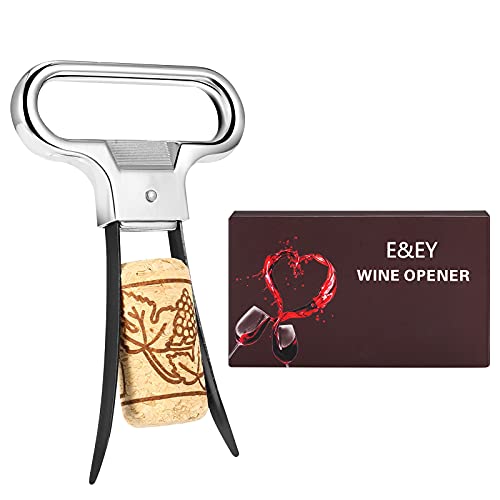
If you regularly open aged bottles with fragile or crumbly corks, consider keeping a two-prong cork puller on hand. Often called an Ah-So opener, this tool features two thin, flexible stainless steel (rust-resistant, easy-to-clean metal) prongs of slightly different lengths. Instead of piercing the center of the cork, you slide the prongs down along the sides between the cork and the inner glass neck. Rocking and twisting the handle eases old corks out completely intact, preventing dry cork dust from falling into your vintage.
For effortless opening without physical pulling, air pressure bottle openers offer another practical alternative. These compact tools use a slender, hollow needle that pierces straight through the center of the cork into the headspace. Pumping the handle introduces gentle air pressure beneath the stopper, easing the cork smoothly out of the neck in seconds. Keeping one of these low-cost openers in your cutlery drawer ensures you can open any bottle cleanly, safely, and without reaching for a knife.

- TAR Score9.4
TAR Score is a ranking system developed by TopAppliancesReviews.com. TAR score has no relationship or impact from any manufacturers or sales agent websites. Learn more
- BrandGOBETTER

- TAR Score9.4
TAR Score is a ranking system developed by TopAppliancesReviews.com. TAR score has no relationship or impact from any manufacturers or sales agent websites. Learn more
- BrandHYZ

- TAR Score9.4
TAR Score is a ranking system developed by TopAppliancesReviews.com. TAR score has no relationship or impact from any manufacturers or sales agent websites. Learn more
- BrandCORKAS

- TAR Score9.2
TAR Score is a ranking system developed by TopAppliancesReviews.com. TAR score has no relationship or impact from any manufacturers or sales agent websites. Learn more
- BrandChef Craft
- TAR Score8.8
TAR Score is a ranking system developed by TopAppliancesReviews.com. TAR score has no relationship or impact from any manufacturers or sales agent websites. Learn more
- BrandE&EY

- TAR Score8.8
TAR Score is a ranking system developed by TopAppliancesReviews.com. TAR score has no relationship or impact from any manufacturers or sales agent websites. Learn more
- BrandSwaytail

- TAR Score8.6
TAR Score is a ranking system developed by TopAppliancesReviews.com. TAR score has no relationship or impact from any manufacturers or sales agent websites. Learn more
- BrandIPEROT

- TAR Score8.6
TAR Score is a ranking system developed by TopAppliancesReviews.com. TAR score has no relationship or impact from any manufacturers or sales agent websites. Learn more
- BrandIPEROT
Last update on 2026-10-03 / Affiliate links / Images, Product Titles, and Product Highlights from Amazon Product Advertising API


Top Rated Best Quality Range Hoods: 2026 Expert Picks

The 12 Best Small Solar Generators 2026

10 Best Quality Semi Automatic Washing Machine of 2026 For Leak-Free Laundry

11 Best Small Washer Machine of 2026 For Everyday Laundry

12 Best Vibration Pads For Washing Machine of 2026 To Stop Walking and Shaking

11 Best Selling Front Load Washing Machine of 2026 For Quiet Odor-Free Laundry

11 Best Washing Machine For King Size Bedding of 2026 To Prevent Cycle Errors

10 Best Small Front Loader Washing Machine of 2026 For Tight Closets