How to Open a Coconut Safely with a Knife

A heavy brown coconut sits on the cutting board, sloshing quietly as dinner prep comes to a sudden halt. The safest method is to drain the liquid first, then firmly tap the blunt back spine of a heavy knife around the middle seam until the shell pops in two. Swinging a sharp blade edge at a round surface causes nasty slips, but controlled strikes with the dull side let natural tension do the breaking.
The right approach changes with the type of coconut on the counter. Mature brown coconuts crack best under blunt force, while young white coconuts require shaving away the soft outer husk to pry open the top cap. Blade weight makes a huge difference too, because a thin slicing knife can bend or snap against the dense shell. Getting inside takes only a few measured motions once you know where to strike.
Choose a Heavy Blade Instead of a Thin Slicing Knife
Opening a coconut requires mass and blunt force, not razor sharpness. Kitchen accidents often happen when someone grabs a thin utility knife or paring knife against a hard brown shell. Thin blades bend under pressure. When a light blade strikes a curved hull, it easily glances sideways off the fibrous shell and slips toward your fingers. Thin edges can also chip against dense shell fibers, ruining fine cutlery.
To split a coconut safely, pick a knife that brings natural heft. A heavy meat cleaver or an eight-inch Western chef knife provides enough momentum to crack the shell without requiring a wild swing. Keep this checklist in mind before starting:
- Weight over sharpness: You will hit the shell with the blunt back edge of the blade, so overall knife mass matters far more than slicing sharpness.
- Full tang construction: Choose a knife with full tang construction (meaning one solid piece of blade steel extending all the way through the handle). Blades with partial tangs, where the metal narrows inside the handle, can loosen under repeated impacts.
- Thick blade spine: Verify that the spine (the blunt back edge of the blade) is flat and square. A broad spine distributes impact evenly and protects your hands.
- Blade purpose: Save thin blades like your high-carbon Japanese chef knives for fine slicing tasks. For dense shells, choose sturdy, thick-spined tools commonly found in German high-carbon steel knife block sets that have the heft to absorb shock.
- Non-slip handle: Choose a handle with a secure, textured grip so wet hands will not slide forward during use.
Drain the Water Cleanly by Piercing the Soft Eye First
Never crack a coconut while it remains full of water. A water-filled coconut is heavy, unbalanced, and rolls easily across your board. Cracking a full shell causes liquid to splash everywhere, turning your prep space slick right while you handle heavy cutlery. Draining the liquid first stabilizes the coconut and lets you verify that the water smells fresh.
At the top of every mature brown coconut, you will find three dark indentations known as the eyes (dark soft spots on top). Two of these eyes are protected by hard shell plates. The third eye serves as the natural sprout pore, remaining soft and easy to puncture.
Follow these steps to drain the water:
- Fold a damp dish towel into a ring on your counter and set the base of the coconut inside to hold it steady.
- Take a small paring knife, metal skewer, or clean screwdriver. Press the tip into each of the three eyes until you locate the one that yields under moderate pressure.
- Push the tip through that soft eye. Twist the tool in a small circle to widen the hole to about a quarter-inch.
- Puncture a second eye if possible. A second hole allows air to enter as liquid pours out, preventing a slow airlock.
- Turn the coconut upside down over a clean glass and shake it until all water drains out.
- Smell and taste a drop of the liquid. Fresh coconut water smells sweet and nutty. If it smells sour, fermented, or oily, discard the fruit immediately.
Tap Along the Shell Equator Using the Blunt Blade Spine
Once drained, the mature brown coconut cracks easily using basic vibration. The shell acts like an architectural arch: it resists direct crushing, but fractures quickly under targeted tapping along its midpoint. This middle seam is called the equator (the middle line around the shell), located halfway between the eyes and the base.
Never swing the sharp cutting edge into the shell. Sharp edges bounce off curved husks, creating severe slip hazards while chipping the blade. Instead, strike the equator using only the spine (the blunt back edge of the blade).
Follow these steps to split the shell:
- Hold the drained coconut in the palm of your non-dominant hand. Keep your fingers low and away from the center line, or cradle the shell in a folded kitchen towel.
- Grip your heavy chef knife or cleaver in your dominant hand. Turn the knife so the cutting edge points straight up toward the ceiling, keeping only the blunt spine facing the coconut.
- Locate the equator line circling the widest center point of the coconut.
- Strike the equator firmly with the blunt blade spine using a brisk wrist motion from six inches away. Do not take wild chops.
- Rotate the coconut an inch in your hand after each strike, tapping the same equator line as you turn it.
- Listen to the impact sound. Early taps produce a dull thud. After several strikes, the sound turns into a sharp click as a fracture forms.
- Continue tapping along the visible crack line. Within two or three full rotations, the shell will split cleanly into two matching halves.
Shave the Husk and Pry the Cap on Young Green Coconuts
Young coconuts require a different strategy. Typically sold trimmed into white fibrous cones wrapped in plastic, these coconuts have a soft outer husk covering a thin inner shell. Because the fibrous husk absorbs blunt force, tapping the blade spine against it will only crush the fibers without splitting the shell.
You must shave the white cone down to the inner dome, then use the heel (the wide back corner near the handle) to pry open a lid. The heel is the thickest part of the knife, giving you the rigidity needed to lever the shell open.
Follow these steps to open a young coconut:
- Remove all plastic wrap and place the flat base of the coconut onto a stable cutting board with a non-slip mat underneath.
- Hold the lower base with your non-dominant hand, keeping fingers well below the top cone.
- Use a chef knife or cleaver to shave downward at an angle around the pointed top, like sharpening a pencil. Shave away the white fibrous husk until you expose the brown inner dome.
- Place the heel of the knife against the side of the exposed dome, about an inch below the pointed tip.
- Strike the dome firmly with the knife heel to pierce through the inner shell.
- Keep the blade heel lodged inside the puncture. Push the knife handle downward and twist outward to pry the shell crack open.
- Rotate the coconut and repeat the puncture-and-pry strike on three or four sides of the dome until the circular cap loosens.
- Lift the cap off with your fingers to access the sweet water and soft meat inside.
Separate the Firm Coconut Meat Without Stabbing Toward Your Hands
Carving meat out of a mature shell cup with a sharp paring knife is a common kitchen mistake. Coconut flesh is slick with natural oils, and curved shells make knife tips unpredictable. If you push a pointed blade into the cup and it slips, it can drive straight into your palm.
Use thermal shock to release the meat safely. Extreme temperature shifts cause the hard shell and the white meat to expand and contract at different rates, loosening the bond between them without knife carving.
Apply one of these two safe methods:
- The freezing method: Place cracked coconut halves in the freezer for twenty minutes. Cold temperatures cause the meat to shrink slightly away from the rigid shell. Remove the halves, place them cut-side down on a towel, and tap the shell back with a rolling pin or mallet. The meat pops out in clean chunks.
- The oven method: Place coconut halves cut-side down on a baking sheet in an oven heated to 350 degrees Fahrenheit for ten minutes. Heat releases steam between the meat and shell wall. Once cool enough to touch, light taps on the shell release the flesh.
If any stubborn pieces remain, slide the rounded tip of a butter knife or dinner spoon between the shell and flesh, then twist outward. Once free, peel the thin brown skin from the meat using a standard vegetable peeler.
Upgrade to Dedicated Coconut Openers if You Prep Them Often
Using standard kitchen cutlery works for an occasional coconut, but swinging heavy blades and prying dense shells carries risk. If you prepare fresh coconuts weekly for smoothies, baking, or fresh water, dedicated coconut tools make the process much faster and safer.
Specialized coconut tools replace blade swings with controlled mechanical leverage. Consider these helpful tool types when building your prep kit:
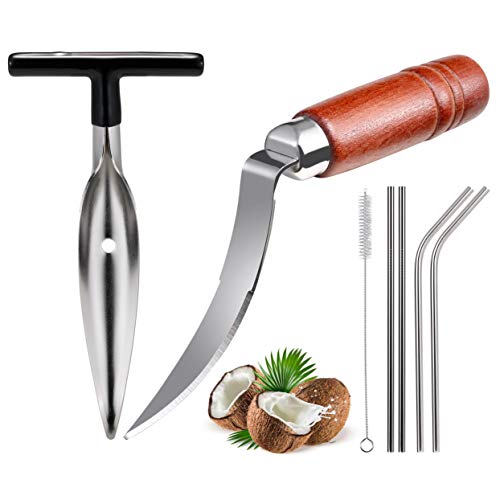
- Cylindrical punch tools: These tools feature a hollow cutting tube made from food-grade stainless steel (a rust-resistant, easy-to-clean metal). You simply press and twist the tube through the eye or husk to core a round hole for a straw or pouring spout without any chopping.
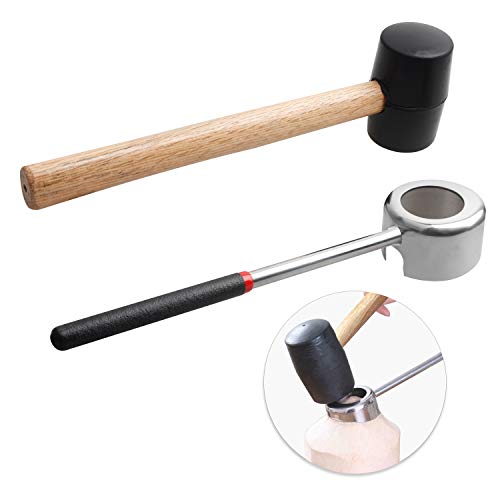
- Mallet and punch kits: Some sets combine a steel punch with a shock-absorbing rubber mallet, allowing you to drive a cutter cleanly through mature shells with light, direct taps that will not slip.
- Curved meat scrapers: Instead of prying with spoons, specialized scrapers have curved stainless steel teeth that match the inner contour of the shell. They slide along the wall to shave neat ribbons of meat quickly.
- Comfort handles: Look for openers with soft silicone or non-slip wood handles, which provide a firm grip even when coated in coconut oil.

- TAR Score9.0
TAR Score is a ranking system developed by TopAppliancesReviews.com. TAR score has no relationship or impact from any manufacturers or sales agent websites. Learn more
- BrandKCKHFA

- TAR Score9.0
TAR Score is a ranking system developed by TopAppliancesReviews.com. TAR score has no relationship or impact from any manufacturers or sales agent websites. Learn more
- BrandBAMI-LEE House

- TAR Score8.6
TAR Score is a ranking system developed by TopAppliancesReviews.com. TAR score has no relationship or impact from any manufacturers or sales agent websites. Learn more
- Brandzhuohai
- TAR Score8.6
TAR Score is a ranking system developed by TopAppliancesReviews.com. TAR score has no relationship or impact from any manufacturers or sales agent websites. Learn more
- BrandYiePhiot

- TAR Score8.6
TAR Score is a ranking system developed by TopAppliancesReviews.com. TAR score has no relationship or impact from any manufacturers or sales agent websites. Learn more
- BrandCJFocus

- TAR Score8.6
TAR Score is a ranking system developed by TopAppliancesReviews.com. TAR score has no relationship or impact from any manufacturers or sales agent websites. Learn more
- BrandXHGAYL
- TAR Score8.4
TAR Score is a ranking system developed by TopAppliancesReviews.com. TAR score has no relationship or impact from any manufacturers or sales agent websites. Learn more
- BrandModaSin

- TAR Score8.4
TAR Score is a ranking system developed by TopAppliancesReviews.com. TAR score has no relationship or impact from any manufacturers or sales agent websites. Learn more
- BrandCJFocus
Last update on 2026-10-03 / Affiliate links / Images, Product Titles, and Product Highlights from Amazon Product Advertising API
FAQs
Can you crack a coconut without draining the water first?
You can crack an undrained coconut, but it creates a messy and unsafe work surface. When a full coconut cracks, escaping water splashes across your cutting board, making your hands and tools slick. Draining the liquid first keeps your prep area dry and ensures the shell stays stable in your palm.
What should you do if the knife spine will not crack the shell?
If your knife spine is too light to crack the shell, never switch to the sharp cutting edge. Instead, place the drained coconut inside a plastic bag or wrap it in a heavy kitchen towel. Take the wrapped fruit outside and tap it firmly against a concrete step, or strike the middle equator with a wooden rolling pin or mallet on your counter.
Is it safe to hit the coconut shell with a sharp knife edge?
No, hitting a hard coconut with a sharp knife edge is dangerous and ruins your blade. The rounded shell easily deflects thin cutting bevels, causing the blade to glance into your fingers. The impact can also roll, chip, or snap the delicate cutting edge. Always strike with the blunt back spine.
How can you tell if a mature coconut has spoiled inside?
Check the three eyes at the top before purchasing to confirm they are dry and free from mold. Shake the coconut near your ear; you should hear plenty of sloshing liquid. Once opened, fresh coconut water smells sweet and clean, and the meat should be pure white. Discard the coconut if the water smells sour, tastes fermented, or the meat has gray discoloration.


Top Rated Best Quality Range Hoods: 2026 Expert Picks
The 12 Best Small Solar Generators 2026

10 Best Quality Semi Automatic Washing Machine of 2026 For Leak-Free Laundry

11 Best Small Washer Machine of 2026 For Everyday Laundry

12 Best Vibration Pads For Washing Machine of 2026 To Stop Walking and Shaking

11 Best Selling Front Load Washing Machine of 2026 For Quiet Odor-Free Laundry

11 Best Washing Machine For King Size Bedding of 2026 To Prevent Cycle Errors

10 Best Small Front Loader Washing Machine of 2026 For Tight Closets