
How to Cut Waffle Fries with a Knife at Home

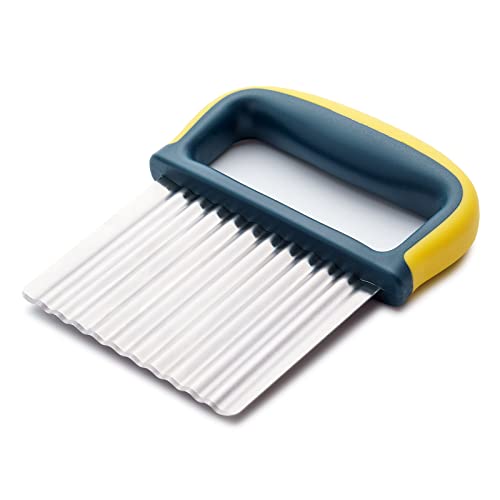
Making crisp waffle fries requires a wavy crinkle-cutter knife instead of a standard smooth kitchen blade. A standard flat knife cannot produce the crisscross holes, because the open lattice pattern only forms when opposing ridges intersect on both sides of the slice.
Pulling this off successfully depends on a strict quarter turn between every cut and keeping each slice remarkably thin. Slicing too thick leaves a solid crinkle chip with no holes, while cutting a flat base on your potato stops it from wobbling across the cutting board. Getting the rhythm down takes just a few passes once you understand how the two sides line up.
The Short Version
- Blade requirement: You cannot cut waffle fries with a regular flat kitchen knife. You must use a crinkle cutter knife with a corrugated, wavy blade to press ridges into the potato.
- The quarter-turn rhythm: Rotate the potato exactly 90 degrees (a quarter turn) between every single downward cut so the waves cross over each other.
- Thin slice thickness: Keep your slices thin, roughly 1/8 inch thick (about the height of two stacked nickels), so the valleys on the front cut meet the valleys on the back cut to punch the holes open.
- Stable work surface: Slice a thin scrap off one long side of the potato before you begin, giving it a flat base that stops it from rolling across the cutting board.
Blade Reality: Why Flat Chef Knives Cannot Make Waffle Cuts
Many home cooks pick up their sharpest chef knife, hoping a quick change in angle will produce a crisscross waffle fry. A straight knife blade only slices in a single, flat plane. If you make a flat cut, rotate the potato a quarter turn, and make another flat cut, you simply get a flat chip or a square french fry stick. Carving tiny rectangular holes into raw potato slices with a paring knife is technically possible, but it takes hours, crushes the potato flesh, and leaves you with broken scraps.
While standard kitchen blades like those found in German high-carbon steel premium knife block sets excel at dicing, mincing, and making uniform straight cuts, waffle fries depend entirely on corrugated steel. A wavy crinkle cutter knife features a blade pressed into repeating peaks and valleys. When you push this wavy blade through a potato, it carves alternating ridges and furrows into the cut surface.
The crisscross pattern with open holes (known as a lattice) happens purely through blade geometry. Your first downward cut creates vertical waves across the potato face. When you rotate the potato 90 degrees and cut again, the blade creates horizontal waves. As long as that second cut is thin enough, the valleys carved into the front of the slice run directly into the valleys carved into the back. Where those low spots meet from opposite sides, the potato flesh disappears completely, creating an open window. Where the high peaks meet, solid potato remains to hold the grid together.
Potato Prep: Setting Up Your Board and Potato for Safe Slicing
Raw potatoes are hard and dense, which means your knife needs firm, steady downward pressure. Setting up your cutting board correctly keeps the potato from shifting and protects your fingers while you work.
- Select large Russet potatoes: Russets have a high starch content and low moisture, which helps the thin potato grid hold its shape and crisp up during cooking. Yukon Golds also work well if you prefer a richer, buttery taste.
- Wash and dry the skins: Scrub off any loose dirt under cold water. Dry the potato completely with a clean towel, because wet potato skin easily slips out of your grip. You can leave the skin on for a rustic edge or peel it off entirely.
- Cut a flat bottom: Lay the potato on your cutting board. Slice off a thin sliver (about 1/4 inch thick) along its flattest long side. Rest the potato directly on this new flat surface so it sits rock-solid without rocking back and forth.
- Secure your cutting board: Wet a paper towel or a thin dishcloth, wring it out so it is damp, and lay it flat under your cutting board. This stops the board from sliding across the counter when you press down with the wavy blade.
- Curl your guide fingers: Hold the back end of the potato with your guide hand, curling your fingertips inward like a bear claw. Keep your knuckles forward and your fingertips tucked safely behind the path of the blade.
Step-by-Step Guide: The Quarter-Turn Slicing Rhythm
Cutting waffle fries by hand requires a steady tempo. Once you establish the distance and the turn, the process moves quickly across the whole potato.
- Make the first leveling cut: Place your wavy crinkle knife about 1/4 inch in from the end of the potato. Press straight down through the potato until the blade touches the board. Set this first piece aside, as it only has waves on one side. You now have a flat, corrugated face exposed on the potato.
- Turn the potato 90 degrees: Keep the potato resting on its flat base and rotate it exactly one quarter turn. If the wavy ridges on the exposed face are running up and down (vertically), rotate the potato so those ridges now run left to right (horizontally).
- Set your slice thickness: Move your knife blade back from the corrugated face by roughly 1/8 inch (3 to 4 millimeters). A good visual reference is the thickness of two nickels stacked together. If the blade is too far back, you will cut a solid chip; if it is too close, the slice will shred.
- Press straight down: Push the wavy blade straight down into the board using smooth, steady downward pressure. Do not saw back and forth. Sawing tears the thin walls of the lattice and ruins the clean edges of the holes.
- Check your holes and repeat: Lift the slice and look through it. You should see open, distinct square or diamond holes throughout the grid. Now rotate the potato 90 degrees again so the ridges run vertically, align your blade 1/8 inch back, and press down. Repeat this rhythm: cut, quarter turn, cut, quarter turn.
Fixing Common Mistakes: Why Your Fries Lack Holes
If your fries are not showing open windows on your first attempt, you do not need a new knife. A few small adjustments to your stance, your grip, or your spacing will fix the problem immediately.
The fries are solid wavy chips with no holes: This is the most common mistake. It happens when your slice is too thick (usually 1/4 inch or wider). When the slice is thick, the valleys on the back cut never reach deep enough to intersect the valleys on the front cut. Slide your knife closer to the front face and make your next slice noticeably thinner.
The fries tear, shred, or fall apart: Slicing too thin leaves almost no potato structure between the intersecting waves, causing the fry to dissolve into loose strings. It can also happen if you wiggle or drag the knife blade horizontally while pushing down. Increase your slice thickness slightly and focus on a single, straight downward push.
Holes appear on one side but the other side is solid: This wedge shape happens when your knife enters the potato at an angle. The top of your cut might be a perfect 1/8 inch, but the blade drifted outward to 1/4 inch by the time it reached the cutting board. Keep the blade completely parallel to the face of the potato from top to bottom.
The waves run parallel instead of crossing: If your slices look like ordinary wavy potato chips, you forgot to rotate the potato. It is easy to fall into a regular chopping habit and make two cuts in a row without turning. Say the rhythm out loud while working: slice down, rotate 90 degrees, slice down, rotate 90 degrees.
Post-Cut Prep: Soaking and Drying for Crispy Lattice Fries
Because waffle cuts create far more surface area than straight french fries, the potato releases a heavy amount of milky surface starch during slicing. Managing this starch before cooking is the secret to getting crispy ridges rather than soggy, limp fries.
- Soak in cold water: Drop your freshly cut waffle fries into a large bowl filled with cold tap water. Let them soak for 30 to 45 minutes. The water will turn cloudy as free starch washes away from the potato surface. Removing this starch keeps the fries from burning or sticking together in the heat.
- Rinse until clear: Drain the bowl through a colander and rinse the fries under cold running water until the runoff is completely clear.
- Dry thoroughly: Lay clean kitchen towels or several layers of paper towels across your counter. Spread the waffle fries out in a single layer and pat them thoroughly dry on both sides. Any surface water left in the small grooves will turn into steam during cooking, which softens the potato and causes hot cooking oil to splatter dangerously.
- Cook in a single layer: Whether you bake them at 425 degrees Fahrenheit, use an air fryer, or deep-fry them in hot peanut or vegetable oil at 350 to 375 degrees, keep the fries spread out. The open grid allows hot air and oil to flow directly through the potato, crisping both sides at the same time.
Choosing the Right Crinkle Cutter Knife for Waffle Fries
When selecting a dedicated wavy knife blade for making waffle fries, look for a tool built specifically to handle dense root vegetables. A standard thin kitchen slicer will flex under heavy downward pressure, while a purpose-built crinkle tool provides the stiffness needed to keep your cut thickness even from top to bottom.
Look for a blade made of food-grade stainless steel (a rust-resistant, easy-to-clean metal). The blade should measure at least 3.5 to 4 inches wide and around 3 inches tall so it can press through a full-sized Russet potato in one pass without getting stuck halfway down. A deep wave profile with well-defined peaks creates larger, cleaner holes in the finished fry.
Handle design is equally important for comfort and safety. Top-mounted crossbar handles allow you to press directly downward using your upper body weight, which takes strain off your wrist during large batches. If you choose a tool with a traditional side handle, ensure it features a textured, non-slip rubber grip that will not slip if your hands are damp from washing potatoes. Just like the everyday blades found in Japanese chef knife sets for precision slicing, crinkle cutters last longest when hand-washed and dried with a towel immediately after use rather than left sitting in a wet sink.

- TAR Score10.0
TAR Score is a ranking system developed by TopAppliancesReviews.com. TAR score has no relationship or impact from any manufacturers or sales agent websites. Learn more
- Brandbraxan
- TAR Score9.4
TAR Score is a ranking system developed by TopAppliancesReviews.com. TAR score has no relationship or impact from any manufacturers or sales agent websites. Learn more
- BrandNax Caki

- TAR Score9.4
TAR Score is a ranking system developed by TopAppliancesReviews.com. TAR score has no relationship or impact from any manufacturers or sales agent websites. Learn more
- BrandJAYVAR

- TAR Score9.2
TAR Score is a ranking system developed by TopAppliancesReviews.com. TAR score has no relationship or impact from any manufacturers or sales agent websites. Learn more
- BrandHIC Kitchen

- TAR Score9.2
TAR Score is a ranking system developed by TopAppliancesReviews.com. TAR score has no relationship or impact from any manufacturers or sales agent websites. Learn more
- Brandhomfanseec

- TAR Score9.2
TAR Score is a ranking system developed by TopAppliancesReviews.com. TAR score has no relationship or impact from any manufacturers or sales agent websites. Learn more
- BrandGuardians

- TAR Score8.8
TAR Score is a ranking system developed by TopAppliancesReviews.com. TAR score has no relationship or impact from any manufacturers or sales agent websites. Learn more
- BrandVITUER

- TAR Score8.8
TAR Score is a ranking system developed by TopAppliancesReviews.com. TAR score has no relationship or impact from any manufacturers or sales agent websites. Learn more
- BrandYopolaz

- TAR Score8.8
TAR Score is a ranking system developed by TopAppliancesReviews.com. TAR score has no relationship or impact from any manufacturers or sales agent websites. Learn more
- BrandNECOOKS
Last update on 2026-10-04 / Affiliate links / Images, Product Titles, and Product Highlights from Amazon Product Advertising API
FAQs
Can I cut waffle fries with a regular straight kitchen knife?
No, you cannot cut genuine waffle fries with a flat chef knife or utility knife. Waffle fries rely on overlapping corrugated ridges, which require a wavy blade. A straight knife only creates flat surfaces, producing either flat potato slabs or standard square fries.
How thick should waffle fries be cut to get open holes?
Aim for a thickness of roughly 1/8 inch, or between 3 and 4 millimeters. This is about the height of two stacked nickels. Slicing thicker than this leaves a solid potato center, while slicing thinner can cause the delicate grid to tear apart.
What potato variety makes the best homemade waffle fries?
Russet potatoes make the best waffle fries because their high starch and low moisture content help the delicate lattice stay rigid and crisp. Yukon Gold potatoes are a good alternative if you prefer a softer, creamier center, though they may need slightly longer frying to turn crisp.
Can I cut waffle fries ahead of time and store them?
Yes, you can cut the fries up to 24 hours in advance. Keep them completely submerged in a covered bowl of cold water in the refrigerator to stop them from turning gray or brown. Dry them thoroughly with paper towels before cooking so they crisp up properly.


Top Rated Best Quality Range Hoods: 2026 Expert Picks

The 12 Best Small Solar Generators 2026

10 Best Quality Semi Automatic Washing Machine of 2026 For Leak-Free Laundry

11 Best Small Washer Machine of 2026 For Everyday Laundry

12 Best Vibration Pads For Washing Machine of 2026 To Stop Walking and Shaking

11 Best Selling Front Load Washing Machine of 2026 For Quiet Odor-Free Laundry

11 Best Washing Machine For King Size Bedding of 2026 To Prevent Cycle Errors

10 Best Small Front Loader Washing Machine of 2026 For Tight Closets






