
How to Cut Plexiglass With a Knife Without Cracking It

A framed picture sits open on the living room rug while a new clear acrylic sheet sticks out half an inch past the frame edge. Slicing straight through hard plastic will crack it, but you can cut it cleanly if you score a deep groove and snap it over a sharp table edge. A utility knife or plastic blade carves that break line so the sheet parts evenly instead of shattering across the center.
Success depends mainly on the plastic type and thickness. Thin acrylic up to one-eighth of an inch snaps easily, while panels thicker than a quarter inch need a saw. Flexible plastics like polycarbonate will only bend rather than fracture. A hooked scoring blade also peels out plastic curls much faster than a flat razor. Getting your straightedge clamped down firmly makes the whole process quick, predictable, and safe.
Why Do You Score Plexiglass Instead of Slicing It?
Plexiglass is a common brand name for clear acrylic plastic sheet. Unlike soft materials such as cardboard, foam, or leather, acrylic plastic is rigid and brittle. You cannot slice straight through it with a knife blade. If you try to force a knife all the way through a sheet of plexiglass, the blade will bind, wander off course, or shatter the plastic into uneven shards.
To cut acrylic cleanly with a hand knife, you use a method called score and snap. To score simply means to carve a groove into the surface of the plastic along a straight line. You do not cut all the way through the material. Instead, you carve a deep channel that acts like a deliberate fault line. When you apply bending pressure over the edge of a table, that pressure concentrates right along the groove. The plastic snaps cleanly along the scored line, leaving a straight separation across the entire sheet.
This score-and-snap technique works reliably on sheets up to 1/8 inch or 3/16 inch thick. Thicker sheets (such as 1/4 inch or greater) require too much force to break by hand and need a power saw with a fine-tooth blade instead. The material type also matters. Clear acrylic snaps cleanly when scored, but polycarbonate (a tough, flexible plastic that bends instead of snapping) will only fold and turn white along the line. Always check that your material is acrylic plastic before you plan to score and snap it.
What Tools Do You Need Before You Start?
Setting up your work area properly keeps your cut straight and protects your hands. You do not need power tools for thin acrylic, but you do need stable workshop items that keep your guide rail steady and your knife under complete control.
- Flat work table: A sturdy workbench or table with a crisp 90-degree edge provides the rigid support you need to score the sheet and snap it cleanly.
- Metal straightedge: Use a heavy steel ruler or metal level. Wooden or plastic rulers can slip easily, and a sharp blade can shave off wood or plastic and ruin your straight line.
- Two bar clamps: Clamping your metal straightedge directly to the acrylic and tabletop prevents the guide from sliding while you apply heavy blade pressure.
- Utility knife or acrylic scoring tool: A standard utility knife with a fresh blade works on thin sheets. A dedicated acrylic scoring knife with a hooked tip works even better because it plows out plastic shavings instead of just wedging the plastic apart.
- Safety glasses and work gloves: Scoring acrylic can release tiny plastic chips, and freshly snapped plastic edges are razor-sharp. Eye protection and gloves keep you safe at every stage.
- Fine-tip marker: A fine permanent marker or grease pencil lets you draw precise cut marks directly onto the factory protective masking film.
How Do You Score and Snap the Plastic Sheet?
Follow these steps in order to get a straight cut without cracking your sheet or chipping the corners.
- Mark your cut line on the protective film. Leave the paper or plastic factory film on both sides of the sheet. This film prevents accidental surface scratches while you work. Measure your cut with a tape measure, and make small marks with your marker at both ends of the sheet.
- Clamp your metal straightedge securely. Lay the sheet flat on your table. Place your metal straightedge along your marks. Offset the straightedge just enough to account for the thickness of your blade. Fasten a clamp at each end of the straightedge, securing both the ruler and the plastic firmly to your work table. Push against the straightedge with your hand to confirm it cannot shift.
- Make your first light scoring pass. Hold your knife against the metal guide with the blade tilted slightly in the direction of the cut. Pull the blade toward your body using light, steady pressure. Do not push down hard on this first pass. The goal is to establish a shallow, accurate track that guides your knife on future passes so the blade does not jump. Always keep your free hand behind the blade path.
- Carve a deep groove with repeated passes. Now apply firm, even downward pressure. Pull the blade along the exact same groove repeatedly. If you use a hooked acrylic tool, you will see thin, ribbon-like curls of plastic peel out of the channel. If you use a utility knife, lean the blade slightly to each side on alternating passes to shave the walls of the groove wider. Make 5 to 15 passes depending on sheet thickness. Carve until the groove reaches about one-third of the sheet thickness.
- Position the score line over the table edge. Release the clamps. Slide your sheet forward until the scored groove aligns precisely with the sharp, straight edge of your table. The scored groove must face upward toward the ceiling. Lay a straight piece of scrap wood over the clamped portion of the sheet, directly behind the cut line, and clamp it to the table. This board locks the back of the sheet flat and prevents unwanted flexing.
- Snap the sheet with quick, even pressure. Stand directly in front of the table. Place both hands flat on top of the overhang piece, spreading your palms evenly along the cut line. Take a breath, and press down firmly in one quick, decisive motion. Do not press down slowly, as slow bending can cause the plastic to twist and crack. A quick push produces a sharp pop, and the plastic will separate cleanly along the scored groove from edge to edge.
What Mistakes Cause Plexiglass to Crack or Shatter?
When acrylic cracks unevenly, rushed technique or uneven snapping force is almost always the cause. Avoiding a few common mistakes will save you from wasting expensive plastic sheets.
The most frequent error is trying to snap the sheet before the groove is deep enough. If you only score the surface two or three times, the plastic still retains most of its original strength. When you push down on a shallow scratch, the bending stress wanders into random internal tension lines, sending a jagged fracture across the center of your sheet. Always take the time to carve down at least one-third into the plastic before attempting to break it.
Another major mistake is pushing down slowly instead of making a fast snap. Acrylic is a brittle polymer that tolerates very little flex. When you bend it gradually, the plastic twists and tears, leaving jagged ridges that look like shark teeth along the seam. The downward motion must be sudden, firm, and uniform across the entire overhang.
Attempting to cut curved lines with a hand knife will also ruin your project. Score-and-snap cutting relies on a straight lever edge to concentrate force along a single straight fault line. A curved score line cannot snap cleanly because the material on the outer edges binds against the curve and shatters. If your project requires circles or curved profiles, use a scroll saw or a fine-tooth coping saw instead of a knife.
Never score acrylic on an uneven or soft surface. If the sheet flexes underneath your blade while you carve your line, the groove depth will be inconsistent. Work on a flat, solid surface, clamp your straightedge tightly, and keep your blade sharp to avoid skips and gouges.
How Do You Smooth the Fresh Cut Edge Safely?
After your sheet snaps cleanly, the cut edge will be straight, but it will feel sharp. You will usually find a small burr (a sharp plastic ridge that forms along the bottom edge during the snap). Smoothing this edge makes the piece safe to handle and gives it a clean, finished appearance.
Start by scraping away the burr. Take a utility blade or a stiff scraper and hold it upright at a 90-degree angle to the edge. Drag the blade backward along the edge toward you like a cabinet scraper. This scraping action peels away the sharp ridge in thin ribbons and flattens out tiny high spots. Never push the cutting edge forward into the plastic, as the blade can catch and gouge deep notches into the edge.
Next, smooth the edge with sandpaper. Wrap a sheet of 120-grit sandpaper around a flat wooden block. Sanding with a hard block keeps the edge flat and square, preventing you from rounding off the corners. Sand along the length of the edge using long, steady strokes until the coarse blade marks disappear.
Follow up with 220-grit sandpaper to refine the surface. If you need a smooth, satin finish for a visible frame, finish by wet-sanding with 400-grit sandpaper. Add a few drops of water to the edge as you sand. The water cools the plastic so friction heat does not soften the acrylic, and it washes away fine dust particles. Once the edge is smooth to the touch, peel away the protective masking film.
What Kind of Knife Works Best for Acrylic Sheets?
While a standard utility knife can score thin plastic sheets in a pinch, choosing the right cutting knife makes the job faster and reduces hand fatigue. A standard utility knife blade has a wedge-shaped bevel designed for slicing soft goods. When pushed against hard acrylic, that wedge tends to skate across the surface and requires excessive downward force to make progress.
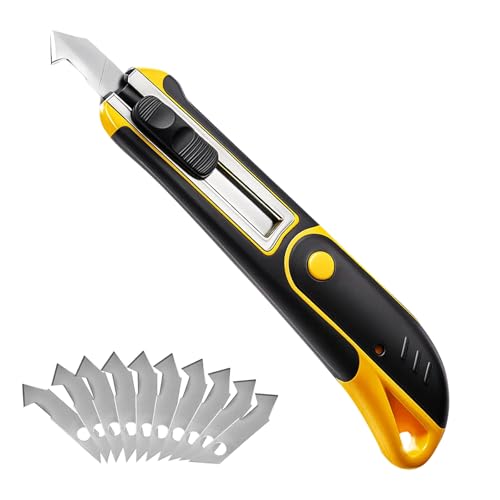
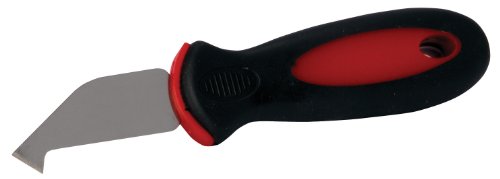
A dedicated acrylic scoring knife uses a hooked blade tip made of hardened tool steel or SK5 steel. Instead of wedging the plastic apart, the hooked tip acts like a miniature chisel, gouging out clean ribbons of acrylic on every stroke. This creates a square-bottom groove that concentrates stress much better than a V-shaped razor cut, allowing you to snap the sheet with fewer passes.
When selecting a knife for this job, look for a tool with a solid, ergonomic handle that fills your palm comfortably. A curved handle or a textured grip gives you better leverage and keeps your fingers from slipping toward the blade. Models that include internal blade storage inside the handle are also helpful, as scraping abrasive plastic dulls blade tips over time, and having fresh replacement blades on hand keeps your scoring lines crisp and clean.

- TAR Score8.8
TAR Score is a ranking system developed by TopAppliancesReviews.com. TAR score has no relationship or impact from any manufacturers or sales agent websites. Learn more
- BrandBAISALJI
- TAR Score8.6
TAR Score is a ranking system developed by TopAppliancesReviews.com. TAR score has no relationship or impact from any manufacturers or sales agent websites. Learn more
- BrandSteelite

- TAR Score8.6
TAR Score is a ranking system developed by TopAppliancesReviews.com. TAR score has no relationship or impact from any manufacturers or sales agent websites. Learn more
- BrandCALPALMY

- TAR Score8.6
TAR Score is a ranking system developed by TopAppliancesReviews.com. TAR score has no relationship or impact from any manufacturers or sales agent websites. Learn more
- BrandSUPREMETECH

- TAR Score8.4
TAR Score is a ranking system developed by TopAppliancesReviews.com. TAR score has no relationship or impact from any manufacturers or sales agent websites. Learn more
- BrandYouU

- TAR Score8.2
TAR Score is a ranking system developed by TopAppliancesReviews.com. TAR score has no relationship or impact from any manufacturers or sales agent websites. Learn more
- BrandHJYZY
- TAR Score8.0
TAR Score is a ranking system developed by TopAppliancesReviews.com. TAR score has no relationship or impact from any manufacturers or sales agent websites. Learn more
- BrandRed Devil

- TAR Score8.0
TAR Score is a ranking system developed by TopAppliancesReviews.com. TAR score has no relationship or impact from any manufacturers or sales agent websites. Learn more
- BrandPZRT

- TAR Score6.0
TAR Score is a ranking system developed by TopAppliancesReviews.com. TAR score has no relationship or impact from any manufacturers or sales agent websites. Learn more
- Brandaccufine
Last update on 2026-10-03 / Affiliate links / Images, Product Titles, and Product Highlights from Amazon Product Advertising API
FAQs
Can you cut plexiglass with a standard kitchen knife?
No, you should never use kitchen cutlery to cut or score plexiglass. Kitchen knives feature thin, flexible edges ground for soft foods, and hard acrylic plastic will quickly chip the metal or cause the blade to slip dangerously. While high-carbon steel blades designed for food prep, such as Japanese chef knife sets for precision slicing, excel in the kitchen, cutting acrylic requires a rigid utility knife or a hooked scoring blade made of thick tool steel.
How many scoring passes do you need to make on plexiglass?
The number of passes depends on the thickness of your sheet and the type of blade you use. For a standard 1/8-inch acrylic sheet, a hooked scoring knife usually requires 6 to 10 firm passes to carve deep enough. A standard utility knife may take 12 to 15 passes because it removes less material per stroke. Always verify that your groove penetrates about one-third of the sheet thickness before attempting to snap the plastic.
Which side of the score line should face up when you snap plexiglass?
The scored groove must always face upward toward the ceiling, away from the table edge. When you press downward on the overhang, the upward-facing groove is placed under tension, which pulls the carved fault line open and forces the break along that exact path. If you place the score line facing down, the groove compresses instead of expanding, causing the plastic to bend and crack crookedly.
Can you cut curves in plexiglass using a scoring knife?
No, you cannot cut curved lines in plexiglass with a scoring knife. Hand scoring works only for straight lines because snapping requires uniform leverage across a straight table edge. If you try to snap a curved score mark, the surrounding plastic binds against the curve and shatters. For curved shapes or circles, use a handheld jigsaw, scroll saw, or fine-tooth coping saw.


Top Rated Best Quality Range Hoods: 2026 Expert Picks

The 12 Best Small Solar Generators 2026

10 Best Quality Semi Automatic Washing Machine of 2026 For Leak-Free Laundry

11 Best Small Washer Machine of 2026 For Everyday Laundry

12 Best Vibration Pads For Washing Machine of 2026 To Stop Walking and Shaking

11 Best Selling Front Load Washing Machine of 2026 For Quiet Odor-Free Laundry

11 Best Washing Machine For King Size Bedding of 2026 To Prevent Cycle Errors

10 Best Small Front Loader Washing Machine of 2026 For Tight Closets






