
How to Cut a Pill With a Razor Knife Without Crushing It

Splitting a tablet without a dedicated cutter is nothing to worry about if you take your time. To get an even split right now, set the tablet on a non-slip surface, align a sanitized blade over the center groove, and press straight down firmly without sawing back and forth. Tenting a clean paper towel lightly over the blade keeps the split pieces from flying across the room.
The right approach depends on the pill itself and the condition of your tool. Only divide tablets that have a score line (the indented groove pressed across the center), because medicines designed to dissolve slowly throughout the day can release dangerously fast if broken. A clean blade is just as critical, so you never introduce workshop oils to your medicine. A flat, steady surface prevents slipping and stops the tablet from crumbling into powder. Follow these safe steps to get an accurate dose.
Check the Pill Markings Before You Make Any Cut
Never cut a tablet until you verify that the medication is safe to split. Breaking the wrong pill can destroy its chemical delivery system, releasing a full day of medicine into your bloodstream in a single minute or causing severe stomach irritation. Your safety always comes before your dose schedule.
Before you pick up any tool, check your medication against this safety checklist:
- Look for a pre-molded score line: The score line (the indented groove pressed into the tablet center by the manufacturer) is the clearest visual sign that a pill is designed for splitting. If the pill face is completely smooth, round, and flat on both sides, the manufacturer likely did not formulate it to distribute medication evenly across both halves.
- Verify the release mechanism on your bottle: Check the label for letters such as ER, XR, XL, CR, SR, or DR. These abbreviations stand for extended-release pills (medicine made to dissolve slowly throughout the day). Cutting an extended-release tablet destroys its internal time-delay matrix, which can trigger an accidental overdose known as dose dumping.
- Inspect the outer shell: Look closely at the surface of the tablet under a bright light. If the pill has an enteric coating (a hard outer shell that protects your stomach from irritation or stops stomach acid from destroying the drug early), cutting it exposes the inner chemicals prematurely.
- Read the pharmacy prescription insert: Open the printed patient leaflet that came with your prescription bag. Look for the phrase "tablet may be split" under the dosing instructions. If the leaflet explicitly says to swallow whole, do not cut the pill under any circumstances.
- Call your local pharmacist if you feel uncertain: When the markings are faint or the pill lacks an indented groove, call your dispensing pharmacy. The pharmacist can look up the specific drug batch and verify whether the tablet maintains equal active ingredients when halved.
Sanitize Your Blade and Set Up a Non-Slip Workstation
Using a dirty tool to split medicine introduces bacteria, industrial oils, and metal shavings directly into your digestive system. Never reach into a workshop drawer for an old carpet knife or a used box cutter blade. Utility blades from the hardware store often ship with a thin coat of factory machine oil to stop surface corrosion while sitting in warehouse packaging.
Start with a fresh, unused utility blade made of stainless steel (a rust-resistant, easy-to-clean metal). Scrub the blade thoroughly using warm tap water and plain liquid dish soap to strip away factory lubricants. Dry it with a clean paper towel, then wipe the entire cutting edge with a cotton pad soaked in 70 percent isopropyl rubbing alcohol. Let the blade air-dry completely for two minutes. Allowing the alcohol to evaporate fully prevents lingering solvent from softening the chemical binders that hold your pill together.
Next, prepare a firm, level cutting surface at your kitchen table or counter. Hard, slick surfaces like glass plates, ceramic bowls, or bare granite countertops are dangerous because hard pill coatings slide across them the moment you apply downward pressure. At the same time, avoid soft plastic cutting mats that bow or flex when pressed.
Set a solid wooden or heavy plastic cutting board directly onto your counter. Place a damp paper towel or a silicone baking mat flat underneath the board to stop it from shifting while you work. Do not try to split pills with standard kitchen cutlery. While thick chef knives taken from magnetic knife block and knife set combos or heavy slicers found in German high-carbon steel premium knife block sets are great for food prep, their wide blade bevels act like blunt wedges against medicine. A wide wedge splits food by pushing it outward, but against a dry, brittle pill, that same wedge pressure shatters the tablet into useless chalky rubble before the cutting edge ever touches the board. You need the ultra-thin profile of a single-edge utility blade.
Follow These Exact Steps to Split the Tablet Cleanly
Splitting a pill with an open razor requires a straight downward push, steady hands, and physical containment. When brittle medicine snaps under pressure, the two halves act like compressed springs and shoot outward. Follow these numbered steps to keep your fingers safe and your medication intact.
- Position the tablet firmly on the board: Place your pill right in the center of your secured cutting board. Turn the pill until the indented score line points straight up toward the ceiling. Align the groove so it runs perpendicular to your body, pointing directly away from your chest.
- Drape a clean paper towel over the pill: Take a single sheet of dry, clean paper towel and lay it loosely over the tablet. This sheet acts as a containment tent. When the tablet fractures, the paper catches the flying fragments and stops them from bouncing across your kitchen floor or landing in pet food bowls.
- Seat the razor edge inside the groove: Slide your clean utility blade underneath the front edge of the paper towel drape. Look closely from the side to position the center of the sharp edge directly into the molded score groove. Keep the blade completely vertical at a 90-degree angle to the board. If the blade tilts to the left or right, it will shear off an uneven chunk instead of splitting down the middle.
- Position your hands safely away from the edge: Grip the top spine of the utility blade holder with your dominant hand. Keep your fingers high on the dull metal back, never near the bottom corners or sides of the exposed cutting edge. Use your non-dominant hand to lightly hold the edges of the paper towel against the cutting board several inches away from the blade path.
- Apply straight downward pressure without sawing: Press down firmly and smoothly in one continuous motion. Do not saw back and forth. Sawing creates friction, chews through the pill binders, and turns the center of your dose into fine powder. Let the razor-thin metal edge sink into the score line until the tablet cleanly snaps into two equal pieces against the board.
- Lift the paper towel carefully to inspect the split: Remove downward pressure and lift the blade straight up. Peel back the paper towel canopy slowly. You should see two clean halves resting side by side with only a tiny pinch of loose dust between them.
Manage Crumbling Tablets and Uneven Doses Without Risking Your Health
Even with careful technique, some tablets crumble into uneven pieces or powdery dust. This usually happens because of the filler ingredients inside the medication. Pharmaceutical companies use binders like starch, cellulose, and lactose to press dry powders into solid tablets. Some formulas are dense and snap like hard candy, while others absorb ambient humidity from bathroom medicine cabinets and turn soft and chalky.
If your pill splits unevenly, such as a 70/30 split where one piece is visibly larger than the other, do not try to trim the bigger piece down with the razor knife. Shaving tiny slivers off an uneven half almost always crushes the remaining solid core into dust. Instead, assess the type of medication you are taking:
For medications with narrow margins, such as blood thinners, thyroid regulators, or heart medications, taking an inaccurate half can cause real physical symptoms. Set both uneven pieces aside inside an empty, labeled pill container. Call your pharmacist to explain that the tablet crumbled during splitting. They can tell you whether to discard the pieces or how to handle the dose safely.
If your doctor approves halving less sensitive medications, like mild pain relievers or basic over-the-counter allergy tablets, you can take the larger half today and the smaller half tomorrow to balance the total dose over a 48-hour window. Never sweep loose powder crumbs off the cutting board into your mouth to make up for a small piece. Loose powder dissolves instantly on the tongue, creating an unpleasant chemical burn or throwing off the absorption rate in your stomach.
When a specific medication crumbles into dust every time you press a razor into it, stop splitting it yourself. Your prescription might have expired, or the tablet binders may be too fragile for mechanical separation. Contact your prescribing doctor and ask them to write a prescription for the exact lower milligram dose so the pharmacy can supply factory-made full tablets.
Switch to a Dedicated Pill Splitter for Daily Medication Doses
Using a bare razor knife is a reliable emergency method when you are traveling or waiting on a prescription refill, but it is not a safe long-term solution for daily health care. Bare utility blades expose your fingertips to open steel edges, and pressing down on rounded pills day after day leads to blade slips, scratched countertops, and scattered medicine.
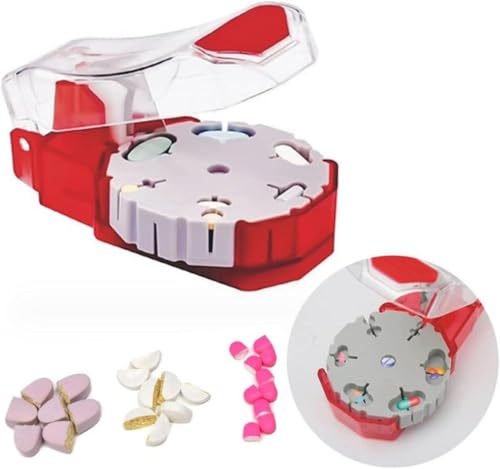
For daily or weekly dose preparation, invest in a dedicated mechanical pill splitter. These small devices solve the exact slipping and flying problems you face with an open razor. A quality pill cutter encloses the cutting blade completely inside an impact-resistant plastic housing. When you close the hinged lid, the internal stainless steel blade lowers automatically into the tablet, keeping your fingers shielded from harm at all times.
When choosing a pill splitter, verify these practical design features before you buy:
- A flexible silicone holding channel: Look for a base equipped with a textured silicone mat or rubberized grip arms. Silicone holds the slick, rounded sides of hard-coated tablets firmly in place so they cannot roll away when the blade makes contact.
- An adjustable V-shaped alignment guide: The best splitters feature a sliding or fixed V-groove that centers pills of various shapes, from tiny three-millimeter thyroid pills up to large oblong vitamin supplements. The V-shape centers the tablet directly under the blade midline without requiring you to steady the pill with your fingers.
- A self-retracting blade guard: Choose a model where a physical plastic shield covers the sharp edge whenever the cutter lid is propped open. This mechanism prevents accidental finger cuts when you reach inside the chamber to remove your split halves.
- A clear optical lid: A transparent cover lets you look directly down through the plastic to confirm the blade sits right on the score line before you apply final hand pressure.

- TAR Score9.0
TAR Score is a ranking system developed by TopAppliancesReviews.com. TAR score has no relationship or impact from any manufacturers or sales agent websites. Learn more
- BrandBUG HULL

- TAR Score8.6
TAR Score is a ranking system developed by TopAppliancesReviews.com. TAR score has no relationship or impact from any manufacturers or sales agent websites. Learn more
- BrandONE PIX

- TAR Score8.6
TAR Score is a ranking system developed by TopAppliancesReviews.com. TAR score has no relationship or impact from any manufacturers or sales agent websites. Learn more
- BrandDEPAD

- TAR Score8.6
TAR Score is a ranking system developed by TopAppliancesReviews.com. TAR score has no relationship or impact from any manufacturers or sales agent websites. Learn more
- BrandEZY DOSE

- TAR Score8.6
TAR Score is a ranking system developed by TopAppliancesReviews.com. TAR score has no relationship or impact from any manufacturers or sales agent websites. Learn more
- BrandEZY DOSE

- TAR Score8.6
TAR Score is a ranking system developed by TopAppliancesReviews.com. TAR score has no relationship or impact from any manufacturers or sales agent websites. Learn more
- BrandViLoSa

- TAR Score8.6
TAR Score is a ranking system developed by TopAppliancesReviews.com. TAR score has no relationship or impact from any manufacturers or sales agent websites. Learn more
- BrandYULIKIKER

- TAR Score8.2
TAR Score is a ranking system developed by TopAppliancesReviews.com. TAR score has no relationship or impact from any manufacturers or sales agent websites. Learn more
- BrandApex

- TAR Score7.0
TAR Score is a ranking system developed by TopAppliancesReviews.com. TAR score has no relationship or impact from any manufacturers or sales agent websites. Learn more
- BrandYRDGRG
- TAR Score6.6
TAR Score is a ranking system developed by TopAppliancesReviews.com. TAR score has no relationship or impact from any manufacturers or sales agent websites. Learn more
- BrandQPOIBSD
Last update on 2026-10-04 / Affiliate links / Images, Product Titles, and Product Highlights from Amazon Product Advertising API
Frequently Asked Questions About Cutting Tablets
Can I safely cut a pill that does not have a score line?
No, you should never cut a pill that lacks a pre-molded score line unless your doctor or pharmacist explicitly directs you to do so. The absence of an indented center groove usually indicates that the tablet has an uneven distribution of active ingredients or contains a specialized protective coating. Splitting an unscored pill often leaves one piece with almost no active drug and the other piece with an accidental overdose.
Why did my pill turn into powder when I cut it with a razor?
Pills turn into powder when you saw the blade back and forth or use a dull, wedged blade. Sawing acts like sandpaper against the dry binding agents in the tablet, grinding the core into dust rather than fracturing it along natural fault lines. Pill crumbling also happens when tablets absorb moisture from humid environments like bathrooms, which weakens the internal binders holding the medicine together.
Can I use an everyday pocket knife instead of a razor blade?
You should avoid using everyday pocket knives to split medicine. Pocket knives carry thick blade profiles designed for heavy outdoor cutting, which wedge and crush dry pills instead of slicing through them. Pocket knife joints also collect pocket lint, metal grime, and pivot oils that can easily contaminate your oral medication.
What should I do if half of my split pill flies onto the floor?
If half of your medication lands on the floor, discard it, especially if you have pets or small children in your home. Household floors harbor bacteria, dust, and hair that stick to the exposed chalky interior of broken tablets. Call your pharmacist to explain that you lost half a dose so they can record the loss and advise you on when to take your next scheduled tablet.


Top Rated Best Quality Range Hoods: 2026 Expert Picks

The 12 Best Small Solar Generators 2026

10 Best Quality Semi Automatic Washing Machine of 2026 For Leak-Free Laundry

11 Best Small Washer Machine of 2026 For Everyday Laundry

12 Best Vibration Pads For Washing Machine of 2026 To Stop Walking and Shaking

11 Best Selling Front Load Washing Machine of 2026 For Quiet Odor-Free Laundry

11 Best Washing Machine For King Size Bedding of 2026 To Prevent Cycle Errors

10 Best Small Front Loader Washing Machine of 2026 For Tight Closets






