
Best Hard Anodized Nonstick Cookware Set 2026

A dependable best hard anodized nonstick cookware set can make everyday cooking feel less like damage control. Eggs release without leaving half the breakfast welded to the pan, sauces heat more evenly, and cleanup doesn't swallow the rest of the evening. Hard anodized aluminum also feels sturdier than thin bargain cookware, so the pans are less likely to twist or wobble after repeated heating. That extra structure matters on flat glass and electric cooktops where a warped base can create annoying hot spots.
The biggest advantage is the balance between heat distribution and manageable weight. Cast iron holds heat well, but hauling a heavy skillet from burner to sink gets old fast. Stainless steel can develop a beautiful sear, though sticky foods often demand careful temperature control and more oil. Hard anodized cookware lands in the middle, giving home meals steady heat without turning each pan into a gym weight.
A good set should include pieces that actually earn cabinet space. A pair of saucepans, a useful sauté pan, one or two frying pans, and a stockpot cover most weeknight jobs without padding the box with tiny utensils or odd pans that rarely leave the shelf. Matching lids help trap moisture for rice, vegetables, and braised dishes, while comfortable handles make a noticeable difference once a pan is full. Still, oversized collections can become clutter in a small kitchen, so more pieces don't always mean better value.
The nonstick coating deserves realistic expectations. It can reduce the oil needed for pancakes, fish, omelets, and delicate vegetables, but it won't stay slick forever if metal tools, abrasive pads, or constant high heat become part of the routine. Silicone, nylon, or wooden utensils are the safer bet. Medium heat usually gets the job done, and letting the pan cool before washing helps protect both the coating and the pan's shape.
Oven compatibility, lid design, and handle construction can separate a useful set from one that becomes irritating after a month. Some lids tolerate only moderate oven temperatures, while certain handles stay cooler on the stovetop but become hot near neighboring burners. Dishwasher-safe labeling sounds convenient, yet gentle hand washing usually gives the coating a longer working life. That's a tradeoff worth accepting when easy food release matters more than tossing everything into the machine.
Induction cooking creates another wrinkle because aluminum isn't naturally magnetic. A set needs a bonded stainless steel base to work on an induction surface, and even then, base diameter should match the burner closely for consistent heating. Gas, electric coil, and ceramic cooktops are usually less complicated, though high flames can discolor exteriors and heat handles. Practical cookware isn't about chasing flashy claims; it's about choosing durable pans that match the stove, cooking habits, storage space, and patience for maintenance.

- TAR Score9.8
TAR Score is a ranking system developed by TopAppliancesReviews.com. TAR score has no relationship or impact from any manufacturers or sales agent websites. Learn more
- BrandT-Fal

- TAR Score9.6
TAR Score is a ranking system developed by TopAppliancesReviews.com. TAR score has no relationship or impact from any manufacturers or sales agent websites. Learn more
- BrandAll-Clad

- TAR Score9.4
TAR Score is a ranking system developed by TopAppliancesReviews.com. TAR score has no relationship or impact from any manufacturers or sales agent websites. Learn more
- BrandT-Fal

- TAR Score9.4
TAR Score is a ranking system developed by TopAppliancesReviews.com. TAR score has no relationship or impact from any manufacturers or sales agent websites. Learn more
- BrandT-Fal

- TAR Score9.4
TAR Score is a ranking system developed by TopAppliancesReviews.com. TAR score has no relationship or impact from any manufacturers or sales agent websites. Learn more
- BrandT-Fal

- TAR Score9.2
TAR Score is a ranking system developed by TopAppliancesReviews.com. TAR score has no relationship or impact from any manufacturers or sales agent websites. Learn more
- BrandCirculon

- TAR Score9.2
TAR Score is a ranking system developed by TopAppliancesReviews.com. TAR score has no relationship or impact from any manufacturers or sales agent websites. Learn more
- BrandCAROTE
- TAR Score9.0
TAR Score is a ranking system developed by TopAppliancesReviews.com. TAR score has no relationship or impact from any manufacturers or sales agent websites. Learn more
- BrandCuisinart

- TAR Score9.0
TAR Score is a ranking system developed by TopAppliancesReviews.com. TAR score has no relationship or impact from any manufacturers or sales agent websites. Learn more
- BrandRachael Ray
Last update on 2026-08-14 / Affiliate links / Images, Product Titles, and Product Highlights from Amazon Product Advertising API
Best Hard Anodized Nonstick Cookware Set for Daily Meals
A crowded stovetop can expose weak cookware fast. One pan scorches onions near the center, another leaves eggs glued around the edges, and the smallest saucepan somehow feels awkward even with a modest batch of oatmeal. The T-Fal Ultimate Hard Anodized Ceramic Set approaches the best hard anodized nonstick cookware set category with a broad selection of practical pieces, a preheat indicator, and a ceramic cooking surface designed for easier release. It also carries a few limits worth weighing, particularly its lack of induction compatibility and the care required to preserve ceramic nonstick performance.
T-Fal Ultimate Hard Anodized Ceramic Set
The 12-piece lineup covers most ordinary breakfast, lunch, and dinner jobs without leaning too heavily on filler. It includes 8-inch and 10.5-inch frypans, a larger 12-inch covered frypan, 1-quart and 3-quart covered saucepans, and a 5.6-quart covered Dutch oven. T-Fal also adds a slotted spatula and solid spoon, both made from nylon to reduce the chance of scraping the cooking surface. That mix feels more useful than sets padded with several tiny pans that rarely leave the cabinet.
The smallest frypan suits eggs, toasted spices, or a single grilled sandwich, while the 10.5-inch size handles routine sautéing without hogging the burner. The covered 12-inch pan gives larger meals some breathing room, which helps with chicken cutlets, vegetable medleys, and one-pan pasta dishes. Meanwhile, the 5.6-quart Dutch oven has enough capacity for soup, chili, boiling pasta, or braising a family-sized batch. The one-quart saucepan may feel cramped for some recipes, but it earns its keep with melted butter, reheated sauces, and small portions.
Piece count can be misleading, so the actual cooking vessels matter more than the number printed on the carton. Here, eight of the twelve listed pieces are pots, pans, or lids, while the two utensils round out the package. That’s a sensible arrangement, though anyone already stocked with nylon tools may see the extras as unnecessary. Cabinet space also deserves a quick reality check because the 12-inch covered frypan and Dutch oven aren’t exactly shy.
Heat Control Without the Usual Guesswork
T-Fal’s Thermo Spot Technology gives this set one of its more recognizable features. The indicator turns solid red once the pan reaches the intended preheating point, taking some of the guesswork out of timing. That can help prevent food from hitting a barely warm surface, where proteins tend to stick and vegetables begin steaming instead of browning. It won’t replace heat awareness, but it offers a useful visual cue during busy meal prep.
The claimed even heatbase is designed to limit hot spots across the cooking surface. Hard anodized aluminum naturally conducts heat efficiently, so temperature changes tend to move through the pan faster than they would through a thick cast-iron skillet. That responsiveness helps with delicate sauces and quick sautés, where a sluggish pan can keep cooking long after the burner is lowered. Still, burner size matters, and placing a small pan over an oversized flame can create uneven heating around the sides.
The preheat indicator may also discourage a common mistake: adding food before the pan has settled into a stable temperature. A fully warmed skillet gives pancakes a more consistent first side and helps sliced vegetables begin browning rather than leaking water. On the flip side, the red spot shouldn’t be treated as permission to crank the stove to maximum. Medium heat is usually plenty for ceramic nonstick cookware, and constant high heat can shorten the coating’s useful life.
Gas, electric, and ceramic stovetops are supported, but induction is excluded. That limitation is easy to overlook because many modern cookware sets advertise broad cooktop compatibility. An induction range requires a magnetic base, and this set isn’t built for that system. From a practical angle, the broader discussion of nonstick anodized cookware can help clarify how base construction, coatings, and cooktop requirements differ across sets.
Ceramic Release and Everyday Cleanup
The Inoceram Glide ceramic coating is designed to release food with less resistance, especially during lower-fat cooking. Eggs, pancakes, fish fillets, and sticky sauces are the obvious beneficiaries because they can turn cleanup into a scraping session on bare metal cookware. A smoother surface also makes it easier to move fragile food without tearing it apart. That convenience is a big part of the set’s appeal, but ceramic coatings still need thoughtful handling.
Scratch resistance doesn’t mean scratch proof. Metal spatulas, sharp-edged tongs, and abrasive scrubbers can gradually roughen the surface, even if visible damage doesn’t appear right away. The included nylon tools support safer habits from day one, and silicone or wooden utensils work well too. Keeping a protective pad between stacked pans can also prevent rims and bases from rubbing against the cooking surface.
T-Fal recommends hand washing, which is both a strength and an inconvenience depending on the household routine. A slick surface generally rinses clean without much effort, so hand washing shouldn’t feel like scrubbing a baked-on casserole dish. Still, anyone accustomed to loading every pot and pan into the dishwasher may find the extra care tedious. Ceramic coatings tend to reward gentler cleaning, though, and a soft sponge with mild dish soap is usually enough.
Food release will also depend on how the pan is used over time. Cooking sprays can leave a stubborn film that gradually dulls the slick feel, while excessive heat may cause oils to polymerize against the coating. A modest amount of butter or cooking oil is often the safer route. Letting the cookware cool before rinsing helps too, since sudden temperature changes can stress the pan and make residue harder to remove.
Handles, Lids, and Pouring Control
The riveted silicone handles aim for a secure grip without the bare-metal discomfort common on some cookware. Silicone feels reassuring during stovetop cooking, particularly when shifting a full saucepan or tilting the covered frypan. Rivets give the handles a solid mechanical connection, though food residue may collect around the interior attachment points. A small brush can reach those tight areas better than a flat sponge.
Pouring edges add control when draining liquid, transferring sauce, or sliding pan juices into a serving bowl. That detail sounds minor until a rounded rim sends broth down the outside of the pot and onto the counter. The shaped edge won’t eliminate every spill, especially with a heavy Dutch oven, but it makes controlled pouring less clumsy. A helper handle on the largest pieces would further improve balance, so grip placement is worth checking before lifting a full pot.
The glass lids trap heat while leaving the food visible. That helps with rice, steamed vegetables, and slow simmering because the lid doesn’t need to be lifted every few minutes. Keeping it closed preserves temperature and moisture, which can make cooking more consistent. Glass adds weight, though, and the lid handles can become warm during extended simmering.
Oven limits differ between the cookware and lids. The pots and pans are rated up to 400°F, while the lids are rated up to 350°F. That’s enough for finishing a frittata, holding a dish warm, or moving a stovetop recipe into a moderate oven. Recipes that require higher roasting or broiling temperatures will need different cookware, and silicone handles should always be treated as hot once they leave the oven.
Pros That Matter in a Busy Kitchen
Broad everyday coverage stands out as the set’s biggest practical strength. The three frypan sizes reduce the need to cook a small portion in a huge skillet, while the saucepans and Dutch oven cover liquids, grains, soups, and reheating. The included lids match the pieces where moisture control matters most. This range supports varied meals without forcing every recipe into the same two pans.
Thermo Spot guidance is another meaningful plus for cooks who struggle with preheating. It creates a repeatable visual reference rather than relying on a splash of water or a hand hovering above the surface. That’s handy during rushed mornings, when attention is split between coffee, toast, and a pan of eggs. The feature remains simple, but simple tools often get used more consistently than elaborate ones.
The combination of a hard anodized exterior and ceramic interior also strikes a useful balance. The outer construction is meant to provide more strength than lightweight, untreated aluminum, while the inner coating focuses on release and cleanup. Silicone handles, glass lids, and pouring edges support the day-to-day experience instead of serving as decorative extras. The grey finish also looks understated enough to suit kitchens that don’t need cookware shouting from the stovetop.
Cons and Care Tradeoffs
No induction compatibility is the clearest drawback. Anyone using an induction range can rule this set out immediately, regardless of how appealing the piece selection or coating may be. It also reduces flexibility for households planning a future stove upgrade. Cookware often lasts longer than an appliance cycle, so cooktop changes deserve some thought before buying.
Ceramic nonstick care brings another tradeoff. Easy release is convenient, but maintaining it requires moderate heat, nonmetal utensils, and gentle washing. Cooks who prefer aggressive searing, frequent broiling, or dishwasher-only cleanup may find the routine fussy. The coating is better suited to controlled everyday cooking than rough restaurant-style treatment.
The different oven temperature limits can also create confusion. A pan that tolerates 400°F may still need its lid removed once the recipe climbs above 350°F. That’s manageable, but it adds one more detail to remember while moving between stovetop and oven. The set won’t cover very high-temperature roasting, and it isn’t intended for broiler use based on the provided specifications.
The 12-piece label sounds generous, yet two pieces are utensils and several are lids. That isn’t deceptive, but shoppers expecting twelve separate pots and pans may feel shortchanged. The included vessels are sensibly sized, though the one-quart saucepan remains fairly specialized. A larger second saucepan might prove more useful for households that regularly prepare grains, vegetables, and sauces at the same time.
All-Clad Hard Anodized Expert Nonstick Cookware Set
Uneven browning, warped bases, and handles that feel awkward once a pan is full can turn an ordinary dinner into a juggling act. The All-Clad HA1 Expert set enters the best hard anodized nonstick cookware set conversation with a sturdier build, induction compatibility, and a piece selection that covers frying, simmering, sautéing, and large-batch cooking. Its appeal isn’t built around a huge item count. Instead, the set leans on practical cookware sizes, a reinforced base, and a nonstick interior intended to make everyday cooking less fussy.
All-Clad HA1 Expert 7-Piece Set
The collection includes 8-inch and 10-inch fry pans, a 2.5-quart saucepan, a 3.5-quart saucepan, a 4-quart sauté pan, and an 8-quart stockpot, with lids supplied for the covered pieces. That lineup handles more real kitchen work than sets loaded with tiny utensils or specialty pans that spend most of their lives buried in a cabinet. The smaller skillet suits eggs, toasted nuts, and single portions, while the 10-inch pan leaves more room for chicken breasts, vegetables, or several pancakes. It’s a tidy arrangement, and frankly, the sizes make sense.
The two saucepans add useful flexibility during meals that require more than one burner. A 2.5-quart saucepan can handle oatmeal, sauces, reheated soup, or a modest batch of rice, while the 3.5-quart version gives pasta, vegetables, and larger side dishes more breathing room. That difference may sound small on paper, but it helps avoid filling a little pan to the rim or heating a giant pot for a cup of sauce. Less sloshing, fewer boil-overs, and fewer dishes chosen simply because nothing else fits.
The 4-quart sauté pan may become the set’s workhorse because its straight sides hold sauces and ingredients more securely than a shallow skillet. It can move from browning meat to simmering a pan sauce without requiring a second vessel. The 8-quart stockpot serves a different role, offering space for pasta, broth, chili, corn, or a large batch of soup. Storage is the tradeoff here, since a pot that size claims a noticeable chunk of cabinet space.
Construction That Addresses Warping and Hot Spots
The cookware uses hard anodized aluminum, a material valued for responsive heating and added surface strength compared with untreated aluminum. All-Clad reinforces that body with an optimized stainless steel base, which improves stability and gives the pans a magnetic foundation for induction cooktops. That layered approach tackles two common complaints at once: uneven temperature spread and bases that gradually lose their flat shape. A stable bottom also sits more securely on smooth glass and induction surfaces.
Warp resistance matters most after repeated heating and cooling cycles. A pan that rocks on the burner doesn’t maintain full contact, so some areas heat faster while others lag behind. The reinforced base is designed to reduce that problem and support consistent heat across the cooking surface. It can’t correct a burner that’s too small or an overloaded pan, but it gives the cookware a more dependable starting point.
Induction compatibility sets this collection apart from many aluminum-based nonstick sets. Aluminum itself doesn’t work with induction, so the stainless steel base is doing more than adding visual polish. It allows magnetic energy from the cooktop to heat the vessel while the aluminum body distributes that heat through the pan. From a practical angle, related construction differences are also discussed in stainless steel cookware for induction cooktops, where base design plays a similarly important role.
Heat consistency also helps protect delicate foods from sudden scorching. Scrambled eggs, cream sauces, and fish fillets benefit from a pan that responds evenly rather than developing one aggressive hot zone. Still, medium heat remains the sensible setting for most nonstick cooking. High burner output can overheat the coating long before the food needs that level of intensity.
Nonstick Performance and Cleaning Habits
The interior uses a long-lasting PTFE nonstick coating intended to release food cleanly and reduce scrubbing after meals. That surface suits eggs, pancakes, grilled sandwiches, and other foods that tend to cling to stainless steel without careful temperature control. It also allows many recipes to cook with less added fat, though a small amount of oil or butter can still improve browning and flavor. Easy release is the main convenience here, not a promise that the pan can be treated carelessly.
All-Clad describes the cookware as scratch resistant, but scratch resistance and scratch proof are two different things. Metal tools, sharp-edged tongs, and abrasive pads can still wear down a nonstick surface over time. Silicone, wood, or nylon utensils are the safer companions, particularly for stirring near the rivets or loosening food around the edges. A soft sponge also makes more sense than a rough scouring pad after dinner.
Cleanup should be easier because residue has fewer places to grip, especially after lower-temperature cooking. Burned oil, however, can still form a sticky film if the pan spends too much time over high heat. Letting the cookware cool before washing helps prevent thermal stress and keeps cleanup more comfortable. The easy-clean surface saves time, but a little restraint at the stove preserves that benefit.
Nonstick longevity often comes down to routine rather than one dramatic mistake. Repeated overheating, stacking pans without protection, and scraping food with metal can gradually dull the release. Pan protectors or soft cloths between nested pieces reduce contact damage, while moderate heat keeps the coating from working harder than necessary. That’s not complicated maintenance, but it does ask for better habits than a bare stainless steel skillet.
Handles, Lids, and Oven Flexibility
The set uses double-riveted stainless steel handles shaped for a secure grip and steady maneuvering. Rivets provide a firm connection, which becomes especially valuable with the full sauté pan or the 8-quart stockpot. Stainless steel handles may stay cooler than expected during short stovetop tasks, but they can still heat up near powerful burners or during extended cooking. A towel or potholder should remain close by rather than assuming the grip is always cool.
The contoured handle shape helps with balance, particularly while pouring sauce or shifting a pan between burners. A secure grip also matters when moving heavier cookware from the stove to the oven. The tradeoff is that exposed stainless steel isn’t as soft in the hand as silicone-wrapped handles. Some cooks prefer the firm professional feel, while others may notice pressure during longer lifting tasks.
Tempered glass lids allow food to remain visible while heat and moisture stay trapped. That’s handy for rice, vegetables, soups, and braises because lifting the lid repeatedly releases steam and changes the cooking environment. Glass also makes it easier to catch a rising boil before it spills over. The lids add weight, though, and their handles can become hot during oven use or a long stovetop simmer.
The cookware is rated oven safe up to 500°F, giving it more flexibility than sets limited to moderate oven temperatures. A skillet can move from searing to roasting, while the sauté pan can finish thicker dishes without transferring everything to a baking vessel. That temperature range suits many casseroles, baked pasta dishes, and stovetop-to-oven recipes. Broiler use isn’t specified in the provided information, so it shouldn’t be assumed.
Daily Strengths and Practical Limitations
Induction readiness is one of the strongest reasons to consider this set. Many hard anodized collections exclude induction, which can force a cookware replacement after a stove upgrade. The stainless steel base keeps this collection compatible with induction while preserving the lighter, responsive character of aluminum. That broader compatibility gives the set a longer useful path across different kitchen setups.
The piece selection also avoids a lot of unnecessary clutter. Two fry pans, two saucepans, one sauté pan, and one large stockpot cover the majority of routine cooking without pretending that more pieces automatically mean more value. The 8-quart stockpot is especially useful for large batches, though it may be oversized for very small kitchens or one-person meals. In a tight cabinet, that pot will need a proper home.
Weight may be another consideration because the reinforced base and stainless steel handles add substance. The cookware should feel more solid than thin budget aluminum, but that sturdiness can make the larger pieces less effortless to move. A filled stockpot or sauté pan will demand both hands, particularly when transferring hot liquid. That isn’t a flaw so much as the cost of a more stable construction.
The PTFE nonstick coating makes delicate cooking and cleanup easier, but it won’t suit every style. Cooks who rely on extremely high heat, aggressive scraping, or frequent broiling may prefer uncoated stainless steel or cast iron for those jobs. This set is better matched to controlled stovetop cooking, moderate oven use, and recipes where easy release matters. Used within those boundaries, its reinforced base, practical sizing, and broad cooktop compatibility address several annoyances that cheaper nonstick cookware often leaves unresolved.
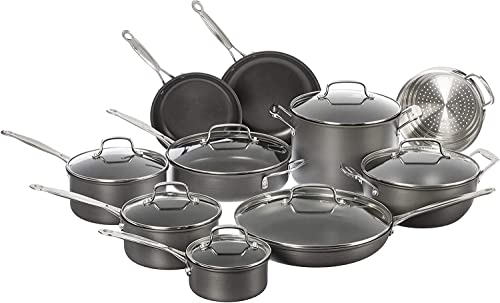
T-Fal Ultimate Hard Anodized 17-Piece Cookware Set
A crowded burner lineup can expose every weak point in a cookware collection. One saucepan feels too small, the big skillet has no lid, and the pan needed for pancakes is somehow already holding last night’s leftovers. The best hard anodized nonstick cookware set should smooth out those daily snags with useful sizes, predictable heating, and surfaces that don’t turn cleanup into a wrestling match. T-Fal’s 17-piece collection aims squarely at that problem, bringing together multiple saucepans, three standard frypans, a griddle, a sauté pan, a Dutch oven, a steamer insert, and a compact egg pan.
T-Fal Ultimate Hard Anodized 17-Piece Set
The sheer range of pieces is the first thing that separates this set from smaller collections. It includes 1-quart, 2-quart, and 3-quart covered saucepans, which gives different batch sizes a proper home instead of forcing every task into one medium pot. The 8-inch and 10-inch frypans cover routine breakfast and dinner work, while the 11.5-inch covered frypan adds more room for larger portions. That spread feels practical rather than decorative, especially in a kitchen where several burners are often busy at once.
The set also includes a 10.25-inch griddle, a 3.5-quart sauté pan, a 5-quart Dutch oven, a 3-quart steamer insert, and a small egg pan. The griddle suits pancakes, grilled sandwiches, tortillas, and foods that benefit from low sides and easy spatula access. The sauté pan handles saucier recipes more neatly because its taller walls contain splatter and liquid better than a shallow skillet. Meanwhile, the Dutch oven and steamer insert expand the set beyond basic frying and boiling.
Seventeen pieces sounds generous, though the count includes lids and specialty cookware rather than seventeen separate pots and pans. That’s worth understanding before cabinet space becomes the next headache. The egg pan may feel charming and convenient for a single egg, but it’s also the piece most likely to seem overly specialized in a small kitchen. Still, the collection covers enough everyday jobs that most pieces have a clear reason to exist.
Hard Anodized Build and Everyday Durability
The cookware uses a hard anodized exterior paired with a forged design intended to improve strength and hold its shape through repeated use. Hard anodized aluminum is generally tougher at the surface than untreated aluminum, which helps it resist the small knocks and scratches that happen during washing, stacking, and daily cooking. The material also conducts heat quickly, so burner changes tend to reach the food without a long delay. That responsiveness is useful for sauces, eggs, and vegetables that can go from underdone to overcooked in a hurry.
Durability, though, depends on more than the exterior. A stable base matters because warped cookware can rock on flat burners and create uneven contact with the heat source. T-Fal’s forged construction is designed to provide a sturdier feel, but sensible handling still matters. Letting a hot pan cool before washing and avoiding sudden blasts of cold water can reduce thermal stress over time.
The black exterior gives the set a uniform, no-nonsense look, though darker cookware can show mineral spots or dried water marks after washing. Those marks don’t necessarily affect cooking, but they may bother anyone who likes every piece looking freshly unboxed. A soft towel after washing solves much of that cosmetic issue. More importantly, the exterior feels built for routine stovetop work rather than occasional display.
Titanium Nonstick for Easier Food Release
The interior uses a titanium-reinforced nonstick coating intended to keep food moving more freely across the surface. Eggs, pancakes, fish, and sticky sauces stand to benefit most because they’re the dishes that expose a weak coating fastest. Less sticking also means less scraping after dinner, which can make the set appealing during packed weeknights. A small amount of oil may still improve browning and flavor, but the pan shouldn’t demand a heavy slick just to release food.
Nonstick convenience comes with familiar rules. Metal utensils, sharp-edged tools, and rough scouring pads can gradually damage the surface, even if the coating is described as durable. Silicone, nylon, or wooden utensils are safer for stirring, flipping, and serving. The coating will likely fare better with moderate heat than with a burner left screaming on high.
Cooking sprays can also leave behind a stubborn film that makes a pan feel less slick over time. Plain oil or butter is usually easier to manage and wash away. The smooth-release surface should make routine cleanup simpler, but burnt-on grease can still build up if heat stays too high for too long. A soft sponge and mild soap are the more sensible tools once the cookware has cooled.
Thermo-Spot Takes Guesswork Out of Preheating
T-Fal’s Thermo-Spot heat indicator turns solid red when the pan reaches the intended preheating point. That visual cue is useful for anyone who tends to add food too early, especially with eggs, pancakes, or meat that needs immediate contact with a properly warmed surface. A cold pan can cause ingredients to absorb oil, release moisture, or stick before the coating has a chance to do its job. The indicator creates a repeatable reference without requiring a thermometer or water-droplet test.
Preheating consistency also helps with browning. Vegetables placed into a properly heated skillet are more likely to sear than steam, and pancake batter tends to spread more evenly once the pan is ready. The feature won’t compensate for an oversized burner or excessive heat, though. Medium heat remains the smarter setting for most nonstick cooking, even after the indicator changes color.
The Thermo-Spot also encourages a more deliberate rhythm at the stove. Rather than tossing ingredients into a barely warm pan and chasing the temperature afterward, the cook can prep, wait for the cue, and begin with a more stable surface. That small shift can make results more consistent, particularly during breakfast when several tasks collide at once. It’s a simple feature, but simple is often what gets used.
Handles and Lids Built for Busy Cooking
The set uses riveted silicone handles designed to provide a comfortable, secure grip during stovetop use. Silicone softens the feel compared with bare metal and can make a loaded saucepan easier to control while pouring. Rivets add a firm mechanical connection, which matters once the 5-quart Dutch oven or sauté pan is full. The tradeoff is that food residue can collect around the interior rivet heads, so a small brush may be more useful than a flat sponge.
The vented tempered glass lids trap heat and moisture while allowing a clear view of the food. That visibility helps with rice, vegetables, sauces, and braises because lifting the lid repeatedly releases steam and changes the cooking environment. The vents also allow some pressure to escape, which can reduce rattling during a simmer. Glass adds weight, however, and lid handles may still become hot during longer cooking sessions.
Silicone grips feel reassuring on the stovetop, but oven use changes the situation. The cookware is rated up to 400°F, while the lids are rated up to 350°F. That range works for many stovetop-to-oven recipes, including frittatas, baked pasta, and dishes that need a moderate finishing temperature. A potholder is still necessary because handles and lids can heat considerably inside the oven.
Piece Selection for Real Kitchen Tasks
The three covered saucepans are a major practical strength. A 1-quart pan suits butter, sauces, and small portions, while the 2-quart size handles grains, soup, or reheating without feeling oversized. The 3-quart saucepan is roomy enough for pasta portions, vegetables, and larger side dishes. Having all three means fewer awkward compromises and less chance of a boil-over from using a pan that’s simply too small.
The frying lineup covers several portions without forcing a large pan into every task. The 8-inch skillet fits a quick breakfast, the 10-inch model handles everyday sautéing, and the 11.5-inch covered frypan offers extra space for larger meals. That lid is especially useful for melting cheese, finishing chicken, or reducing splatter. Still, three frypans plus a griddle take up real storage room, so nesting space deserves some thought.
The 3.5-quart sauté pan bridges the gap between frying pan and saucepan. Its broad base supports browning, while the straight sides contain liquid during simmering. The 5-quart Dutch oven covers soups, pasta, and one-pot meals, and the steamer insert adds another cooking method without requiring a separate appliance. The tiny egg pan is more niche, but it may earn its spot for single portions or small reheating jobs.
Dishwasher Convenience With a Few Caveats
T-Fal describes the set as dishwasher safe, which can be a relief after a large meal. Loading the cookware into the machine saves time and keeps cleanup from stretching into the evening. Still, dishwasher detergents and high drying heat can be rougher on nonstick surfaces than hand washing. The convenience is real, but gentler care may help preserve the coating’s slick feel longer.
A soft sponge and warm water will usually be enough because the nonstick interior shouldn’t hold onto residue aggressively. That makes hand washing less of a chore than it sounds, especially if pans are rinsed soon after cooling. Burnt oil around the edges may need extra attention, but abrasive pads are best avoided. A little patience beats scratching the surface for the sake of saving two minutes.
Stacking can cause more damage than washing if cookware is nested without protection. The bottom of one pan can rub against the coating of another, leaving small marks that build over time. Pan protectors or soft cloths are inexpensive ways to reduce contact damage in a crowded cabinet. That matters even more with a 17-piece set, since stacking will be difficult to avoid.
Cooktop Compatibility and Oven Limits
The cookware works on common stovetops but does not support induction. Gas, electric coil, and ceramic cooktops fit the stated compatibility, while induction owners will need a magnetic base that this collection doesn’t provide. That’s the clearest limitation in the set’s design. It also matters for anyone considering a future appliance change, since cookware can outlast a range.
Gas flames should remain under the base rather than curling around the sides, where they can heat the handles and discolor the exterior. Electric and ceramic burners work best when pan size closely matches the heating element. The forged aluminum body should respond quickly, but burner mismatch can still create uneven results. Proper pairing matters as much as the material itself.
The unrelated internal reference requires a clean separation from the cookware discussion. From a practical angle, household maintenance topics sometimes involve sealants for washing machine seals, though that subject has no direct effect on cooking performance or cookware care. Keeping those two topics distinct avoids forcing a connection that simply isn’t there. The cookware remains defined by its nonstick interior, broad piece selection, and non-induction stovetop compatibility.
Strengths, Weaknesses, and Realistic Expectations
The set’s strongest feature is its range of usable sizes. Three saucepans, three frypans, a griddle, a sauté pan, a Dutch oven, and a steamer insert cover more cooking situations than a basic starter collection. That variety can reduce the need to buy specialty pieces later. It can also make simultaneous meal preparation easier because similar jobs don’t have to compete for the same pan.
The main weaknesses are storage demand, non-induction compatibility, and the care required by any nonstick coating. A large collection can overwhelm a small cabinet, especially once lids and specialty pieces enter the mix. The egg pan may feel unnecessary, while the griddle could overlap with the larger frypans for some cooking routines. More pieces are useful only when there’s space and a genuine role for them.
Realistic expectations will make the set easier to live with. The hard anodized exterior and titanium-reinforced coating are designed for durability, but they won’t benefit from metal utensils, extreme heat, or careless stacking. The 400°F oven limit is useful for moderate baking and finishing, yet it doesn’t make the cookware suitable for every high-heat recipe. Treated with reasonable care, the collection is positioned to handle broad daily cooking without turning every meal into a cleanup project.
T-fal Ultimate Hard Anodized 14-Piece Cookware Set
Meal prep gets messy fast when the available pans don’t match the job. A skillet feels cramped, a saucepan boils over, and the only large pot is already tied up with pasta. The best hard anodized nonstick cookware set should reduce that friction with sensible sizes, steady heating, and surfaces that release food without a long soak afterward. T-fal’s 14-piece collection tackles those everyday problems with three covered saucepans, three fry pans, a square griddle, a Dutch oven, and a steamer insert, though its storage needs and lack of induction support deserve a clear-eyed look.
T-fal Ultimate Hard Anodized 14-Piece Set
The collection starts with 8-inch and 10.25-inch fry pans, plus an 11.5-inch covered fry pan for larger portions. That range makes it easier to match the pan to the amount of food instead of heating a broad surface for a single egg or crowding several chicken pieces into a small skillet. The covered 11.5-inch pan is especially useful for recipes that begin with browning and finish with a gentle simmer. Its lid also helps contain splatter, which can save the stovetop from looking like a grease map after dinner.
Three covered saucepans, sized at 1 quart, 2 quarts, and 3 quarts, give smaller cooking jobs some much-needed separation. The one-quart pan suits melted butter, gravy, or a modest serving of oatmeal, while the larger two cover grains, vegetables, soup, and reheating. This graduated setup keeps cooks from filling a tiny pot to the brim or using a bulky Dutch oven for a cup of sauce. Little efficiencies like that add up on weeknights.
The 5-quart Dutch oven, 10.25-inch square griddle, and 3-quart steamer insert round out the package. The Dutch oven can handle pasta, chili, soup, and one-pot meals without becoming awkwardly oversized. The griddle gives pancakes, quesadillas, and grilled sandwiches a broad surface with low edges, while the steamer insert adds a gentler method for vegetables and seafood. Fourteen pieces sound substantial, and cabinet space will need to keep pace with that number.
Hard Anodized Build and Titanium Nonstick
The cookware combines a hard anodized exterior with a forged design intended to improve strength and resist everyday wear. Hard anodized aluminum also conducts heat efficiently, helping the pans respond without the sluggishness of heavier cookware. That quick response is useful for sauces and eggs, where a small temperature change can make the difference between tender and overdone. Still, responsive cookware rewards attention because high heat can push food past its sweet spot in a hurry.
Inside, the titanium-reinforced nonstick coating is designed to keep food moving smoothly across the surface. Pancakes, omelets, fish fillets, and sticky glazes stand to benefit most because they expose weak release faster than a pot of boiling water ever will. Less sticking also cuts down on scraping, so cleanup feels less like a second cooking session. A little oil or butter can still help with browning and flavor, but the pan shouldn’t need a heavy layer just to behave.
Scratch resistance shouldn’t be mistaken for immunity. Metal utensils, sharp-edged tongs, and rough scrubbers can gradually wear the coating, even if the first few encounters leave no obvious mark. Silicone, wood, and nylon tools are the safer route, especially around the curved sides and interior rivets. Moderate heat matters too, since repeated overheating can shorten the slick working life of almost any nonstick surface.
Thermo-Spot and Heat Control
T-fal’s Thermo-Spot indicator turns solid red once the pan reaches the intended preheating temperature. That visual signal takes some guesswork out of timing, particularly during rushed breakfasts or recipes that depend on immediate surface contact. Food added too early can release moisture, absorb oil, or stick before the pan stabilizes. A clear cue helps establish a repeatable starting point without fiddling with thermometers.
Preheating properly can improve texture as well as release. Vegetables are more likely to brown instead of steam, and pancake batter tends to settle more evenly on a ready surface. The red indicator doesn’t mean the burner should remain cranked, though. Medium heat will cover most nonstick cooking, while high heat is better reserved for cookware built specifically for aggressive searing.
The pans still depend on burner size and placement. A small skillet sitting over a broad flame can heat along the sides and warm the silicone handle area more than expected. Flat electric or ceramic elements work best when the pan base matches the burner closely. The forged aluminum construction supports consistent heating, but no cookware can completely erase a poor burner-to-pan match.
Handles, Lids, and Oven Use
The set uses riveted silicone handles designed to provide a comfortable, secure grip during stovetop cooking. Silicone feels softer than bare metal and can make a full saucepan easier to control while pouring. Rivets add stability, which matters with a loaded Dutch oven or the wide covered fry pan. Food residue may gather around the attachment points, so a small cleaning brush can reach spots that a sponge misses.
The vented tempered glass lids trap heat and moisture while allowing a view of the food. That visibility is useful for rice, vegetables, sauces, and braised dishes because lifting a lid repeatedly changes the cooking environment. Steam vents can also reduce rattling and help manage gentle simmering. Glass lids add weight, however, and their handles can become hot during longer cooking sessions.
The cookware is rated for oven temperatures up to 400°F, while the lids are rated up to 350°F. That range supports frittatas, baked pasta, casseroles, and recipes that move from stovetop to oven at moderate temperatures. The different limits require a little attention because a covered pan may need its lid removed as the oven climbs. Potholders remain essential, since silicone grips and lid handles can heat significantly inside an oven.
Pros That Show Up During Real Cooking
Practical variety is the strongest part of this collection. Three saucepans, three fry pans, a griddle, a Dutch oven, and a steamer insert cover far more than basic boiling and frying. Multiple dishes can cook at once without forcing two recipes to compete for the same pan. That flexibility is especially helpful during larger meals, where timing falls apart quickly if every component needs identical cookware.
The covered 11.5-inch fry pan adds versatility that smaller open skillets can’t match. It has room for larger portions and can contain sauce, steam vegetables, or finish thicker cuts under a lid. The square griddle brings a different kind of usefulness, providing broad access for a spatula and enough surface for several smaller items. These pieces feel purpose-driven rather than added simply to inflate the count.
Dishwasher-safe convenience is another practical advantage for busy kitchens. The nonstick interior should already reduce residue, and machine cleaning can shorten the post-meal routine even further. Still, hand washing with mild soap and a soft sponge may be gentler on the coating over time. The set gives both options, leaving the tradeoff between convenience and cautious care in the cook’s hands.
Cons and Everyday Tradeoffs
The clearest drawback is no induction compatibility. Gas, electric, and ceramic stovetops fit the stated design, but induction owners will need cookware with a magnetic base. That limitation also matters for anyone planning a future range replacement. Cookware often stays in service for years, so a change in stove type can turn a usable set into a storage problem.
Storage is the next hurdle. Three saucepans, three fry pans, a griddle, a Dutch oven, lids, and a steamer insert require more than a narrow cabinet shelf. The square griddle may be particularly awkward to stack with round pieces, and the steamer insert adds height. Pan protectors can reduce scratches during nesting, but they won’t create extra room where none exists.
The unrelated internal reference needs its own clear boundary. From a household-planning angle, washing machines for a second floor involve vibration, drainage, and floor-support concerns that have no bearing on this cookware’s heating or nonstick performance. Keeping that subject separate prevents an artificial connection. This set’s actual tradeoffs remain its size, coating care, oven limits, and exclusion of induction cooktops.
Care Habits That Protect the Set
Nonstick cookware tends to last longer with moderate heat and gentle utensils. Empty pans shouldn’t sit over a hot burner for extended periods, and cooking sprays may leave a stubborn film that dulls the release. Plain oil or butter is usually easier to control and wash away. Letting the cookware cool before rinsing also reduces sudden temperature stress.
Dishwasher use is allowed, but repeated cycles may be harsher than hand washing. Strong detergent and high drying heat can be tough on both coatings and exterior finishes. A soft sponge, warm water, and mild soap are usually enough because the nonstick surface gives residue fewer places to grip. Burned oil around the rim may need extra patience, not a rough scouring pad.
Stacking deserves attention in a set this large. The base of one pan can rub against the interior of another, creating small marks that accumulate with time. Soft cloths or pan protectors provide a simple barrier, especially between the griddle and fry pans. Reasonable care won’t eliminate normal wear, but it can keep the cooking surfaces smoother and the handles more comfortable to use.
T-fal Ultimate Hard Anodized 12-Piece Cookware Set
Small annoyances pile up quickly during dinner prep. A saucepan runs out of room, eggs cling around the edges, and a loose grip makes draining pasta feel riskier than it should. The best hard anodized nonstick cookware set should remove those everyday obstacles without demanding complicated care or a cabinet the size of a pantry. T-fal’s 12-piece set keeps the lineup focused, pairing useful pan sizes with a titanium-reinforced nonstick surface, a visual preheat indicator, silicone handles, and covered cookware for simmering and moisture control.
T-fal Ultimate Hard Anodized 12-Piece Set
The collection includes an 8-inch fry pan, a 10-inch fry pan, three covered saucepans in 1-quart, 2-quart, and 3-quart sizes, and a 5-quart Dutch oven with a lid. A solid spoon and slotted spatula complete the listed twelve pieces. That arrangement feels more grounded than oversized bundles stuffed with novelty pans that rarely leave the cupboard. Most of the included cookware handles familiar jobs such as frying eggs, warming soup, cooking grains, boiling pasta, and preparing one-pot meals.
The graduated saucepans bring more value than the piece count alone suggests. The 1-quart saucepan suits melted butter, gravy, or a small serving of oatmeal, while the 2-quart model handles rice, vegetables, and reheated leftovers without feeling bulky. The 3-quart pan gives soups and larger side dishes extra breathing room. Having all three sizes reduces boil-overs and stops a small recipe from rattling around inside an unnecessarily large pot.
The 5-quart Dutch oven anchors the collection for pasta, chili, broth, and larger batches. It’s roomy enough for regular household meals without becoming as cumbersome as an oversized stockpot. The two fry pans cover both quick single portions and broader sautéing tasks, though the absence of a larger covered skillet may be noticeable during recipes that require browning and simmering in the same pan. For a compact set, however, the selection stays practical and avoids obvious filler.
Hard Anodized Strength and Nonstick Release
T-fal combines a hard anodized exterior with a forged design intended to improve durability and help the cookware hold its shape. Hard anodized aluminum also transfers heat efficiently, which can make burner adjustments feel more immediate than they do with heavier materials. That responsiveness is useful for eggs, sauces, and vegetables that can overcook while a sluggish pan catches up. Still, quick heating rewards attention, so medium settings often make more sense than blasting the burner.
The interior uses a titanium nonstick coating designed to help food slide more smoothly and simplify cleanup. Pancakes, fish, omelets, and sticky sauces are the dishes most likely to show the benefit because they tend to expose rough or worn surfaces quickly. Less sticking also means less scraping, which protects delicate food from tearing apart before it reaches the plate. A little oil or butter may still improve flavor and browning, but the cookware shouldn’t need a heavy layer just to release food.
Durability doesn’t erase the need for sensible care. Metal utensils, sharp tongs, and abrasive scrubbers can gradually weaken even a reinforced nonstick surface. Nylon, silicone, and wooden tools are the safer choice, and two compatible utensils already come with the set. Letting hot cookware cool before washing also reduces thermal shock, while soft pan protectors can keep nested pieces from rubbing against one another in storage.
Thermo-Spot and Everyday Heat Control
The Thermo-Spot indicator turns solid red when the pan reaches the intended preheating point. That visual cue can be helpful during rushed mornings, when toast, coffee, and eggs all seem to need attention at once. Food placed into a pan too early may absorb oil, release moisture, or stick before the surface has stabilized. A clear signal creates a more repeatable starting point without requiring a thermometer or a guess based on how the handle feels.
Proper preheating also affects texture. Vegetables placed on a ready surface are more likely to brown than steam, while pancake batter tends to cook more evenly from the first batch onward. The indicator doesn’t turn the pan into an automatic cooking system, though. Heat management still matters, and the red spot shouldn’t be treated as permission to leave the burner on its highest setting.
Burner size plays a role as well. A small fry pan over a wide flame can heat around the sides, which may warm the handle area and create less consistent cooking across the base. Electric and ceramic elements work best when the cookware closely matches the burner diameter. The forged aluminum body supports even heating, but a sensible pan-to-burner match remains part of getting steady results.
Handles, Lids, and Oven Flexibility
The cookware uses riveted silicone handles intended to provide a comfortable, secure grip. Silicone softens the contact point compared with bare metal and can make a full saucepan easier to steady while pouring. Rivets give the handles a firm mechanical connection, which is especially useful once the Dutch oven is loaded with liquid. The small downside is cleanup around the interior rivet heads, where sauce or food residue may collect.
The vented tempered glass lids retain heat and moisture while keeping the food visible. That combination helps with rice, steamed vegetables, sauces, and slow simmering because the lid doesn’t need to be lifted every few minutes. Vents allow some steam to escape, reducing lid chatter during a gentle boil. Glass does add weight, and the handles may become hot during long stovetop sessions or oven use.
The pots and pans are rated for oven temperatures up to 400°F, while the lids are rated up to 350°F. Those limits support moderate baking, frittatas, casseroles, and recipes that move from stovetop to oven. The lower lid rating requires attention because a covered dish may need to continue uncovered at higher temperatures. The provided details describe the cookware as broiler safe at 400°F, but the same temperature limits should still guide use, particularly with lids and silicone components.
Pros, Cons, and Realistic Kitchen Tradeoffs
The strongest advantage is the useful size progression. Three saucepans, two fry pans, and a 5-quart Dutch oven cover a wide range of regular cooking without creating a maze of specialty cookware. The included utensils also suit the nonstick surface, which helps establish safer habits from the start. For a kitchen replacing mismatched or worn pans, the set offers a coherent base rather than an overloaded collection.
Cleanup is another clear strength. The dishwasher-safe design provides convenience after larger meals, while the nonstick surface should make hand washing fairly quick with mild soap and a soft sponge. Dishwasher cycles may be harsher on the coating over time, so hand washing remains the gentler routine. That’s the usual bargain with nonstick cookware: easier food release in exchange for a bit more care.
The most obvious weakness is no induction compatibility. Gas, electric, and ceramic stovetops fit the stated design, but induction ranges require a magnetic base that this set doesn’t provide. The absence of a larger sauté pan or covered fry pan may also limit one-pan recipes that need both a wide browning surface and taller sides. Storage is easier than with a 17-piece bundle, yet six cookware bodies plus lids still require organized cabinet space.
The supplied internal reference belongs to a completely separate household topic. From a neutral maintenance angle, dog hair collectors for washing machines deal with lint control and laundry cleanup rather than cookware performance. Keeping those subjects apart avoids pretending that one affects the other. This T-fal set remains defined by its hard anodized construction, titanium nonstick interior, preheat indicator, and practical collection of everyday pot and pan sizes.


Top Rated Best Quality Range Hoods: 2026 Expert Picks
The 12 Best Small Solar Generators 2026

10 Best Quality Semi Automatic Washing Machine of 2026 For Leak-Free Laundry

11 Best Small Washer Machine of 2026 For Everyday Laundry

12 Best Vibration Pads For Washing Machine of 2026 To Stop Walking and Shaking

11 Best Selling Front Load Washing Machine of 2026 For Quiet Odor-Free Laundry

11 Best Washing Machine For King Size Bedding of 2026 To Prevent Cycle Errors

10 Best Small Front Loader Washing Machine of 2026 For Tight Closets






