
5 Best Generators For Welding of 2026 To Power Remote Field Repairs

Miles down a gravel access road, a cracked loader bucket sits dead in the dirt while the arc strikes. Instead of a steady, biting sizzle, the engine bogs down, the electrode fuses instantly to cold steel, and the breaker trips. Inadequate welding amperage turns what should be a thirty-minute structural fix into hours of grinding away slag and frustrating restarts. Settling for an underpowered rig leaves porous, brittle joints that snap under load, stranding heavy machinery right when work cannot afford downtime.
Dependable field fabrication means laying down deep, consistent penetration wherever a service rig can reach, all without starving the arc. Sizing the right setup comes down to matching true DC output to your rod thickness, securing enough auxiliary wattage to run heavy grinders without stalling the welder, and confirming dual 120-volt and 240-volt plugs for site gear. Here is how the top engine-driven generators for welding compare to keep your beads clean and every support tool humming.
- TAR Score9.7
TAR Score is a ranking system developed by TopAppliancesReviews.com. TAR score has no relationship or impact from any manufacturers or sales agent websites. Learn more
- BrandTomahawk Power

- TAR Score9.0
TAR Score is a ranking system developed by TopAppliancesReviews.com. TAR score has no relationship or impact from any manufacturers or sales agent websites. Learn more
- BrandHobart
- TAR Score8.9
TAR Score is a ranking system developed by TopAppliancesReviews.com. TAR score has no relationship or impact from any manufacturers or sales agent websites. Learn more
- BrandMiller
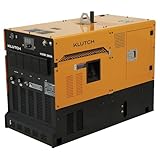
Klutch 11kW Engine-Driven Inverter Stick Welder/Generator with LCD Screen, High-Performance
View on Amazon- TAR Score7.9
TAR Score is a ranking system developed by TopAppliancesReviews.com. TAR score has no relationship or impact from any manufacturers or sales agent websites. Learn more
- BrandKlutch

- TAR Score7.7
TAR Score is a ranking system developed by TopAppliancesReviews.com. TAR score has no relationship or impact from any manufacturers or sales agent websites. Learn more
- Brandzinnore
Last update on 2026-10-22 / Affiliate links / Images, Product Titles, and Product Highlights from Amazon Product Advertising API
How many welding amps do you need for remote equipment and structural repairs?
Required welding amperage depends on your electrode type and steel thickness, with machines providing outputs ranging from 120 Amp up to 260 Max. Amp DC Output. Lower-output options like a 120 Amp or 160 Amp stick welder handle light farm repairs, while structural joints benefit from higher-output units such as the Hobart Champion Elite 225 or a machine delivering 260 Max. Amp DC Output. Always check the electrode manufacturer charts and unit manual to confirm the required amperage for your chosen rod before heading into the field.
Can an engine-driven welder supply simultaneous auxiliary power for jobsite tools?
Yes, but the auxiliary output depends on the generator electrical rating and outlet layout. Equipment in this class provides auxiliary capacities such as 2,200 Watt, 4500 Watt, or up to 11kW Max. Power Output, with select models featuring 120/240 Volt connections. A 2,200 Watt auxiliary circuit runs basic jobsite lights or small drills, while heavier chop saws and grinders running alongside the welder require larger wattage capacity. Verify the continuous wattage rating and simultaneous load limits on the unit specification plate before plugging in high-draw tools.
How does engine horsepower affect welding arc stability?
Engine horsepower determines whether the generator can handle sudden load spikes during arc strikes without stalling or bogging down. A 7 HP gasoline engine provides adequate mechanical power for a 120 Amp welding load, while demanding continuous field fabrication benefits from a larger motor such as a 23.5 hp Kohler CH730. When an engine lacks sufficient horsepower for the welding draw, the machine bogs down, leading to sticking electrodes and weak weld penetration. Verify rated engine horsepower on the manufacturer specification sheet to ensure stable power delivery under heavy arc loads.
What is the difference between an inverter welder generator and standard AC power units?
Inverter welder generators utilize electronic power processing to provide a steady arc and clean auxiliary output, often incorporating an LCD screen for system monitoring. Rigs like a 2,200 Watt quiet inverter generator engine or an 11kW engine-driven inverter stick welder/generator maintain smoother power than a basic AC power welder generator. If your remote setup requires powering small diagnostic instruments or personal devices without running an engine, a small solar generator can serve as an efficient, quiet secondary power source. For heavy field fabrication, an engine-driven stick welder generator remains essential for high-heat penetration.
Can a compact welder generator handle continuous repairs without overheating?
Continuous operation depends entirely on the rated duty cycle and cooling capacity of the machine rather than its peak output. Compact units powered by a 7 HP gasoline engine or rated for 4500 Watt auxiliary power are built primarily for portable maintenance and brief repair cycles. Running any welder near its maximum capacity for extended periods without cooling intervals can overheat electrical components and trigger thermal shutdowns. Check the duty cycle ratings in the manufacturer manual to verify how long the machine can operate continuously at your target welding amperage without overheating.
What factors should you verify before mounting a welder generator to a service truck?
Confirm the machine dry weight, outer dimensions, exhaust orientation, and maintenance access points before securing the frame to a service bed. Heavy machines such as the Bobcat 230 or Hobart Champion Elite 225 require solid structural mounting points and proper airflow clearance around the engine and generator vents. You should also confirm whether the unit provides 120/240 Volt outlets to connect directly with onboard service body air compressors or shop tools. Check the manufacturer dimension drawings and service truck payload capacity to ensure safe transport and easy oil changes in the field.


Top Best Quiet Portable Generator Electric Start 2026 - (2026 Updated)

The 10 Best Portable Power Station For Tailgating 2026

12 Best Small Quiet Generator For Camping of 2026 For Peaceful Campsites

11 Best Quiet Portable Generator For Home of 2026 For Quieter Home Backup

Startup And Runtime Picks: 11 Best Solar Generators For Fridge of 2026

Site-Smart Picks: 10 Best Wind Generator For Home of 2026

Portable Power: 12 Best Small Solar Generators of 2026

Cabin-Ready 10 Best Solar Generators For Cabins of 2026





